






Air-Cooler Applications in Cold Rooms, Warehouses, and Food Storage Areas
Where Air-Cooler Selection Changes the Performance of a Storage Room
In cold rooms, warehouses, and food storage areas, the wrong evaporator is rarely exposed on day one. The room pulls down, the thermostat reaches setpoint, and everyone assumes the refrigeration side is fine. Problems show up later: wet cartons near the door, uneven frosting on the coil, product temperatures drifting between upper and lower shelves, or defrost water becoming a recurring sanitation issue. That is why Air-Cooler selection is less about nameplate capacity and more about how air actually moves through a loaded room under daily operating conditions.
A compact cold room storing boxed dairy, cut vegetables, or packaged meat behaves very differently from a high-bay warehouse holding palletized frozen goods. In the first case, door opening frequency and staff movement dominate the thermal load. In the second, airflow throw distance, stacking height, and aisle arrangement become more critical than a simple tonnage calculation. Engineers who work on these systems long enough usually stop asking only “How much capacity do we need?” and start asking “What happens when the room is half full, fully loaded, or repeatedly opened during peak hours?”
For chilled food rooms, one of the most common mistakes is choosing an air cooler with aggressive air velocity because it looks efficient on paper. That can create dehydration on exposed produce, surface drying on unpacked meat, or temperature striping in rooms where products are stored close to the evaporator face. A gentler air pattern often gives better product outcomes, even if it requires more careful coil sizing and defrost planning. Stable humidity and stable circulation are usually worth more than brute-force airflow.
Frozen storage has the opposite problem more often. Air distribution becomes too weak at the far end of the room, especially when pallets are stacked tightly and leave limited return-air paths. The coil may still perform, but product at the back corner takes longer to recover after loading. In a room used for frozen seafood, prepared foods, or ice cream distribution, that recovery lag matters because repeated loading cycles can build a persistent warm zone. This is where fan arrangement, mounting height, and discharge direction deserve as much attention as refrigerant selection.
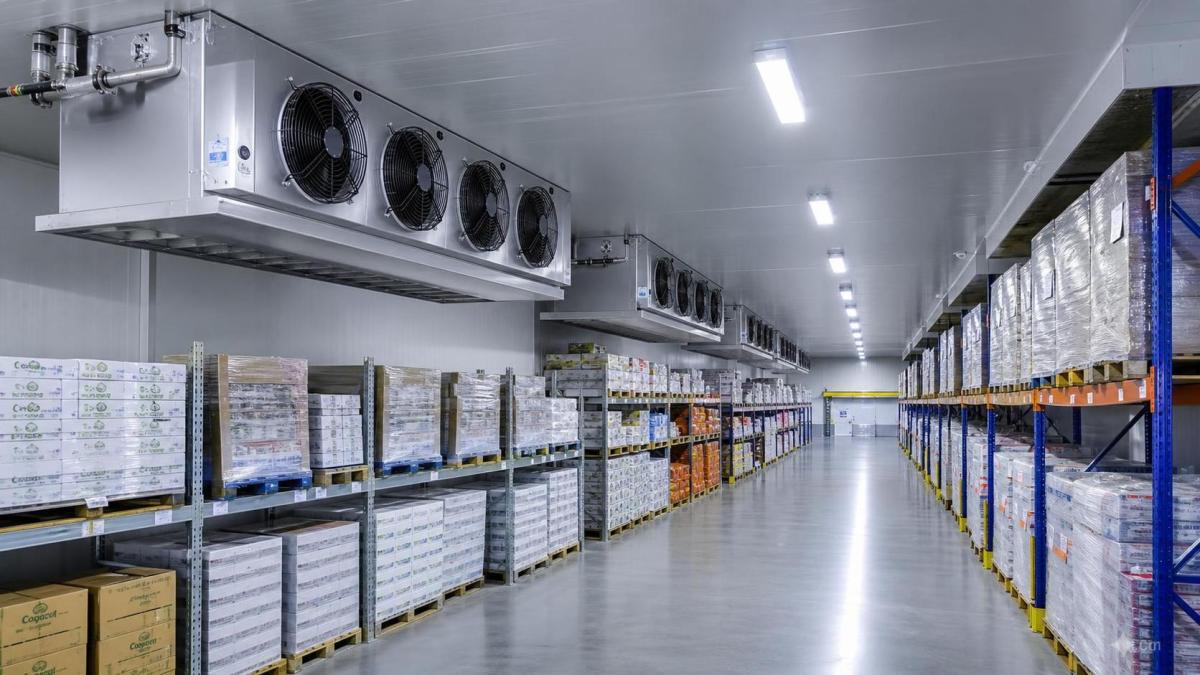
Warehouse operators also tend to underestimate how much door activity distorts the performance picture. A room connected to a staging area with frequent forklift traffic may not need a dramatically larger system, but it often needs better coordination between air cooler placement, door opening pattern, and defrost timing. If warm humid air enters in bursts, frost does not accumulate evenly. One coil may ice faster than another, and the room starts behaving inconsistently even when the controls are technically correct.
What Changes Between Food Storage Environments
Not all food storage rooms should be treated as generic “cold storage.” Fresh produce rooms usually tolerate only limited air-side stress. Packaged beverages are more forgiving but bring heavy door-opening frequency in retail backrooms. Frozen goods need dependable low-temperature holding, yet many operators focus only on room setpoint and overlook defrost drainage, fan delay, and air recirculation around densely stacked inventory.
That last category is increasingly relevant because many operators no longer separate storage from merchandising. In convenience stores, fresh food supermarkets, and community grocery shops, the room is expected to support both inventory holding and product display. In these projects, airflow design cannot ignore human behavior. Front-facing access means repeated door openings, while the replenishment process still has to happen quickly and without warming the sales side.
A useful example is the Display Cold Room, which combines customer-facing glass display doors with a separate rear replenishment aisle. This kind of layout changes how the air cooler is judged. The question is no longer only whether the room can hold 0°C to +10°C or freezer conditions such as -18°C to -22°C, but whether it can maintain that range while front-end access and back-end stocking happen independently. In stores with frequent replenishment, that separation reduces disruption to the air pattern and helps keep product temperature more stable than a single-access arrangement.
Installation Limits Matter More Than Catalog Capacity
On site, the best air cooler on paper can become an average one if the room geometry works against it. Ceiling height, shelf depth, beam position, drain routing, service clearance, and even lighting placement all influence performance. In retrofit rooms, installers often have little freedom. The evaporator may need to sit off-center, or the drain line may require a long route that complicates freeze protection. These are not minor details. Many service complaints begin with installation constraints that were accepted too casually during design.
Maintenance access deserves the same level of attention. Food storage operators rarely complain about a unit that is easy to clean, inspect, and defrost correctly. They complain about downtime, blocked drains, inaccessible fan sections, and coils that are difficult to wash without affecting nearby stock. In humid chilled rooms, sanitation and drainage discipline can be just as important as thermal performance. If the evaporator is placed where cleaning is constantly postponed, the efficiency loss arrives slowly and then all at once during peak usage.
This is one reason manufacturers with in-house design and production control tend to be better positioned for project adaptation. Shandong Boer Refrigeration Equipment Co., Ltd. has built its refrigeration business around commercial equipment and cold storage systems, with air coolers, condensing units, modular cold rooms, insulation panels, and doors forming a complete solution set. That matters in practical application because coil selection, room structure, and access design are connected decisions. When those elements are handled in isolation, mismatches are common.
The company’s production base in Shandong, supported by modern fabrication lines and testing equipment, is relevant here not as a marketing detail but as an engineering one. Consistency in tube expansion, bending, cutting, foaming, and final testing affects repeatability in heat exchange performance and assembly quality. Certifications such as UL, CE, CB, FCC, LVD, EMC, ISO9001, and CQC Energy Conservation indicate that the major product lines have been evaluated against recognized requirements, but certification alone does not choose the right unit for a room. It only means the baseline quality framework is in place; the application decision still depends on site conditions.
A Better Way to Judge Fit
When reviewing an air cooler for a cold room or warehouse, a few questions reveal more than a broad capacity figure:
How often will doors open, and for how long? What is the real storage pattern: loose cartons, dense pallets, hanging product, open shelving? Is product moisture sensitivity high? How much service clearance is actually available after shelving and piping are installed? Will defrost water drain safely in winter conditions? If the room also supports customer-facing display, does the air pattern stay stable during replenishment?
Those are the questions that usually separate a room that merely runs from one that runs predictably. For food storage, predictable performance is the real target. The right Air-Cooler is not the one with the most aggressive specification sheet. It is the one that matches the room’s loading behavior, access rhythm, hygiene requirements, and airflow path closely enough that temperature control stays stable after the installation crew leaves and normal operations begin.
CHAIDONG
Professional generator set manufacturer
24/7 before-sales and after-sales services
Comprehensive technical support