






Air-Cooler Basics: How It Works in Commercial Refrigeration Systems
Why does an Air-Cooler matter so much in a commercial refrigeration system?
If you run a cold room, freezer room, or food storage area, the Air-Cooler is the part that actually delivers cooling into the space. The condensing unit removes heat from the system, but the Air-Cooler is what pulls warm air from inside the room, passes it across a cold evaporator coil, and sends cooled air back out. That air movement is what keeps product temperature stable instead of letting cold air sit in one corner while the rest of the room warms up.
For operators, this matters in very practical ways: better temperature consistency, less spoilage risk, more predictable pull-down time after loading, and fewer complaints about hot spots near doors or shelves.
What is actually happening inside an Air-Cooler?
At a basic level, an Air-Cooler works by heat exchange. Refrigerant enters the evaporator coil at low temperature and low pressure. Fans draw warmer room air across that coil. Heat leaves the air and moves into the refrigerant, so the air gets colder before it is blown back into the cold storage space.
That sounds simple, but performance depends on three things working together:
- enough coil surface area to absorb heat,
- steady airflow from the fans,
- clean coil surfaces without heavy frost or dirt.
When one of those drops off, cooling capacity drops too. That is why an Air-Cooler that is technically “running” can still leave a room struggling to hold temperature.
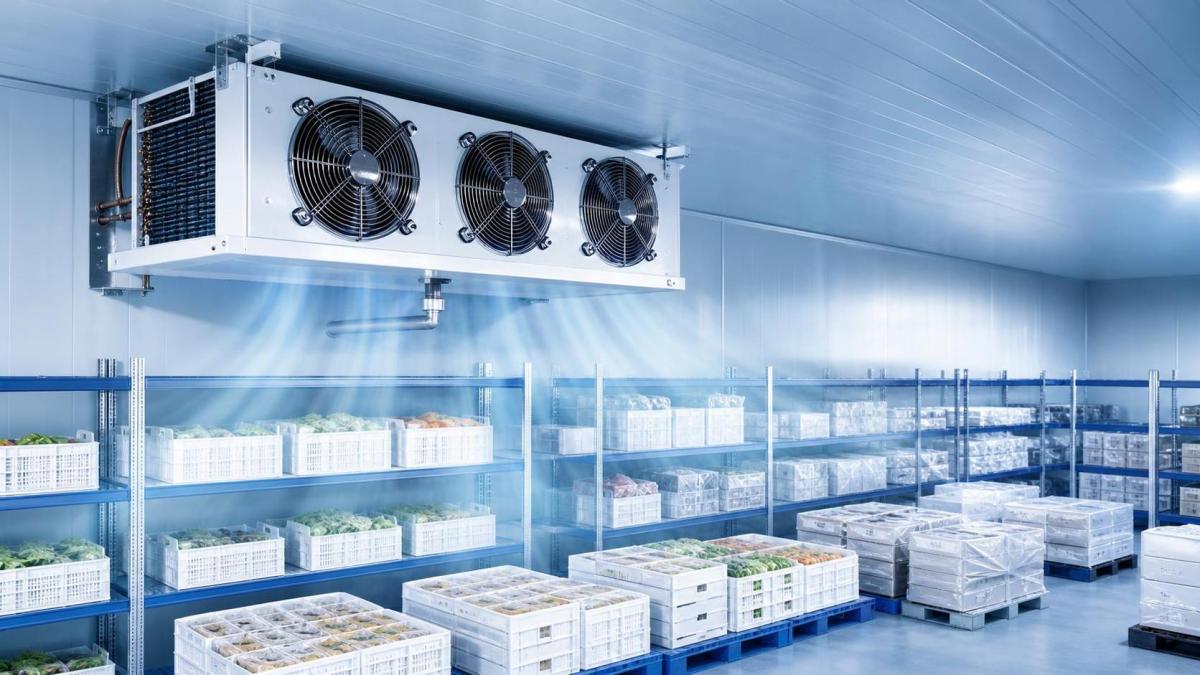
Which parts should an operator understand, even without doing technical repairs?
You do not need to be a refrigeration engineer to spot early trouble. It helps to know the function of the main parts:
These are the points that usually tell you whether the problem is airflow, icing, or drainage before a full service check is needed.
Why does frost form on an Air-Cooler, and when is it a problem?
A light layer of frost is normal because the coil is colder than the air passing over it. Moisture in that air freezes on the surface. The issue starts when frost becomes thick enough to block airflow or insulate the coil.
In real operation, heavy frost usually points to one or more of these conditions:
- frequent door opening,
- warm goods loaded too quickly,
- high room humidity,
- defrost settings that are too short or too infrequent,
- poor drainage after defrost.
Operators often notice the symptom before the cause: fans still run, but air throw feels weak and room temperature starts drifting upward. If that happens, do not judge performance by compressor sound alone. Check coil condition and airflow first.
How does defrost fit into normal Air-Cooler operation?
Defrost is not a side function. It is part of normal operation. An Air-Cooler that never clears frost will gradually lose cooling efficiency, increase fan load, and in bad cases start icing around the drain pan or fan guard.
Electric heating defrosting is common in cold storage systems because it clears ice directly from the coil. In integrated equipment such as Integrated Cold Storage Cold Source , this kind of defrost arrangement is paired with cold storage use in a working temperature range of -10 to +5°C. For operators, the practical question is not just whether defrost exists, but whether the cycle is long enough to clear ice and short enough to avoid unnecessary temperature rise.
A simple field check after defrost: look for clear fins, free drainage, and normal airflow recovery. If ice remains in the lower coil or around the drain area, the room may cool unevenly even though the system restarts.
What does “good airflow” really mean in daily use?
Good airflow is not just fan speed. It means the cooled air can travel across the room, return to the unit, and repeat that loop without major obstruction. Stacked cartons pushed too close to the unit, pallets blocking discharge, or shelving built into the air path can make a properly sized Air-Cooler perform like an undersized one.
As a rule, watch for uneven product temperature in different parts of the room. If items near the door stay warmer or product near the ceiling cools slower, airflow pattern may be the real issue. Some integrated cold storage solutions are designed with known air volume and air throw values to support room coverage. For example, the WG8-9 specification lists an air volume of 4000 and an air throw distance of 33, which are useful reference points when matching the unit to room layout rather than looking at cooling capacity alone.
Can an Air-Cooler waste energy even when it seems to be cooling normally?
Yes, and this is common. A dirty coil, repeated door opening, blocked air circulation, or excessive frost can all force longer run time. The room still reaches set temperature eventually, so the problem gets missed, but power use rises and component wear increases.
This is one reason operators often prefer standardized systems for small and medium cold storage. A packaged option like the Integrated Cold Storage Cold Source combines matched components, includes a Copeland hermetic scroll compressor, uses R404A or R507A refrigerant, and is built to reduce on-site mismatch issues that can lead to low efficiency or repeated faults. That does not remove the need for correct use, but it does reduce the number of variables created during installation.
What are the most common operator mistakes around Air-Coolers?
The big ones are simple:
- Loading warm product too fast and expecting the room to recover immediately.
- Stacking goods directly under or in front of the discharge area.
- Ignoring early frost because the room is still “cold enough.”
- Skipping drain checks after defrost cycles.
- Judging system health only by room temperature and not by airflow condition.
Most Air-Cooler problems grow slowly. By the time temperature alarms appear, the unit has usually been losing efficiency for days or weeks.
When should an operator call for service instead of handling it as routine maintenance?
Call for service when you see repeated icing after defrost, fan motors not running, major water leakage, sharp drop in airflow, or room temperature rising despite clear loading conditions. Those are not just cleaning issues. They can point to defrost faults, electrical problems, refrigerant-side issues, or control problems.
A useful rule is this: if cleaning the visible coil surface, clearing the drain, and correcting storage blockage do not restore normal airflow and room pull-down, the next step is technical inspection. For day-to-day operation, the best approach is to treat the Air-Cooler as an airflow and heat-exchange device. When either air movement or frost control slips, performance follows quickly.
CHAIDONG
Professional generator set manufacturer
24/7 before-sales and after-sales services
Comprehensive technical support