






Can a warehouse cold room be expanded without replacing the plant?
Can a warehouse cold room be expanded without replacing the plant?
Yes—a cold room for warehouse operations can often be expanded while retaining the existing refrigeration plant. But spare cooling capacity, not available floor space, determines whether that is sensible. Extending insulated walls may be straightforward; maintaining product temperatures through peak deliveries, summer conditions, and defrost cycles is the harder test.
The decision usually falls between three options: keep the plant and extend the room, upgrade selected components, or provide separate refrigeration for the addition. A load calculation and a condition assessment should establish which route protects both capital expenditure and operating reliability.
Start with the workload, not the room dimensions
A larger enclosure does not necessarily create a proportionally larger refrigeration load. Additional storage for goods already at the required temperature is different from receiving warm products that must be cooled quickly. Likewise, a room opened occasionally behaves differently from one serving continuous picking and dispatch.
The revised calculation should account for:
- Heat transmission through the expanded walls, ceiling, and floor.
- Air infiltration from doors, loading activity, and connections to warmer areas.
- Daily product intake, incoming temperature, packaging, and required pull-down time.
- Heat from people, lighting, evaporator fans, handling equipment, and defrost.
- Design ambient conditions, operating hours, and any required backup capacity.
Do not treat unused floor area as proof that the existing system is oversized. Equally, a compressor running almost continuously may be responding to dirty heat exchangers, refrigerant problems, or excessive infiltration rather than a fundamental capacity shortage. Resolve those faults before using operating data to justify an expansion.
Check usable capacity across the whole refrigeration circuit
Compressor motor power is not a cooling-capacity rating. Compare the calculated load with manufacturer performance data at the intended refrigerant, evaporating temperature, and condensing conditions. A unit that supports chilled storage may deliver substantially less capacity at freezer duty.
The condenser also needs attention. It must reject the heat absorbed from the room plus the heat associated with compressor operation. A condenser already struggling during hot weather can limit an otherwise adequate compressor. Review coil condition, fan performance, airflow clearance, and hot-air recirculation before deciding whether cleaning, relocation, or additional heat-rejection capacity is necessary.
Inside the room, existing evaporators may have enough nominal capacity but insufficient air distribution for the new layout. Longer aisles, taller racking, and blocked return paths can produce warm pockets while the control sensor reports an acceptable temperature. Adding an air cooler may solve distribution problems, but it does not create additional compressor capacity.
Extended refrigerant pipework introduces further checks: pressure drop, oil return, refrigerant charge, receiver capacity, and expansion-valve selection. Electrical supply and protective devices must also suit the revised installation. These details require engineering review, not simply a larger thermostat setting.
A modular extension still needs careful construction
Prefabricated insulated panels can make an enclosure easier to enlarge, provided the existing panels remain sound and compatible connections are available. The junction between old and new construction deserves particular attention: broken vapor barriers and thermal bridges can cause condensation, ice formation, and insulation deterioration.
A useful expansion drawing should show panel joints, structural supports, door positions, evaporator discharge paths, and clearances around stored goods—not just the extra footprint.
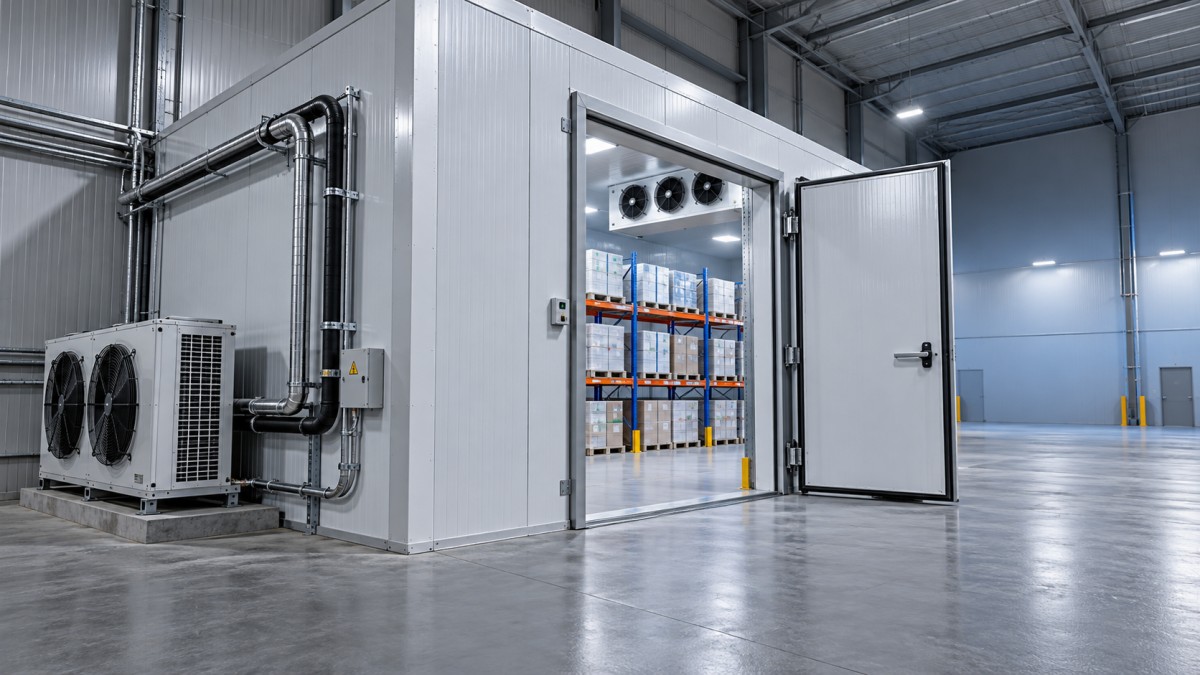
Freezer extensions need a specific floor assessment. Insulation continuity, vapor control, floor loading, drainage, and frost-heave protection where required must be addressed. An ordinary warehouse slab should not automatically be treated as suitable for long-term subzero operation. Structural and fire-safety requirements also depend on the building and local rules.
Choose the upgrade route around the actual constraint
Retain the plant when verified capacity covers the revised load under design conditions, the equipment is serviceable, and airflow and pipework can be adapted. This is most convincing when expansion mainly adds holding space rather than a much heavier product-cooling workload.
Upgrade selected components when a clearly identified bottleneck can be removed without overloading the remaining system. Examples include an additional evaporator for distribution, improved condenser performance, or revised capacity controls. Any change must be checked as part of a matched system; replacing one component can expose a limitation elsewhere.
Add an independent system when the extension needs a different temperature, separate operating hours, or greater operational independence. Keeping the original room intact can reduce disruption. However, separate refrigeration only provides meaningful backup if the layout and operating procedures allow stock to be transferred safely.
Full replacement becomes more credible when the existing plant is unreliable, inefficient at the proposed duty, difficult to service, or constrained by refrigerant availability and applicable requirements. Compare installed cost, expected energy use, maintenance, downtime exposure, and remaining equipment life—not equipment price alone.
A change in use can matter more than extra space
Some wholesale facilities expand toward customer-facing sales rather than storage alone. That changes the assessment: frequent customer access, glass doors, and anti-condensation heating introduce loads that a conventional warehouse-room estimate may miss.
For such applications, the Display Cold Room combines front glass display doors with a dedicated rear replenishment entrance and aisle. Separating stocking from customer access can simplify circulation. Its stated ranges are 0°C to +10°C for chilling and -18°C to -22°C for freezing, with customized configurations available. Those operating ranges do not establish compatibility with an existing plant; door activity, glass heating, and the selected temperature still belong in the load calculation.
Approve an expansion plan, not just an equipment quotation
Before committing, request a documented design basis showing the current and proposed loads, equipment performance at design conditions, pipework changes, control strategy, and commissioning criteria. The installation plan should explain temporary stock protection, isolation arrangements, refrigerant work, and the expected interruption to trading or dispatch.
Controls may need additional sensors, revised defrost sequencing, alarm coverage, and compressor staging. After installation, verify temperature distribution and recovery during representative loading and door-opening conditions. An empty room reaching setpoint is not sufficient evidence of performance under warehouse use.
Shandong Boer Refrigeration Equipment Co., Ltd., established in 2014, manufactures air coolers, condensers, condensing units, modular cold rooms, polyurethane panels, and cold-storage doors. That scope is relevant when enclosure changes and refrigeration modifications need coordinated specifications. For an existing installation, the starting information should include equipment nameplates, refrigerant details, room drawings, temperature records, and projected product throughput.
The practical question is not simply whether the room can be made larger. It is whether the retained system can reliably handle the expanded operation at its most demanding conditions—and whether the evidence supports spending money on adaptation rather than replacement.