






Can one cold room temperature suit mixed food products?
A single cold room temperature can suit mixed food products only when their required storage ranges, moisture tolerance, hygiene status, and holding times genuinely overlap. A room set to a convenient middle point often protects none of the products as well as expected. Chilled meat, dairy, fresh produce, and frozen goods react differently to the same air temperature, air movement, and door-opening pattern. Temperature selection should therefore begin with the most sensitive product and the operational conditions around it, rather than with the room’s average load.
Frozen goods should not share an ordinary chilled room simply because both need refrigeration. A frozen product requires a stable sub-zero environment, while chilled food is damaged by freezing. Lowering the room to protect frozen stock can cause produce injury, surface freezing on dairy products, condensation after removal, and handling problems. Raising the setting for chilled products exposes frozen goods to temperature cycling and softening. These categories need separate zones or separate rooms.
Start with product compatibility, not a nominal setpoint
Mixed chilled storage is more realistic, but it still needs a disciplined comparison. The room air setpoint is only one part of the product condition. Product temperature changes slowly in sealed cartons and quickly in small, exposed packs. A room that displays a stable temperature can contain warmer stock close to a frequently opened door, colder stock in the direct discharge path, and slower-cooling pallets in the center of a dense stack.
Compatibility is strongest where products have similar target ranges, comparable packaging, short holding periods, and no plausible route for cross-contamination. It weakens when unpackaged food, wet cartons, raw proteins, high-respiration produce, and ready-to-eat products enter the same air volume. Packaging reduces exposure, but it does not remove the need to control drainage, cleaning access, and product segregation.
The coldest and warmest locations matter
Air temperature at the return grille does not prove that every pallet is within target. Supply air leaving an evaporator is colder than the average room condition, particularly during pull-down after loading. Goods directly below or opposite the discharge can experience dehydration, frost formation, or localized chilling injury. At the other end of the room, high racking, deep pallet blocks, and poor return-air paths can retain heat.
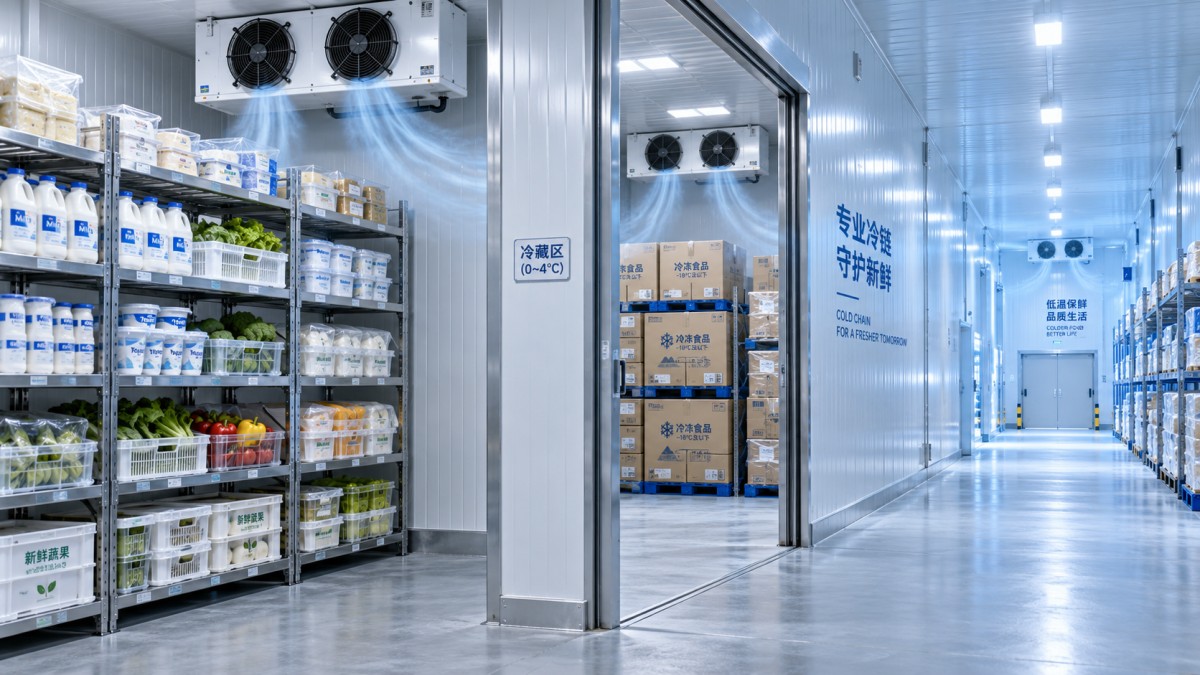
Airflow layout should be assessed with the intended racking plan in place. A clear lane from supply to return does not necessarily indicate good circulation once cartons are stacked to full height. Leave clearance around evaporators, avoid blocking return-air inlets, and prevent cartons from being pressed against insulated walls where condensation or stagnant air can develop. Pallet patterns need air channels, but excessive empty space raises the volume that must be cooled after each door opening.
For low-ceiling rooms where broad circulation is required, a ceiling-mounted unit with discharge to both sides can distribute air across opposing storage areas rather than concentrating it along one aisle. The Bilateral Cold Air Fan configuration is relevant to this layout because its symmetrical horizontal discharge can support a more even temperature field when placement, racking clearance, and return-air access are designed together. Its airflow volume alone should not be treated as proof of suitability; the room dimensions, product arrangement, coil operating condition, and defrost arrangement still determine actual results.
Storage duration changes the decision
A mixed chilled room used for brief staging has a different tolerance from a room used for multi-day storage. A product that is acceptable for a few hours near the edge of its preferred range may lose texture, moisture, or usable shelf life during extended storage. The same applies to repeated loading cycles. A room that remains stable overnight may have large swings during receiving, picking, and dispatch.
The expected dwell time should be defined for each product line before choosing a common setting. Include exceptional conditions, not only the planned average: late collections, partial pallets left after picking, warm inbound deliveries, and a period after defrost. If the design only works when turnover is fast and doors remain closed, it should be treated as a staging arrangement rather than a general mixed-storage room.
Hygiene can rule out a shared room even when temperatures align
Temperature compatibility does not make raw and ready-to-eat food compatible in the same space. Raw meat and seafood can release liquid or carry odors; produce can arrive with soil and field debris; open foods are vulnerable to both. Physical segregation is required where leakage, contact, or airflow transfer could compromise the cleaner product. Store raw products below other goods, use contained trays or sealed secondary packaging where appropriate, and keep damaged cartons out of the room until they are re-contained.
Drainage deserves similar attention. Defrost water, condensate, and wash-down water should leave the room without pooling. A blocked drain or poorly arranged water tray can become a hygiene issue even when the refrigeration capacity is adequate. Cleaning access around the evaporator, walls, floor junctions, and racking should be considered before equipment is fixed in place. The easiest room to clean is often the one least likely to force unsafe product handling later.
Use a load profile instead of selecting by room area alone
Room area is useful for an early estimate, but capacity selection must account for the actual heat load. Warm product entering each day, packaging, lighting, fan motors, personnel activity, door openings, and infiltration can outweigh the steady transmission load through panels. Mixed goods add another complication: product may enter at different temperatures and be packed at different densities. A lightly loaded room containing warm, dense cartons can require more pull-down capacity than a larger room holding already-chilled stock.
Evaporator performance should be compared at the intended room condition, not borrowed from a rating point that does not match the application. At lower room temperatures, available capacity changes, frost accumulation can increase, and defrost recovery becomes more important. A selected unit also needs sufficient air throw without creating a harsh stream across unprotected produce. Coil spacing, fan arrangement, defrost type, drain-line protection, and ceiling height all affect whether the installed system holds a uniform product environment.
When one setting is a reasonable choice
A shared chilled room is defensible when all stocked items have a verified overlapping storage range, are protected by suitable packaging, have compatible hygiene status, and move through within a defined period. The room should have a mapped temperature profile under normal stock density, clear segregation rules, and monitoring points that reflect product locations rather than only the evaporator return air.
Where these conditions are not met, a small partitioned zone, an insulated enclosure, or separate chilled and frozen rooms usually prevents more problems than trying to manage incompatible stock through operating discipline alone. The selected Cold Room Temperature should describe the required product environment across the usable storage area, not merely the value shown on a controller.
CHAIDONG
Professional generator set manufacturer
24/7 before-sales and after-sales services
Comprehensive technical support