






H-Type Condenser 402CD for High Ambient Areas: Key Selection Factors
What Actually Matters When Choosing an H-Type Condenser 402CD for High Ambient Areas
The biggest mistake in selecting an H-Type Condenser 402CD for hot climates is treating the model number as the decision. It is not. In high ambient areas, the real question is whether the condenser can still reject heat efficiently when outdoor temperatures stay elevated for long periods, often during the same hours when refrigeration load is also peaking. A unit that looks acceptable on nominal capacity can become the weak point of the system once condensing temperature rises, compressor power climbs, and head pressure control becomes unstable.
That is why experienced project teams do not start with catalog capacity alone. They start with operating conditions: design ambient temperature, expected pull-down demand, refrigerant, compressor matching, installation space, airflow path, and how much performance margin the project can realistically afford. In cold storage work, especially for commercial and industrial applications, an undersized or poorly matched condenser rarely fails dramatically at first. More often, it causes high energy consumption, frequent compressor cycling, nuisance alarms, and shortened equipment life.
For an H-type condenser, the “H” configuration is usually valued because it supports a practical balance between heat exchange surface, airflow organization, and installation footprint. But in high ambient regions, that structural advantage only translates into reliable field performance when the coil, fan arrangement, and refrigerant circuit are selected with the climate in mind. A condenser that performs well in a moderate climate may not have enough reserve once the ambient condition moves far above standard rating assumptions.
Capacity Should Be Read Against Real Ambient Conditions
This is where many selection discussions go off track. Engineers may compare units by nominal heat rejection or general model size, but the more useful comparison is performance degradation under heat stress. In practice, high ambient selection means asking: what happens to condensing temperature when the site is at its summer peak, and how does that affect the compressor envelope and total system efficiency?
A condenser selected too tightly may still run, but it pushes the system into a less forgiving operating range. The compressor works harder, discharge temperature rises, and energy use increases. If the refrigeration plant serves cold rooms with frequent door openings, warm product loading, or long daytime operating windows, the margin becomes even more important. For project managers, this is not a theoretical concern; it directly affects commissioning stability and whether the finished installation performs as promised.
A sensible review usually includes these checks:
- Design ambient temperature rather than annual average temperature
- Required condensing temperature approach under peak load
- Compatibility with the selected refrigerant and compressor operating envelope
- Allowance for coil fouling, dust, and airflow losses over time
- Whether the project needs spare capacity for future load changes
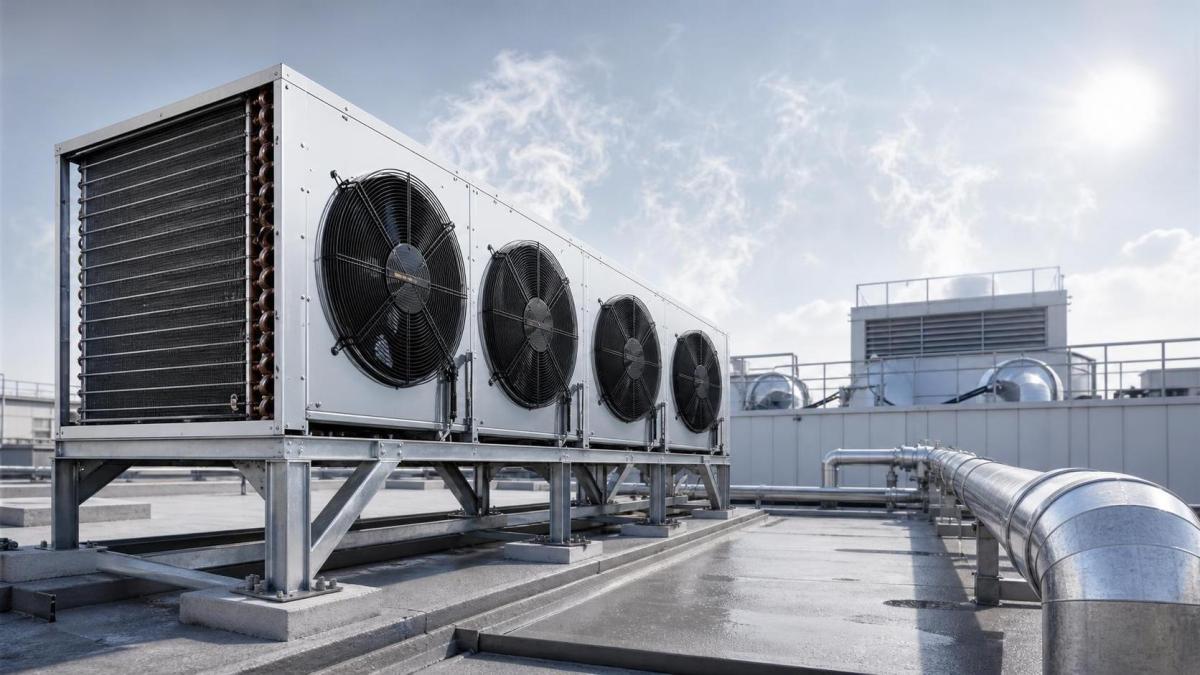
In many real projects, the selection issue is not that the condenser is obviously wrong, but that it has no operational cushion. That distinction matters. A system installed in a coastal logistics hub, a dry inland industrial park, or a dense urban roof location may face very different heat rejection conditions even if the nominal dry-bulb temperature is similar.
Material Durability Is Not a Secondary Question
For high ambient areas, heat is only one part of the environment. Corrosion, dust loading, solar exposure, and unstable maintenance quality often shape the long-term result more than the day-one rating sheet. Coil tube material, fin treatment, cabinet coating, and fan motor protection level deserve the same attention as thermal performance. In harsh outdoor locations, a condenser can lose real efficiency simply because fin surfaces foul quickly or casing integrity declines earlier than expected.
This is one reason established manufacturers place so much emphasis on process control and testing. Shandong Boer Refrigeration Equipment Co., Ltd., for example, has built its manufacturing around standardized production workflow, high-precision inspection, and a quality assurance system tied to internationally recognized certifications such as UL, CE, CB, FCC, LVD, EMC, ISO9001, and China’s CQC energy conservation certification. Those certifications do not replace engineering judgment, but they do help reduce uncertainty around manufacturing consistency when a project team is comparing suppliers.
Airflow and Installation Conditions Often Decide the Outcome
A properly selected H-Type Condenser 402CD can still underperform if installed in a poor airflow environment. Roof parapets, narrow service corridors, mixed exhaust streams, and insufficient maintenance clearance can all cause recirculation of hot air. Once that happens, the unit is effectively operating in a higher local ambient than the weather report suggests. The site team may then blame the equipment, even though the actual issue is installation compatibility.
For project leaders, this means condenser selection should be reviewed together with layout drawings, not after them. Fan discharge direction, service spacing, condenser elevation, prevailing wind exposure, and the presence of nearby heat sources should be checked early. A compact footprint is valuable, but not if it forces the unit into a thermally compromised position.
This same systems view is useful when evaluating the evaporator side. In some projects, stable condensing performance must be paired with an indoor air cooler that supports balanced coil efficiency and defrost behavior. A reference point would be Commercial Ceiling-Mounted Evaporator 402D, which uses copper pipe, aluminum fin construction, external rotor axial flow fans, and multiple fin spacing options for different operating conditions. That type of matching matters because the refrigeration system should be assessed as a whole, not as disconnected components.
Energy Use Is a Selection Factor, Not Just an Operating Result
In high ambient regions, a condenser that keeps condensing pressure under better control will generally support lower compressor power draw across the season. That sounds obvious, but it changes procurement logic. A lower upfront equipment price can be misleading if the condenser regularly forces the plant into a high-head-pressure operating pattern. Over time, the energy penalty and maintenance burden may outweigh the initial savings.
This is especially relevant in cold storage projects with long annual operating hours. Food refrigeration, process cooling, and distribution storage do not forgive inefficient heat rejection. Even a small difference in condensing performance can accumulate into a meaningful operating cost gap. Where possible, teams should ask for performance data under the intended working condition rather than relying only on standard reference points.
Common Misunderstandings During Selection
One common misunderstanding is that “larger is always safer.” Oversizing can create its own control issues, especially if fan staging, refrigerant management, or seasonal operation are not considered. Another is assuming that any unit with the same general application label will behave similarly in the field. Condenser performance depends on coil design, fan specification, circuit arrangement, and manufacturing consistency, not just on broad category.
There is also a tendency to separate procurement from lifecycle thinking. In practice, engineering teams should look at service access, cleaning frequency, spare parts availability, and supplier responsiveness. Boer Refrigeration’s background as a manufacturer focused on commercial refrigeration equipment and cold storage systems, with export experience across more than 30 countries and regions, is relevant here because project execution rarely ends at delivery. Selection decisions are stronger when they account for production capability, technical support, and quality discipline together.
A Better Way to Make the Final Decision
When reviewing an H-Type Condenser 402CD for a high ambient application, the most useful question is not “Is this model available?” but “Does this model still protect system efficiency and reliability when the site is hottest, dirtiest, and most heavily loaded?” That shift in perspective usually leads to better decisions.
A sound selection is normally one that balances heat rejection margin, material durability, installation reality, and operating cost over time. If one of those is ignored, the project may still pass procurement, but it often becomes harder to commission, harder to maintain, and more expensive to run. For engineering decision-makers, that is the real standard to apply.
CHAIDONG
Professional generator set manufacturer
24/7 before-sales and after-sales services
Comprehensive technical support