






How Fast Should a Quick-Freezing Cold Room Pull Down Product Temperature?
Start with the pull-down target, not the room air temperature
When technical teams ask how fast a quick-freezing cold room should pull product temperature down, the useful answer is never “as fast as possible.” The real benchmark is whether the system can move the product core temperature from its loading condition to the specified frozen condition within the required production window, without damaging texture, raising dehydration loss, or driving the plant into unstable operation.
That means your first check is simple: define the target in product terms. Are you evaluating time to surface freeze, time to pass the critical ice-crystal formation range, or time to reach the required core temperature for storage or downstream handling? A quick-freezing cold room can look powerful on paper and still miss the actual requirement if the specification only states room setpoint and total capacity.
In practice, pull-down speed depends on five things more than anything else: incoming product temperature, product thickness, packaging resistance, air distribution, and available refrigeration capacity under the real operating condition. Miss one of those and the quoted freezing time becomes a lab number, not a production number.
Use this checklist before accepting any freezing-time claim
- Check the starting product temperature. A batch loaded at 15°C behaves very differently from one loaded at 5°C. Freezing time comparisons are meaningless unless the initial condition is the same.
- Check whether the quoted time refers to product center or room air. Many disputes start here.
- Check the product geometry. Flat trays, boxed cartons, and stacked tubs do not freeze at the same rate, even at identical mass.
- Check batch loading density. Tight stacking often cuts useful airflow more than expected.
- Check the evaporating condition behind the capacity number. Rated kW only matters if it matches the actual low-temperature duty.
- Check door-opening and loading practice. A room that performs well in a closed test may drift badly during shift change and repeated entry.
If those six items are not defined, you are not evaluating freezing performance yet. You are comparing brochures.
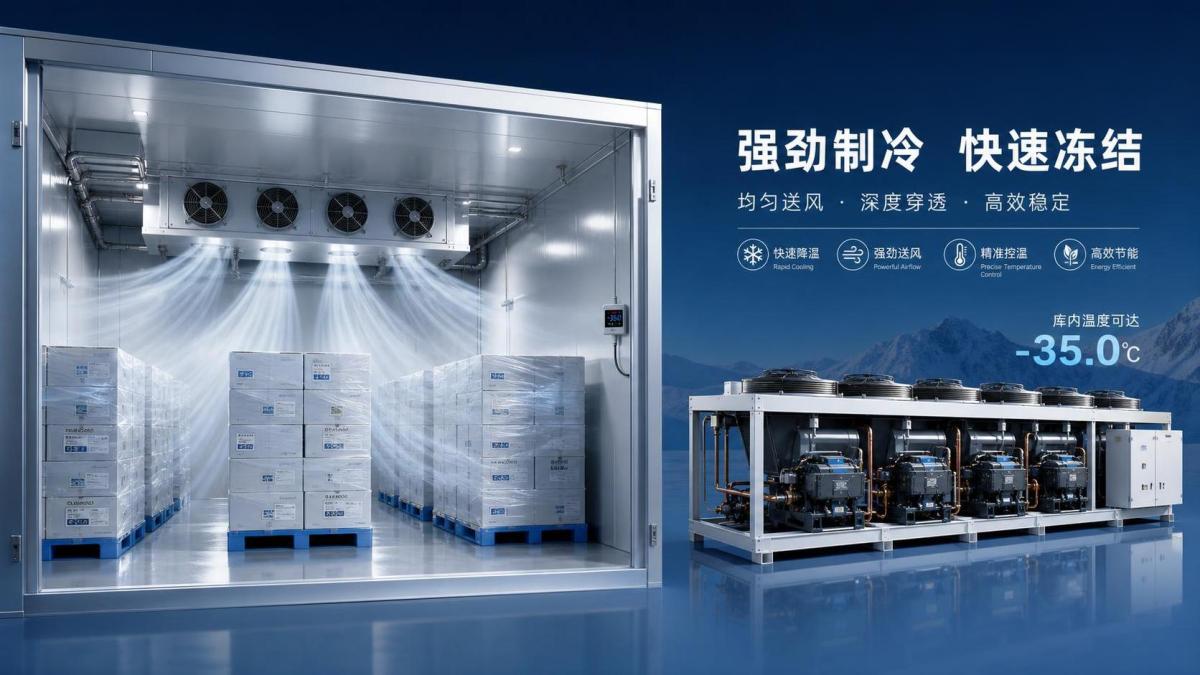
What “fast enough” usually means in evaluation work
For a quick-freezing cold room, “fast enough” usually means the system passes the product through the most sensitive freezing zone quickly enough to protect quality, while still maintaining repeatable throughput. Technical evaluators normally look for consistency more than headline speed. A room that freezes one test batch very quickly but slows down after partial frost build-up, uneven loading, or compressor cycling is not truly fast in production terms.
A practical review point is this: ask for the pull-down profile, not just the final time. You want to see how quickly the room removes sensible heat before freezing, how steadily it handles the phase-change zone, and whether the final approach to target temperature becomes excessively slow. That final section often exposes undersized airflow or poor coil selection.
Watch the critical bottlenecks that slow product pull-down
The biggest field mistake is assuming more installed compressor power automatically means faster freezing. Sometimes it does. Often it does not.
If airflow cannot penetrate the stack, extra refrigeration capacity mostly drives down return air temperature while the product core lags behind. If packaging film, cartons, or liners create thermal resistance, the bottleneck sits at the package boundary. If evaporator layout creates hot spots, some pallets finish late no matter how cold the supply air looks on the controller.
This is why experienced evaluators inspect three zones separately:
- The refrigeration side: net low-temperature capacity at the actual operating point.
- The air side: fan volume, throw, spacing, and blockage after loading.
- The product side: shape, packaging, spacing, and allowable freezing gradient.
If one of these three is weak, the whole quick-freezing cold room slows down.
A simple review table for technical screening
System capacity has to stay usable across the full duty range
Quick-freezing duty is rarely steady. The room may see a heavy initial heat load, then drop into a lower holding phase, then climb again with the next batch. That is where unit selection matters. In larger or mission-critical installations, evaluators often prefer staged or parallel compression because it gives better capacity control and keeps the room from swinging between overload and short cycling.
For example, a Parallel Condensing Unit built around 2 to 8 compressors of the same model can be relevant when the freezing load changes sharply over the shift. The value is not just nameplate capacity. It is the ability to regulate in steps, maintain operation if one compressor is down, and keep partial-load efficiency closer to usable production conditions. That matters more than many buyers expect, because real quick-freezing cold room operation spends a lot of time away from a single design point.
If you are reviewing a unit such as model ZFI180KQE-TRD-523*4, do not stop at the stated 99.04 kW refrigerating output. Check the operating mode behind that value, the control sequence, and whether the room’s airflow and evaporator side can actually absorb that capacity. Otherwise the refrigeration plant may be stronger than the room can use.
Do not ignore product damage while chasing shorter time
A freezing room that pulls down very aggressively can still be the wrong choice if it causes surface cracking, excessive weight loss, package distortion, or non-uniform freezing between outer and inner rows. Technical assessment should include the acceptable product condition after freezing, not just the speed record. This is especially relevant when the product has high moisture loss sensitivity or irregular geometry.
One useful field habit is to compare product core temperatures at several positions in the same batch. If the spread is wide, the room may meet average pull-down time while still failing uniformity. That usually points back to loading pattern or air distribution, not just compressor size.
The decision sequence that saves time
When you screen a quick-freezing cold room, work in this order: define the required core-temperature endpoint, map the real batch load, review airflow through the loaded product, confirm refrigeration capacity at the actual low-temperature condition, then look at control stability during partial load and repeated batch cycling. That order prevents the usual mistake of buying on compressor numbers alone.
If a supplier cannot show how the claimed pull-down time relates to product thickness, loading pattern, and operating condition, the number is not yet decision-grade. If those links are clear, you can judge whether the room is merely cold or genuinely capable of fast, repeatable freezing.
CHAIDONG
Professional generator set manufacturer
24/7 before-sales and after-sales services
Comprehensive technical support