






How Fin Spacing Changes Cleaning Frequency in a V-Type Condenser
How fin spacing really changes cleaning frequency in a V-Type Condenser
The maintenance mistake is usually not poor cleaning technique. It is assuming that every dirty condenser coil gets dirty for the same reason, at the same speed. In a V-Type Condenser, fin spacing is one of the clearest reasons that two units in similar ambient temperatures can end up on very different cleaning schedules.
A tighter fin pitch gives more heat exchange surface in a compact footprint. That is useful when a system needs strong condensing performance without making the equipment excessively large. But the same narrow gap that improves surface area also creates a smaller passage for airborne dust, fibers, grease mist, pollen, and other debris. Once contamination starts bridging between fins, airflow drops first, then head pressure begins to climb, and only after that does the operator usually notice a performance complaint.
Wider fin spacing is more forgiving. It does not stay clean forever, but it usually tolerates dirt loading longer before airflow is seriously choked. For after-sales teams, that difference matters more than the nominal coil geometry on a drawing. It affects how often the site needs inspection, how aggressively the coil can be washed, and whether maintenance should be seasonal, monthly, or tied to actual operating conditions.
This is why “more fins means better” is only half true. In a clean industrial yard or a well-managed cold storage project with filtered air movement around the condensing section, a tighter pitch may operate well for long periods. Put the same V-Type Condenser near flour dust, cotton fibers, kitchen exhaust, traffic soot, or heavy pollen, and the cleaning interval can shorten quickly. The coil does not care about the calendar. It responds to particle type, humidity, oil content, and the velocity profile through the fin pack.
What technicians should actually look at
Fin spacing should never be judged in isolation. A maintenance schedule becomes realistic only when it is read together with four field conditions:
- Contaminant type: dry dust behaves differently from greasy airborne residue.
- Air velocity: higher face velocity can pull particles deeper into the coil instead of leaving them on the surface.
- Humidity and rain exposure: moisture helps debris bond to the fins.
- Cleaning access: some V-type layouts are easy to inspect visually, while others hide fouling deep in the coil angle.
That last point is often underestimated. A coil may look acceptable from the outside and still be partially blocked inside the V section. On many service calls, the first useful sign is not visible dirt but a gradual rise in condensing temperature under otherwise normal load. If fan performance is normal and refrigerant charge is not the issue, reduced airflow through fouled fins becomes a likely suspect.
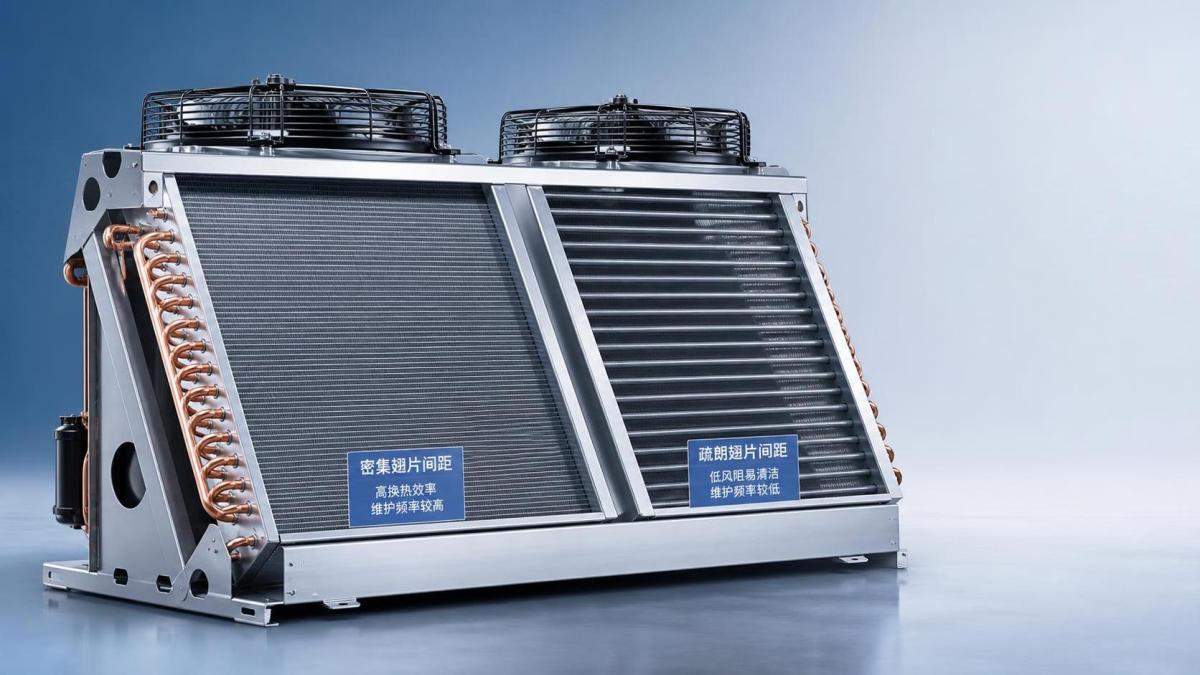
There is also a practical limit to how tightly packed fins can be maintained in the field without damage. Repeated high-pressure washing, aggressive chemicals, or careless brushing can bend fins and reduce the very airflow the cleaning was meant to restore. So when choosing or servicing a V-Type Condenser, maintenance teams should think beyond initial capacity and ask a simpler question: how dirty does this site get, and how much abuse can the coil tolerate over years of cleaning?
The common misunderstanding about cleaning frequency
A fixed interval such as “clean every three months” is easy to issue and easy to misapply. It works only when site conditions are stable and well understood. In refrigeration service, many installations are not. A food processing area, logistics cold room, and roadside commercial condensing platform can all use similar heat rejection equipment, yet their fouling patterns are different enough that the same interval becomes either wasteful or unsafe.
A better approach is to use fin spacing as part of a risk-based schedule. Narrower spacing generally calls for earlier inspection and shorter adjustment cycles until the real fouling rate is known. Wider spacing usually allows a longer interval, but only if operating data stays stable. This is less about theory and more about avoiding two expensive errors: cleaning too often and creating unnecessary downtime, or cleaning too late and forcing the compressor to run against elevated condensing pressure.
In practice, the first season after commissioning tells you more than any generic rule. Shandong Boer Refrigeration, which has spent years manufacturing condensers, air coolers, condensing units, modular cold rooms, and related cold storage equipment for domestic and export markets, generally operates within a production framework shaped by strict technical standards and full quality control. That manufacturing discipline matters, but field cleanliness is still site-driven. Even a well-built coil with sound materials and tested performance will foul according to its environment, not its brochure.
Why this matters across the cold chain
The same maintenance logic appears on the evaporator side as well. In quick-freezing applications, airflow uniformity and coil surface condition directly shape thermal pull-down and defrost behavior. For example, equipment such as The Floor-Standing Counterflow Rapid Cooling/Frozen Air Cooler is built for low-height rapid freezing chambers and quick-freezing warehouses, using internally threaded copper tubes and a straight-line tube matrix to improve heat transfer while helping control frost buildup. That does not make condenser maintenance less important; it shows how coil geometry, spacing, and airflow management affect service frequency throughout the system, not in just one component.
For maintenance personnel, that broader view is useful. A site that struggles with airborne contamination at the condenser may also develop heavier dust loading around fan sections, guards, louvers, and nearby evaporator air paths. Looking at only one coil often leads to repeated service calls without solving the operating pattern behind them.
A practical way to set the interval
If the fin spacing is tight, begin with shorter inspection intervals and extend them only after trend data supports it. Trend data can be simple: visual fouling, condensing temperature, head pressure behavior under similar ambient conditions, fan current, and any change in compressor running time. If the fins are wider and the environment is relatively clean, the interval can be longer, but it still needs confirmation from operating history.
The useful judgment is not “tight fins are bad” or “wide fins are better.” The real question is compatibility between coil design and site contamination load. In a V-Type Condenser, fin spacing changes how fast dirt becomes a performance problem. Once that is understood, cleaning frequency stops being guesswork and becomes part of system protection. That is the point after-sales teams should hold onto: schedule cleaning according to fouling behavior, not habit.
CHAIDONG
Professional generator set manufacturer
24/7 before-sales and after-sales services
Comprehensive technical support