






How air velocity from a dual-discharge cooler affects fresh produce
Air velocity from a dual-discharge cooler affects how quickly fresh produce cools, how evenly it stays within its required temperature range, and how much moisture it loses during storage. Faster airflow can improve heat removal from warm produce, but prolonged exposure can also increase dehydration. A room may reach its temperature setpoint while leafy vegetables near a discharge stream continue to lose weight and firmness.
For quality and safety managers, the operating target is sufficient airflow through the stored load to control product temperature, with limited unnecessary exposure once cooling is complete. That balance depends on the commodity, packaging, incoming temperature, humidity, storage duration, and stack arrangement. A cooler’s rated air volume alone cannot establish whether the produce is adequately protected.
Cooling and moisture loss respond to the same airflow
Moving air reduces the insulating boundary layer around produce and packaging. This improves heat transfer when the surrounding air is colder than the product. During initial cooling, stronger circulation can help remove field heat and reduce temperature differences between exposed and sheltered positions, provided air actually passes through the load.
The same movement also carries water vapor away from exposed produce surfaces. Moisture loss depends on the vapor-pressure difference between the product surface and the surrounding air, together with resistance from skins, packaging, and the boundary layer. Higher local velocity can reduce that boundary-layer resistance. Leafy vegetables and other produce with large exposed surface areas can therefore suffer quality loss even when room temperature appears satisfactory.
Relative humidity must be interpreted alongside product and air temperature. Warm produce entering a cold room can experience a substantial drying drive while it cools, even if the room’s humidity reading seems high. Conversely, reducing fan speed without checking product temperatures may prolong cooling enough to undermine the intended benefit.
The appropriate operating approach can change over a storage cycle. Warm incoming loads need effective heat removal; produce already at its target temperature may need less air movement. Where fan controls support this distinction, any reduced-speed holding mode should be validated against product temperatures throughout the occupied room.
Two discharge directions do not guarantee equal conditions
A dual-discharge evaporator sends cooled air in two directions, which can help distribute circulation across a room. However, the two air paths rarely face identical resistance. Pallet height, wall clearance, carton orientation, and aisle layout can cause one stream to travel freely while the other encounters an obstruction.
This can create two quality problems at once: exposed produce receives persistent direct airflow, while protected positions cool slowly. Lowering the room setpoint to correct a warm location can then increase cold exposure elsewhere. For chilling-sensitive commodities, an unsuitable temperature can cause injury even without freezing.
Air can also return to the cooler through an easy bypass route without exchanging enough heat with the stored load. Strong movement in an aisle may therefore coexist with a warm pallet interior. Discharge velocity, aisle velocity, and velocity at carton openings describe different conditions and should be recorded separately.
A useful airflow diagram shows both discharge paths, the return-air route, pallet positions, and suspected bypasses. It should identify the produce closest to direct airflow as well as positions farthest from effective circulation. These locations provide more useful monitoring points than an evenly spaced sensor grid chosen without reference to the load.
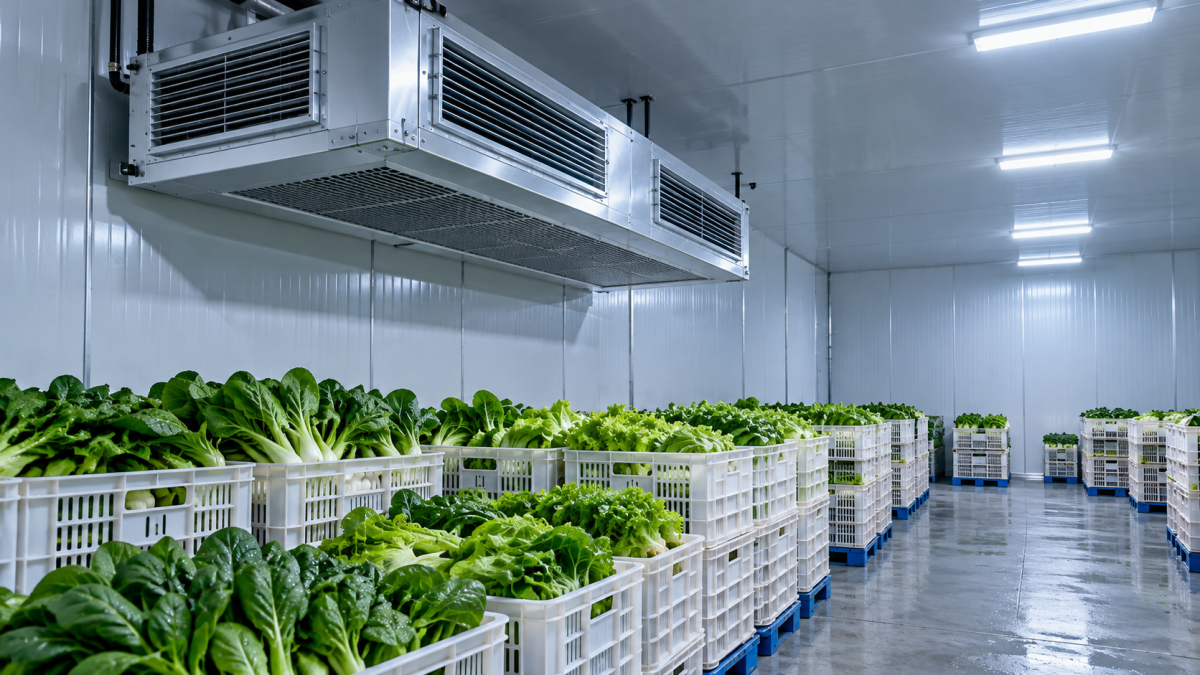
For example, the Bilateral Cold Air Fan uses a ceiling-mounted, dual-discharge arrangement. When evaluating this configuration, check how each discharge path interacts with the intended stacks and whether the return inlet remains clear. Available ceiling space and broad air coverage are useful installation considerations, but they do not establish uniform conditions inside packed produce.
Establish acceptance criteria at the product
There is no single air-velocity limit that protects every fresh commodity, package, and cooling stage. A defensible specification connects airflow to measurable outcomes: cooling time, product-temperature distribution, weight loss, and visible condition over the intended storage period. Any customer or commodity protocol should define the applicable temperature and quality requirements.
Fan airflow, expressed as volume per hour, differs from local air velocity, expressed as distance per second. Dividing air volume by a defined outlet area can estimate average velocity at that outlet, provided the flow and area refer to the same measurement boundary. It does not predict velocity around a pallet, where jets spread, entrain room air, and encounter obstructions.
For a useful site assessment, combine the following checks:
- Measure local air movement. Use an instrument suited to the expected velocity range. Check both discharge directions, exposed product faces, sheltered locations, and the return route under representative loading.
- Track product cooling. Measure representative product temperatures, including positions expected to cool slowly. Record incoming temperature and the time required to reach the specified condition.
- Record temperature and humidity together. Use suitable sensors and document their positions. A reading close to the cooler discharge should not be treated as representative of the whole room.
- Assess moisture loss and condition. Follow comparable samples over the intended holding period, recording mass change and relevant defects such as wilting, shriveling, or loss of firmness.
Keep packaging, commodity, maturity, and storage duration comparable when assessing an airflow adjustment. Otherwise, a change in weight loss may be attributed to fan speed when packaging or incoming condition caused much of the difference. Record whether measurements were taken during normal refrigeration, door activity, or defrost recovery.
Temperature control also has limits as a safety indicator. Adequate cooling supports cold-chain control, but airflow does not sanitize produce or establish microbiological safety. Where a food-safety plan identifies temperature as a control measure, its specified limits and monitoring requirements remain the acceptance basis.
Correct the airflow problem before increasing fan output
If produce cools unevenly, first inspect the air route. Blocked return inlets, stacks placed in discharge paths, and misaligned carton vents can prevent useful circulation. Increasing fan output may intensify drying at exposed positions while delivering little improvement inside the affected pallet.
Packaging deserves particular attention. Liners and wraps can reduce moisture loss, but they can also restrict cooling. Ventilation openings must remain functional through the stacked load. A setting validated for open crates should not automatically be applied to lined cartons or tightly wrapped pallets.
If exposed produce loses excessive moisture while product temperatures remain acceptable, consider redirecting the discharge, changing stack clearances, relocating sensitive goods, or reducing fan speed where supported. Check refrigeration operation as well: coil temperature, operating duration, and moisture removal influence room conditions. Fan adjustment alone may not resolve a humidity problem.
Any reduction in airflow needs a temperature check at the slowest-cooling positions. Also assess surface temperatures where produce receives direct cold air. A satisfactory room average can conceal localized exposure below the commodity’s acceptable range.
Defrost and drainage introduce another variable. Inspect for water carryover, dripping, and persistent wet areas, and include recovery after defrost in temperature monitoring. High humidity can help limit dehydration, while liquid water on produce or packaging creates a separate quality and hygiene concern.
After changing fan settings or stack layout, repeat the assessment under the loading conditions that matter operationally. A partly filled room and a densely loaded room can have different air paths. Keep the validated arrangement in the operating instructions, including clearances and monitoring positions. When packaging, pallet height, or product mix changes, those conditions give the quality team a practical basis for deciding whether airflow needs reassessment.