






How door openings cause cold room temperature fluctuations
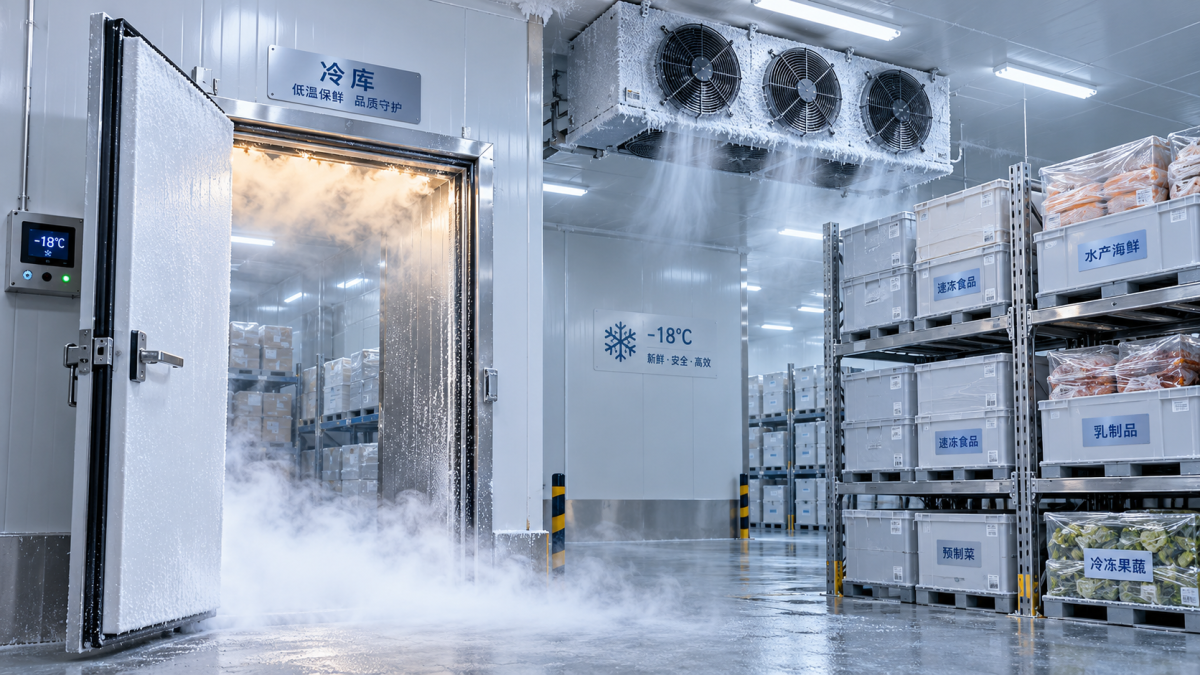
A cold room can have adequate refrigeration capacity on paper and still show repeated temperature excursions if its door is opened frequently or left open longer than the loading task requires. The immediate cause is not merely “warm air entering.” Each opening replaces part of the dense, cold internal air with warmer ambient air and introduces water vapour that later condenses or freezes on cold surfaces. The refrigeration system must then remove both sensible heat from the incoming air and latent heat associated with moisture.
For temperature-sensitive food, this matters because the displayed room temperature may not represent the warmest location or the product temperature. Air near the doorway can rise quickly, while product at the back of a loaded room responds more slowly. Repeated openings can therefore create a pattern of short air-temperature spikes, slow recovery, frost accumulation, and higher compressor running time even when the room’s average temperature appears acceptable.
What happens when a cold room door opens
Cold air is denser than warm air. When a doorway is opened, cold air tends to spill outward along the lower part of the opening while warmer air enters through the upper part. This two-way exchange can occur without any fan or visible draft. Wind, nearby extraction systems, forklift movement, people walking through the opening, and pressure differences between adjacent rooms all increase the exchange.
The heat load created by an opening has several components:
- Air infiltration load: warmer incoming air must be cooled to the room setpoint.
- Moisture load: water vapour in incoming air condenses on coils, ceilings, evaporator fan guards, door frames, and stored goods; below freezing, it becomes frost or ice.
- Product handling load: goods brought in may be warmer than the room, adding a separate pull-down load that is often mistakenly attributed entirely to the door.
- Radiant and conductive gain: an open insulated door no longer acts as a barrier, while the exposed opening allows heat transfer from surrounding surfaces and air.
Humidity is particularly important in freezer rooms. A small volume of humid ambient air can create disproportionate operational trouble because the moisture freezes on the evaporator. Frost reduces airflow through the coil and insulates the heat-transfer surface. The result is a lower effective cooling capacity precisely when the room is experiencing more frequent heat gain.
Why the displayed temperature can be misleading
A room sensor measures the air around its own location, not every point in the cold room. If it is close to an evaporator discharge, it may see cooled air and indicate rapid recovery while the doorway zone remains warm. If it is positioned in a stagnant corner or directly in a supply-air stream, its reading can be unrepresentative in the opposite direction.
Door openings also create stratification. Warm air entering at high level can remain near the ceiling before mixing, while cold air settles at floor level. Pallet stacks, shelving, curtain strips, and poorly arranged cartons interrupt circulation and can create warmer pockets. In chilled rooms, this may cause a local temperature rise around exposed products. In freezer rooms, moisture may freeze at the entrance or on door hardware before the general room sensor shows a serious change.
Product temperature behaves differently from air temperature. A short door opening can cause a sharp air-temperature excursion but limited change in the core temperature of a tightly packed frozen product. Conversely, unpacked chilled goods with large exposed surface area respond faster. The right interpretation depends on product type, packaging, loading density, and the duration of exposure; it should not rely only on the room controller trend.
Opening time is only part of the problem
Reducing door-open time is important, but traffic pattern is often the larger issue. Ten brief openings spaced across an hour do not affect a cold room in the same way as one extended opening. With repeated traffic, the refrigeration system may not return the room to stable conditions between events. The coil accumulates frost, the compressor operates longer, and the next opening begins from a weaker operating position.
Door size and room-to-ambient temperature difference also matter. A large dispatch doorway connecting a freezer directly to a warm, humid loading area has a much higher infiltration risk than a small personnel door opening into a temperature-controlled ante-room. A door opening onto an outdoor loading bay is more variable because ambient temperature, humidity, and wind are not controlled.
The task should be examined rather than only the operator’s behaviour. Picking an order, staging goods in the doorway, waiting for a forklift, searching for stock, or holding a door open while paperwork is completed all turn a short transfer into continuous infiltration. If these activities are routine, an instruction to “close the door faster” will not resolve the underlying workflow issue.
How door-related heat gain affects the refrigeration system
After a door closes, the evaporator must remove the accumulated load. The apparent recovery time depends on the evaporator’s available capacity at the actual room condition, not its nominal rating alone. Frosted coils, blocked return-air paths, incorrect defrost termination, low refrigerant charge, inadequate condenser performance, or a fan issue can all make a door-opening problem look worse.
Air movement must be sufficient to distribute cooling but not configured in a way that creates a direct short path between discharge and return air. In a high-traffic room, evaporator placement and air throw determine whether cooled air reaches the doorway zone and product spaces or simply circulates near the ceiling unit. A ceiling-mounted evaporator should therefore be matched to the room’s operating temperature, layout, product loading, and defrost demand rather than chosen only by floor area.
For example, equipment such as the Commercial Ceiling-Mounted Evaporator 402D is offered with different fin spacings for different operating conditions. This distinction is relevant to door traffic because tighter fin spacing can provide high heat-transfer area in chilled applications, while lower-temperature rooms exposed to moisture ingress need sufficient spacing and an effective defrost arrangement to limit rapid blockage. The evaporator cannot stop infiltration, but its coil design, fan performance, and defrost capability influence how well the room recovers after it occurs.
A common mistake is to increase the thermostat setpoint differential or force a lower setpoint in response to recurring warm readings. This may mask a process issue while increasing the risk of overcooling products near the evaporator, wasting energy, or producing longer defrost-related disturbances. Stable Cold Room Temperature is usually achieved by controlling heat entry and airflow before adjusting the control target.
Door condition and sealing deserve routine inspection
Even when shut, a damaged door can create continuous infiltration. Split gaskets, misaligned hinges, worn sweep seals, warped panels, and incomplete latching leave air paths that are easy to overlook. Frost around the frame in a freezer room is a useful warning sign: it often indicates moist air leakage, although the exact source may be the frame, threshold, vapour sealing, or pressure imbalance rather than the gasket alone.
Door closers must be adjusted to close fully without creating a safety hazard or preventing normal traffic. A door that rebounds after closing, catches on ice at the threshold, or cannot latch because a curtain is incorrectly installed is functionally an open door. Heated frames and thresholds, where fitted, should be checked for correct operation because ice accumulation can damage seals and prevent closure.
Strip curtains and swing doors reduce direct air exchange but are not interchangeable solutions. Strip curtains work best when strips overlap correctly, reach close to the floor, remain clean, and are replaced when torn or permanently curled. They can become ineffective when forklift traffic leaves a persistent gap or when operators push them aside. High-speed doors can reduce opening duration in busy passages, but their benefit depends on opening logic, closing speed, safety sensors, and whether people bypass them by leaving a secondary door open.
Practical checks when temperature instability appears
When a temperature log shows recurring excursions, compare the timing with door events, receiving activity, dispatch periods, defrost cycles, and product loading. A regular spike aligned with shift changes or order picking points toward traffic. A gradual loss of recovery over several days points more strongly toward coil frost, airflow restriction, or deteriorating equipment performance.
Useful observations include whether the door is fully closed between movements, whether products are staged in the entrance, whether floor-level ice is forming, and whether the evaporator fan discharge is blocked by high pallets or racking. Check the sensor location before concluding that the whole room is unstable. If product quality control requires it, use appropriately placed product simulators or validated product-temperature monitoring rather than relying exclusively on a wall-mounted air sensor.
Operational improvements are often straightforward: consolidate transfers, prepare orders before opening the main door, separate receiving and dispatch activity where layout permits, keep pallets clear of door travel and evaporator airflow, remove ice before it prevents sealing, and close doors during pauses rather than treating a few minutes as insignificant. In high-traffic areas, the room design may require a vestibule, insulated rapid door, correctly maintained strip curtain, or a revised material-flow route.
Door openings are unavoidable in a working cold room. Uncontrolled air exchange is not. Temperature stability depends on the combined performance of the door barrier, traffic discipline, room layout, sensor placement, evaporator airflow, and defrost condition. Treating the issue as a door problem alone can miss the real cause; treating it as a refrigeration-capacity problem alone can lead to unnecessary equipment changes while moisture and warm air continue to enter with every movement.