






How insulation quality affects long-term cold room cost
Insulation quality has a direct and lasting effect on cold room operating cost because it determines how much heat enters the enclosure before the refrigeration system has done any useful work. A lower purchase price for panels can be quickly outweighed by higher compressor runtime, more frequent defrosting, unstable room temperatures, and earlier repair work around joints and penetrations.
For a technical evaluator, insulation should be assessed as part of the refrigeration load calculation and building-envelope design, not as a separate finishing item. Panel thickness matters, but it is only one part of the decision. Core density, thermal conductivity, joint construction, vapor sealing, floor insulation, and installation quality often decide whether the specified performance survives years of cold, moisture, traffic, and washdown.
Heat gain becomes a permanent operating expense
Every cold room continuously receives heat through its walls, ceiling, floor, door openings, and service penetrations. Insulated panels reduce conductive heat gain, but they cannot eliminate it. When insulation performs below its intended level, the refrigeration plant must remove that additional heat around the clock.
This affects Cold Room Cost in several connected ways. The most visible effect is electricity consumption, especially in rooms with a large temperature difference between indoor and ambient conditions. Freezer rooms, blast-freezing areas, and facilities located in hot or humid environments are particularly sensitive. A relatively modest increase in heat transmission can produce a sustained increase in compressor operating hours over the life of the facility.
The secondary effects can be just as important. Longer refrigeration runtime raises the load on compressors, fans, controls, and defrost systems. It can also reduce reserve capacity during hot weather, after product loading, or when doors are opened frequently. A room that technically reaches setpoint under light load may still struggle to recover quickly during normal operations if the envelope is allowing excessive heat and moisture into the space.
Insulation quality therefore has to be judged against the operating profile. A cold room used for stable chilled storage has different demands from a rapid-freezing room receiving warm product throughout the day. The second application requires a well-designed enclosure because process load and transmission load can combine during the same peak period.
Panel thickness alone is an incomplete specification
Buyers often compare insulation panels primarily by thickness. Thickness is relevant, but it does not reliably predict thermal performance by itself. Two panels with the same nominal thickness may differ in heat flow, dimensional stability, moisture resistance, and long-term adhesion because of differences in foam formulation, core density, production control, facings, and joint design.
For polyurethane or polyisocyanurate sandwich panels, technical evaluation should begin with the declared thermal performance of the panel core and how that performance is maintained in the installed condition. A lower thermal conductivity supports lower heat transfer, but quoted material properties should not replace an assessment of the complete wall or ceiling assembly.
Questions worth asking during specification review include:
- Is the insulation core uniform across the panel, including edges and areas near joints?
- Does the panel have adequate strength for its span, mounting arrangement, and expected mechanical loading?
- How are tongue-and-groove, cam-lock, or other panel joints configured and sealed?
- Are wall-to-ceiling, wall-to-floor, and panel-to-door-frame transitions detailed to limit thermal bridges?
- Will the facing material tolerate humidity, cleaning chemicals, corrosion exposure, and impact in the intended environment?
- Does the floor assembly include insulation and vapor control appropriate to the room temperature and substrate conditions?
A dense, stable insulation core can help resist deformation and maintain the integrity of panel joints. However, density should not be used as a stand-alone indicator of quality. It needs to be considered together with thermal properties, structural requirements, foam adhesion, panel geometry, and the manufacturer’s production consistency.
Air leakage and moisture often create the larger long-term problem
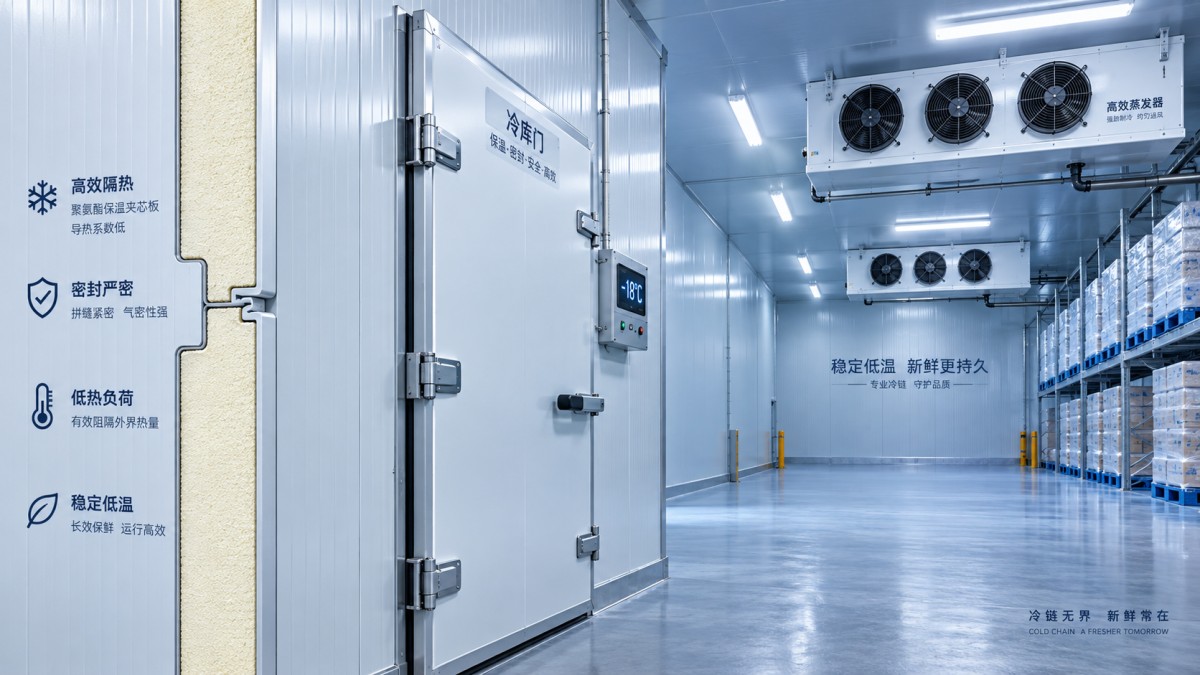
A panel can have good thermal properties in a laboratory condition and still disappoint in service when joint sealing is poor. Air leakage brings both sensible heat and moisture into the room. In chilled applications, this can increase cooling load and condensation risk. In freezer applications, moisture ingress can become frost, ice, and progressive damage around panel joints, doors, and service openings.
Moisture also changes the economics of insulation over time. Wet insulation does not perform like dry insulation. Once vapor reaches colder layers and condenses, thermal resistance can decline while corrosion and material deterioration become more likely. The issue is often gradual, so the facility may first experience it as unexplained energy use, recurring ice formation, or declining temperature stability rather than as an obvious insulation failure.
Particular attention should be given to areas that are often modified after installation: refrigerant pipe penetrations, electrical conduits, drain lines, suspended equipment supports, and sensor cables. A carefully selected panel system can lose much of its advantage when later work creates unsealed openings or compressed insulation paths.
Door interfaces deserve the same scrutiny. Door opening frequency cannot be solved by insulation alone, yet a poorly insulated or poorly sealed door frame creates continuous heat gain even when the door remains closed. In high-traffic rooms, the enclosure specification should be coordinated with the access strategy, including door type, strip curtains or vestibules where suitable, and the operational discipline needed to prevent prolonged openings.
Match the envelope to refrigeration equipment duty
Insulation and refrigeration equipment should be evaluated as one system. Better insulation reduces transmission load, but it does not eliminate product load, infiltration from door openings, internal fan heat, lighting heat, or defrost-related load. Conversely, installing a larger condensing unit to compensate for a weak envelope can conceal the original problem while increasing capital cost and energy use.
This coordination becomes more important in low-height rapid-freezing chambers and quick-freezing warehouses. These rooms need controlled airflow across product while limiting avoidable heat and moisture entry through the enclosure. A floor-mounted air cooler with positive-pressure air delivery may suit the airflow requirement, but its performance will be harder to sustain if the room has weak joints, inadequate ceiling insulation, or thermal bridges around supports.
For example, the The Floor-Standing Counterflow Rapid Cooling/Frozen Air Cooler is designed for low-height rapid-freezing applications and uses a high-airflow arrangement to distribute cooled air through finned tubes toward frozen materials. Its straight-line tube configuration is intended to help control frost accumulation and extend defrost intervals. Those equipment characteristics are most useful when the room envelope also limits external moisture ingress; otherwise, frost load can be driven as much by infiltration as by the evaporator selection.
Technical evaluation should therefore compare the refrigeration capacity at realistic room conditions with the calculated load after accounting for the selected insulation system. A capacity figure without the associated evaporating condition, room temperature, defrost arrangement, product load, and air circulation requirement is not enough to establish operating economy.
Where lower-cost insulation creates avoidable risk
Less expensive insulation can be reasonable where temperature differences are modest, operating hours are limited, and future replacement is easy. It becomes more difficult to justify in low-temperature rooms, humid climates, continuously operated facilities, or sites where production interruption is expensive.
The common mistake is to treat the initial panel price difference as the whole financial comparison. The more useful comparison includes electrical consumption, refrigeration equipment duty, maintenance access, expected joint repairs, product-protection risk, and the difficulty of repairing a failed section once racking, piping, and operations are in place.
There is also a practical limit to over-specification. Extremely thick panels do not automatically deliver proportionate savings when door traffic, unsealed penetrations, poor floor detailing, or process loads dominate the heat balance. The objective is a balanced design in which insulation performance is appropriate for room temperature, ambient conditions, operating schedule, and the actual sources of load.
A procurement review that focuses on lifecycle cost
Before approving a cold room package, ask for a room-specific assessment rather than accepting a generic panel recommendation. Confirm the target room temperature, ambient design conditions, operating hours, product entering temperature, expected door cycles, floor construction, and any washdown or corrosion exposure. These details establish whether insulation is a minor line item or a central determinant of energy and reliability.
Then inspect the details that drawings and quotations can hide: joint sealing method, vapor barrier continuity, corner construction, door frame insulation, penetrations, ceiling support points, and floor-wall transitions. Require the insulation system and refrigeration selection to be checked together, particularly for freezer and rapid-freezing applications.
High-quality insulation does not merely reduce a calculated U-value. It preserves temperature control margins, gives refrigeration equipment a more manageable duty, and reduces the chance that moisture turns into a recurring maintenance problem. That is why the lowest installed panel price is rarely the most useful measure of long-term cold room economy.
CHAIDONG
Professional generator set manufacturer
24/7 before-sales and after-sales services
Comprehensive technical support