






How to prevent condensation at a warehouse cold room entrance
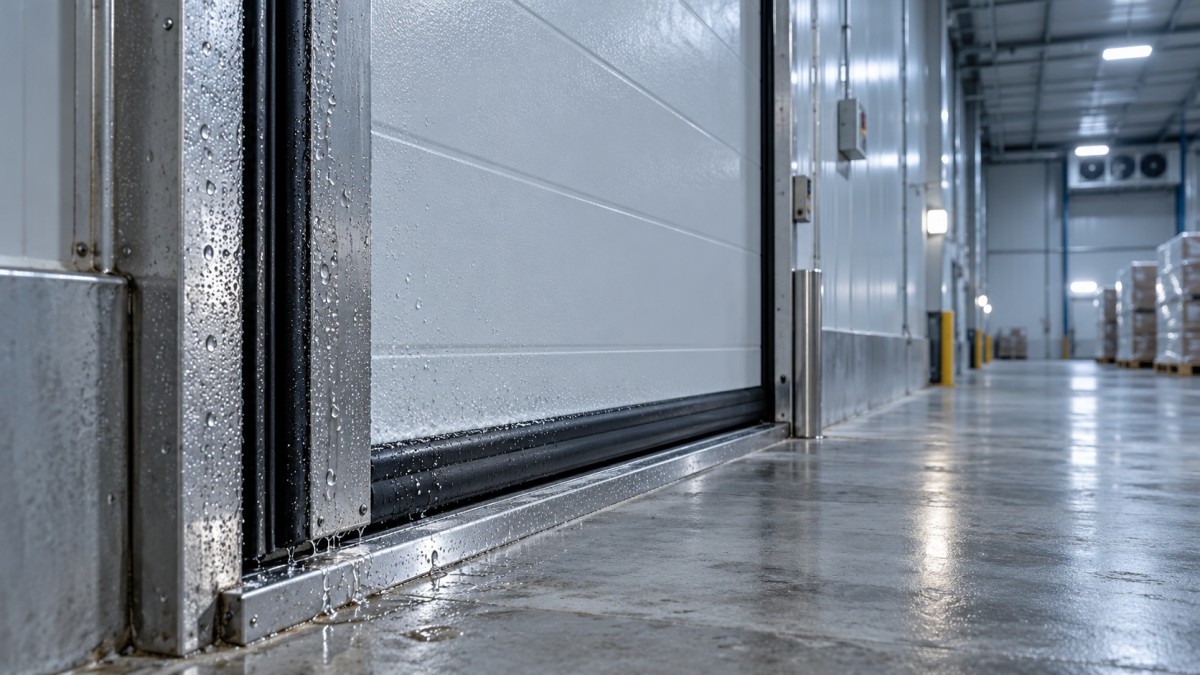
Condensation at a warehouse cold room entrance is controlled by keeping humid air away from cold surfaces and correcting surfaces that become unnecessarily cold. Wiping up water is an immediate safety measure, but lasting prevention depends on door sealing, opening time, surrounding humidity, and the thermal condition of the frame and threshold.
The location and timing of the moisture matter. Water appearing during loading points toward air exchange; a wet patch that persists while the door stays closed suggests a seal leak, a thermal bridge, or a door-frame heating fault. Increasing refrigeration capacity does not solve these causes and can make exposed surfaces colder.
Check where the water starts—not just where it collects
Condensation forms when a surface is colder than the dew point of the air touching it. For example, air at 25°C and 60% relative humidity has a dew point of approximately 17°C. A frame surface at 12°C will therefore collect moisture even if the cold room maintains its correct storage temperature.
At a freezer entrance, that moisture can freeze rather than remain as droplets. Visible fog during an opening indicates that warm, moist air is mixing with cold air, but the fog alone does not identify which component needs repair.
Trace drips upward before assigning a cause. Water on the threshold may originate at the top of the frame, and a puddle beside the entrance may come from a drain rather than the door.
Make the entrance safe before adjusting equipment
Restrict access to slippery areas, remove standing water, and use the site’s approved method for ice removal. Do not chip ice from gaskets or heated frames with sharp tools, or pour hot water onto a freezer threshold: this can damage components and leave more water to refreeze.
If ice prevents full closure, repeated motor operation can overload the drive or damage the seal. Take the door out of normal service under site procedures and arrange maintenance. Electrical checks, heater repairs, and powered-door adjustments require qualified personnel and appropriate isolation.
Restore a continuous seal around the closed door
Inspect the full perimeter, including the bottom edge, corners, and areas vulnerable to pallet impacts. Look for split or hardened sealing strips, ice behind the gasket, loose retainers, and packaging trapped between the door and frame. Clean seals using the door manufacturer’s approved method.
Watch a complete closing cycle from a safe position. A sliding door must reach its intended seated position, not merely cover the opening. Track debris, worn rollers, impact damage, or an incorrect stop position can leave a narrow air path even when the door appears closed.
On suitable accessible sections, a paper-strip check can reveal uneven compression: close the door on a strip and compare the resistance when pulling it free at several points. Keep hands clear of powered mechanisms and follow the manufacturer’s inspection procedure. This is a screening check, not a substitute for alignment measurements.
Do not solve an alignment problem by simply increasing closing force. Excess force can accelerate wear and create a safety hazard without correcting the underlying gap.
Reduce open time without compromising safe passage
When the door opens, warm air can enter through the upper part of the opening while cold air spills out below. Forklift movement, drafts, and pressure differences add to this exchange. The practical objective is to reduce unnecessary exposure—not to make people or vehicles race the closing door.
- Stage goods before opening so the doorway is not used as a waiting area.
- Keep pallets and packaging clear of the closing path and safety sensors.
- Set automatic hold-open time to suit actual passage requirements.
- Check whether passing traffic outside the room triggers unnecessary openings.
- Use partial opening only where the door supports it and the clearance remains safe.
For a high-frequency entrance, a powered insulated door can improve closure consistency. An Electric sliding door (specifically for cold storage) can combine adjustable operation with low-temperature-resistant seals; some configurations also include anti-icing heaters. These features are useful only when opening speed, sensor coverage, seal compression, and heating provision match the entrance conditions. An insulated door is not automatically a high-speed barrier, and automation cannot compensate for excessive surrounding humidity.
Control humidity on the warm side
For a cold room for warehouse storage, the surrounding warehouse is part of the moisture-control problem. Measure temperature and relative humidity near the entrance during normal work and the busiest loading period. A reading taken in a distant office or during an idle shift may miss the conditions causing the droplets.
Use these readings to determine the local dew point, then compare it with frame, panel, and threshold temperatures. Infrared thermometers can give misleading results on reflective stainless steel; use an appropriate surface probe or a suitable measurement target following the instrument instructions.
Check for moisture sources such as open loading bays, wet cleaning, uncovered wash areas, and warm incoming goods. Keep exterior doors closed when practical and allow cleaned floors to dry. Ventilation helps only when the replacement air has a lower moisture content; bringing in humid outdoor air can worsen the problem.
Where the surrounding dew point remains too high, dehumidification or conditioned make-up air may be needed. Equipment should be selected for the actual temperature and moisture load. A portable unit rated under warm test conditions may provide inadequate removal in a cool loading area.
Use entrance protection where traffic makes sealing alone insufficient
Strip curtains can reduce air exchange during passage, but missing strips, inadequate overlap, curling, and impact damage reduce their effectiveness. They must also preserve visibility and safe vehicle movement. They do not replace the insulated door when the entrance is idle.
An air curtain needs application-specific selection and commissioning. A poorly directed jet can mix warm and cold air rather than separate them, especially where cross-drafts or pressure differences are strong. Check discharge direction, doorway coverage, and performance during real traffic—not simply whether the fan runs.
Where frequent access continues to cause moisture problems, a vestibule or interlocked two-door arrangement can limit direct exchange. It requires enough space for the load and vehicle to clear one door before the other opens. Emergency escape and safe access must remain available; an interlock must not trap people.
Investigate cold spots that remain after airflow is controlled
A frame or threshold that stays wet with the door closed may have a thermal bridge: a conductive path through metalwork, fixings, or an inadequately insulated junction. Damaged insulation or a failed vapor seal can also require specialist investigation. Covering a wet area with additional sealant without identifying the moisture path can conceal deterioration.
Where frame or threshold heaters are fitted, have their operation and controls checked. Local heating can keep a vulnerable surface above the dew point or prevent ice formation, but it does not remove incoming moisture. Adding heating without reducing infiltration increases the refrigeration load and may leave condensation elsewhere.
Confirm the improvement during the conditions that caused the problem
After corrective work, observe a complete operating cycle: quiet periods, loading peaks, cleaning, and relevant defrost periods. Record surrounding temperature and humidity, door-open duration, and the exact location of any renewed water or ice. Compare results under similar conditions rather than judging success from one dry morning.
If the entrance is dry while closed but becomes wet during traffic, focus further work on opening control and moisture exchange. If one spot remains wet even during idle periods, investigate its seal, insulation, or heating. That distinction prevents repeated gasket replacement or unnecessary refrigeration adjustments when the actual fault lies elsewhere.
CHAIDONG
Professional generator set manufacturer
24/7 before-sales and after-sales services
Comprehensive technical support