






How to verify a cold room manufacturer's panel fire test reports
A cold room manufacturer’s panel fire test report supports a purchase only when the documented results apply to the panels being supplied and their intended installation. Verification starts with three questions: is the document authentic, what fire performance does it demonstrate, and does its scope cover the proposed construction? A genuine report can still be unsuitable when the core formulation, panel joints, mounting arrangement, or application differs from the tested specimen.
Obtain the complete report, relevant classification documents, and any formal documents extending the permitted application. A cover page showing a favorable rating does not establish which configurations are covered. Keep the project’s required fire performance alongside these documents so that verification addresses the actual requirement.
Establish what the reported result measures
Reaction to fire and fire resistance answer different questions. Reaction-to-fire testing evaluates characteristics such as contribution to fire growth, flame spread, smoke production, or flaming droplets under specified exposure conditions. Fire-resistance testing evaluates how an assembly maintains specified functions during a defined fire exposure, such as integrity and insulation, and loadbearing capacity where relevant.
A reaction-to-fire classification does not establish a fire-resistance duration. Likewise, a fire-resistance result for a particular wall assembly does not automatically classify the material’s smoke production. Terms such as “fireproof,” “self-extinguishing,” and “fire-rated” are insufficient unless connected to an identified test method, classification, and applicable construction.
Authenticate the report and the laboratory’s scope
Read the report number, issue date, revision, applicant, production location where identified, specimen description, and page numbering. Missing annexes matter: construction drawings, photographs, and limitations often contain the information needed to determine applicability. If the document references another report, obtain that document when it forms part of the claimed coverage.
Use contact details found independently on the issuing laboratory’s official website to verify a questionable report. Ask whether the number, revision, applicant, and product description match its records. A confidentiality restriction can require authorization from the report holder; it does not establish that a report is false.
Where accredited testing is required, verify the laboratory’s accreditation through the relevant accreditation body’s directory. Confirm that the scope covered the specific test method when testing occurred. General laboratory accreditation, or accreditation for unrelated tests, does not establish competence within the required scope.
Do not apply an invented expiry period to every report. Test reports record testing performed at a particular time; certifications and listings can have separate validity and surveillance conditions. Older evidence needs review against product changes, applicable standard editions, and project acceptance requirements.
Match the specimen to the supplied panel
The product name is only the starting point. Compare the report’s specimen description with the purchase specification, approved drawings, and production identification. A shared trade name across several panel ranges does not prove that every variant has equivalent fire performance.
- Core identity: establish whether the specimen used polyurethane, polyisocyanurate, mineral wool, or another material. Broad material labels alone do not identify formulation, density, or construction.
- Panel thickness and its permitted range must be explicit. Greater thickness does not automatically extend a result.
- Record facing material, sheet thickness, coatings, and adhesives where specified. These are part of the construction and can influence the result.
- Joint details deserve close comparison. Profile geometry, engagement depth, seals, fasteners, and exposed core edges affect how the assembly behaves during heating.
- The supplied product needs a traceable connection to the tested specification through model references, controlled drawings, batch identification, and relevant production records.
For example, evidence for a panel assembled with a particular joint seal does not automatically cover a visually similar panel installed with a different sealant. A change from one foam formulation to another also requires an applicability review, even when nominal thickness and thermal conductivity remain unchanged.
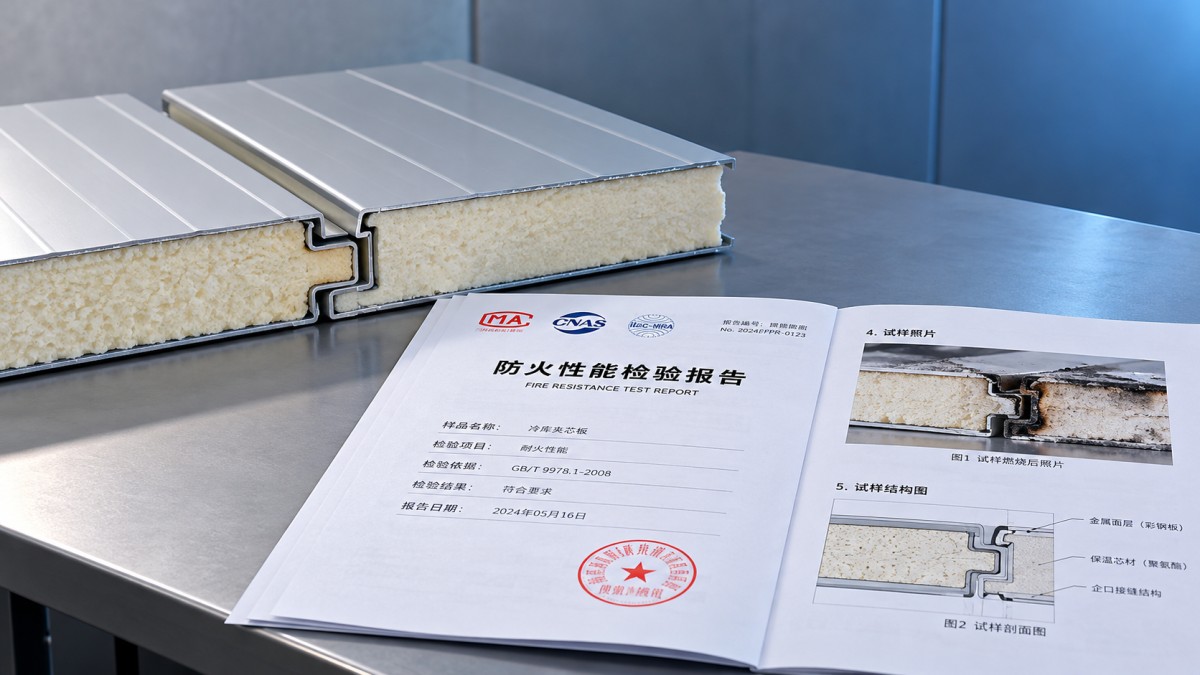
Compare report photographs and section drawings with an actual panel sample. Look closely at tongue-and-groove geometry, facing returns, locking devices, and seal locations. Photographs help reveal differences, but written specifications remain necessary for features that cannot be identified visually, including core formulation and adhesive type.
Read the permitted application before accepting a substitution
A test result describes a specimen tested under defined conditions. Classification documents and applicable direct or extended application rules establish which variations are covered. Locate those provisions rather than assuming that small dimensional changes are acceptable.
For fire resistance, examine panel orientation, unsupported span, supporting structure, fixing spacing, perimeter restraints, and exposure direction. A wall result does not automatically cover a ceiling. An asymmetric assembly tested from one side also needs evidence supporting any claim for exposure from the opposite side.
Reaction-to-fire results likewise require attention to mounting, substrate, joints, and air gaps. A result obtained with a particular backing arrangement cannot simply be transferred to a different end-use configuration unless the classification scope permits it.
If a proposed substitution falls outside the documented scope, request a recognized extension, an assessment acceptable under the project’s approval route, or additional testing. A sales letter asserting “equivalent performance” does not establish the technical basis for that extension.
Include installation details that interrupt the panel assembly
Panel evidence does not automatically cover doors, viewing windows, pipe sleeves, cable openings, or junctions with other construction. These details require evidence appropriate to the performance claimed for the completed enclosure. A tested panel wall can lose its intended compartmentation function through an unsupported opening or an unsuitable perimeter joint.
Refrigeration connections make this especially relevant. Pipework serving a V-Type Condenser can pass through the cold room envelope. Where that envelope requires fire resistance, the penetration detail needs evidence covering the relevant panel construction, pipe material, insulation, opening size, and sealing arrangement. The condenser’s heat-transfer specification provides no evidence for that penetration.
Installation drawings should identify the same joint components and fixing arrangements used in the applicable evidence. Expanding foam, sanitary sealant, and a tested firestop system serve different purposes; appearance or product color cannot establish interchangeability.
Record an acceptance decision that survives delivery
Create a short verification record linking each project requirement to its supporting document, revision, covered configuration, and any unresolved deviation. Separate confirmed coverage from pending evidence. This makes it possible to release an acceptable panel specification while holding a particular door detail or penetration arrangement for resolution.
At delivery, compare panel labels, thickness, joint geometry, and batch records against the approved specification. Retain identification photographs before installation conceals panel edges and fixings. If the supplied construction differs, keep the affected material on hold until the difference is resolved through documented evidence.
The final record should identify the exact panel construction accepted and the installation conditions attached to that acceptance. A statement that “the manufacturer has a fire certificate” leaves both points unresolved.
CHAIDONG
Professional generator set manufacturer
24/7 before-sales and after-sales services
Comprehensive technical support