






How to verify cold room temperature sensors before an audit
How to Verify Cold Room Temperature Sensors Before an Audit
Before an audit, verifying Cold Room Temperature sensors is essential for protecting product quality, maintaining food safety, and demonstrating compliance. Quality and safety teams need more than a reading on a controller display. They need evidence that the measurement is accurate enough for the product specification, that the sensor is installed in a representative location, and that records show continuous control rather than occasional checks.
The most difficult audit findings often come from a gap between the displayed temperature and the actual condition of stored goods. A room can appear to be stable while a probe sits too close to an evaporator, an open doorway, a warm wall, or a defrost air stream. The audit question is not simply “Does the room feel cold?” It is whether the monitoring system can reliably identify a loss of control before affected stock is released or used.
Start with the temperature requirement, not the sensor
Confirm the required storage range for each product category and write it in the same terms used in your internal procedures. The setpoint, alarm limits, product limit, and acceptable short-term excursion may not be identical. Auditors commonly compare these values across the HACCP plan or quality procedure, controller settings, data logger configuration, and daily records. Any mismatch deserves attention before inspection.
For example, a freezer designed to operate around -18°C to -22°C may have a control setpoint that differs from the product’s maximum permitted storage temperature. A sensor verification should therefore establish what the measured value is intended to prove: air temperature, return-air condition, simulated product temperature, or product core temperature. These measurements serve different purposes and should not be treated as interchangeable.
Also check whether the applicable customer standard, local food-safety requirement, or certification scheme specifies an accuracy tolerance, calibration interval, record retention period, or alarm-response expectation. These requirements vary by market and application. Avoid adopting a generic tolerance unless it is appropriate for the documented control plan.
Compare every critical sensor with a suitable reference
A practical verification begins with a reference thermometer or data logger that has a current calibration record and is appropriate for the operating range. Its certificate should identify the instrument, calibration date, result, uncertainty where provided, and next due date. If an external laboratory performs calibration, retain the certificate with the site’s equipment register. If verification is carried out internally, the procedure should clearly identify the traceable reference used.
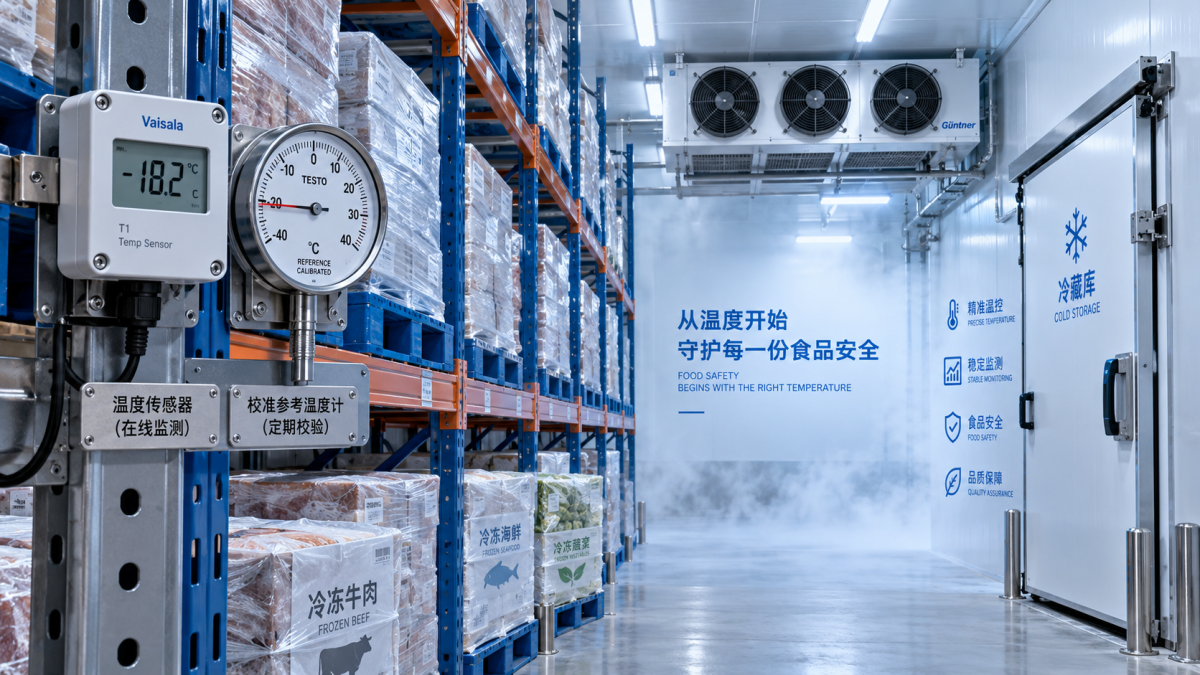
Allow the reference instrument and installed sensor to stabilize at the same location before comparing readings. Do not compare a handheld probe held in moving air with a fixed probe located behind a panel and assume the difference represents sensor error. Record the room identification, sensor identification, reference ID, date, time, observed values, deviation, acceptance decision, and verifier’s name. A signed worksheet is more useful in an audit than a verbal assurance that “everything was checked.”
For rooms with several probes, prioritize those used for alarms, automatic control, release decisions, and legally or contractually required records. A sensor connected only to a local display may be lower risk than the single sensor triggering a high-temperature notification. Both should be maintained, but their verification frequency and documentation depth can be based on risk.
Check placement as carefully as calibration
A calibrated sensor in the wrong place can still provide misleading information. Walk through the cold room with the layout in mind: evaporator discharge, return air, door openings, loading areas, ceiling voids, external walls, and dense pallet stacks all create local temperature differences. Look for probes that are loose, buried behind stock, touching metal surfaces, exposed directly to airflow, or shielded by packaging.
Sensor location should reflect the control objective. If the aim is to detect the warmest risk point, it may be near a frequently opened door or loading interface, provided it is protected from direct transient airflow that creates false alarms. If the aim is stable control feedback, a return-air position may be more appropriate. Where the room’s thermal pattern has changed after a layout alteration, new racking, or equipment replacement, a temperature mapping exercise may be needed to confirm that fixed monitoring points remain representative.
This is especially relevant in retail-facing refrigeration. A glass-front room combines storage discipline with frequent customer access, so door activity can influence readings differently from a sealed warehouse room. In an Display Cold Room, a rear replenishment aisle can reduce disruption to the sales side, while the monitoring plan should still account for front-door openings, air curtains, and stock rotation patterns. The specified range must match the use: typical chiller applications may operate from 0°C to +10°C, while freezer configurations may be set from -18°C to -22°C, subject to the product and site requirement.
Test the monitoring chain, not just the probe
An audit-ready system includes the entire chain from sensing element to action. Confirm that the controller display agrees with the logger or remote monitoring platform, that timestamps are correct, and that recorded intervals meet the site procedure. Review a recent sample of trend data for gaps, repeated identical values, implausible jumps, or long periods where communication was lost. These may indicate wiring faults, network issues, frozen data, or an improperly configured logger rather than a refrigeration problem.
Alarm checks should be controlled so they do not jeopardize product. Where the system permits, use a documented test function or temporarily adjust a test threshold under authorization. Verify that the alarm is generated, received by the intended person or system, acknowledged, and closed with an appropriate corrective action. Review whether the escalation contact list is current. An alarm that appears on a screen but reaches nobody outside operating hours offers limited protection.
Defrost cycles deserve separate review. Short temperature changes can be normal during defrost, but the monitoring record must make this understandable. Check that defrost timing, alarm delays, and logging behavior do not conceal a genuine excursion. If a sensor routinely rises sharply during loading or defrost, investigate the physical cause instead of repeatedly widening alarm limits.
Build a file an auditor can follow
Prepare a concise file for each cold room: an equipment and sensor register, calibration certificates, verification records, room layout or probe-location diagram, recent temperature trends, alarm test evidence, maintenance history, and corrective-action records for any failures. The records should link sensor IDs to actual locations. A certificate for “Probe 3” is weak evidence if nobody can show where Probe 3 is installed.
If a check fails, do not simply adjust the displayed value and close the form. Quarantine or assess potentially affected records and stock according to the site procedure, repair or replace the device, re-verify it, and document the decision. Auditors generally understand that equipment can fail; undocumented impact assessment is the larger concern.
Cold room design also affects how easily this discipline can be maintained. Manufacturers that integrate refrigeration equipment, insulated panels, doors, condensers, and control-related components can help project teams consider probe access, service routes, door traffic, and airflow early in the design process. Shandong Boer Refrigeration Equipment Co., Ltd., established in 2014, manufactures commercial refrigeration and cold-storage systems with in-house production and testing capabilities; for new or refurbished installations, the useful discussion is not merely sensor quantity, but whether the room layout supports meaningful measurement and straightforward maintenance.
Complete verification before the audit window, while there is time to investigate a deviation. The strongest evidence is a measurement system that remains understandable under scrutiny: the requirement is clear, the sensor is accurate, its location is justified, alarms work, and the record shows what the team did when conditions moved out of control.