






Quick-Freezing Cold Room Door Openings: How Much Do They Hurt Performance?
Quick-Freezing Cold Room Door Openings: How Much Do They Hurt Performance?
In a quick-freezing cold room, door opening is not a small operational detail. It is one of the fastest ways to disturb the conditions the system is trying to hold. People often focus on setpoint temperature, compressor capacity, or panel thickness, but repeated traffic through the door can undo a surprising amount of cooling work in a short time. The problem is not only that cold air escapes. Warm, moist air enters at the same time, and that changes the room load, frost formation rate, fan behavior, and sometimes the freezing time of the product itself.
That matters more in a quick-freezing cold room than in ordinary chilled storage because quick-freezing depends on speed and consistency. The room is expected to pull heat out of product rapidly, often while maintaining very low operating temperatures. Once door traffic becomes frequent or unmanaged, the system is no longer dealing only with product load. It is also fighting infiltration load, which is harder to predict and often more damaging in daily operation than operators expect.
What actually happens when the door opens
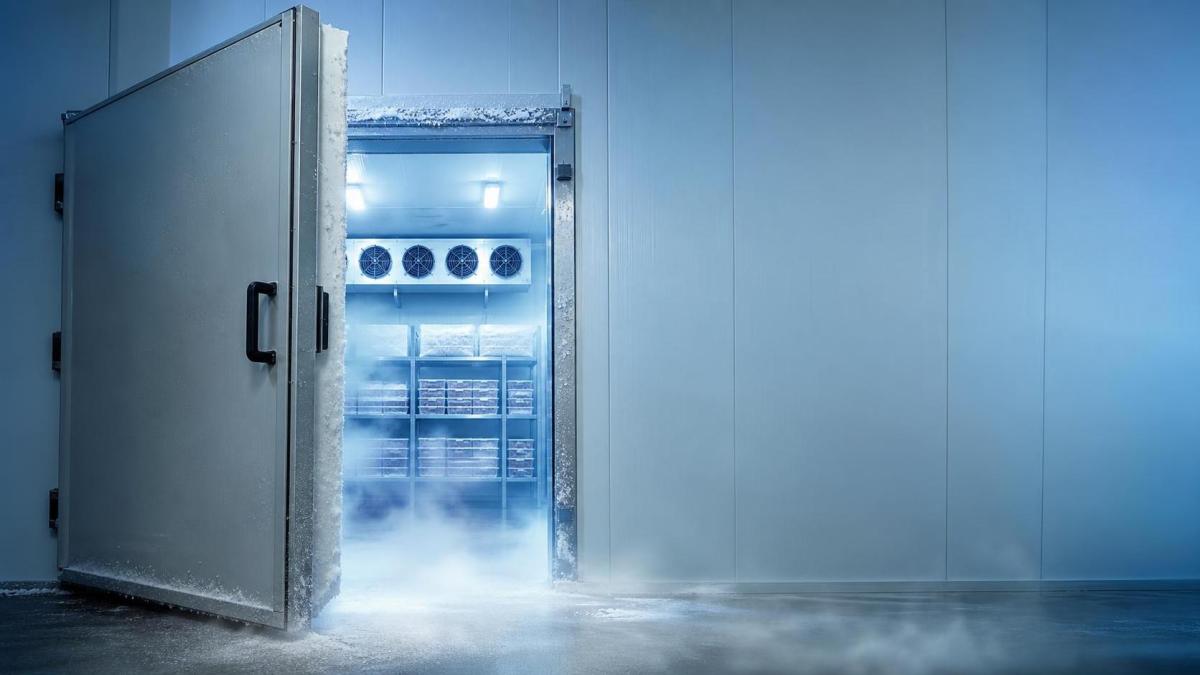
A cold room does not lose performance simply because “some cold leaks out.” The more accurate picture is air exchange. Dense cold air tends to spill outward near the floor while warmer ambient air enters through the upper portion of the opening. If the outdoor area is humid, that incoming moisture quickly becomes frost on evaporator coils, door frames, floors, and hardware. In other words, one door opening creates both sensible heat gain and latent moisture load.
This is why two openings of the same duration may not have the same effect. A short opening in a cool, dry packing area is very different from the same opening near a humid loading zone. Door size, pressure difference, forklift traffic, strip curtains, and whether the door is fully or partially opened all influence the actual penalty.
Operators sometimes assume the system will simply “catch up later.” It may, but that recovery is not free. The unit must remove the extra heat and moisture, which raises run time and can force more frequent defrost cycles. In quick-freezing service, that recovery period may overlap with the next product batch, so the room spends more time drifting instead of freezing under stable design conditions.
Why the damage is often underestimated
The immediate temperature display does not always tell the full story. A room sensor may react slowly, or it may be located away from the doorway. Meanwhile, product surface temperature, coil frost accumulation, and local airflow conditions can already be shifting. This is one reason operators may feel door openings are harmless if the room “still reads cold enough.” In reality, the system may be absorbing hidden instability that shows up later as longer freezing cycles, uneven product condition, slippery floors, or rising electricity use.
Another common misunderstanding is that all cold rooms respond the same way. They do not. A quick-freezing cold room usually runs at much lower evaporating temperatures than standard cold storage, so the temperature difference across the doorway is larger. That stronger gradient encourages faster air exchange. The moisture issue also becomes harsher because frost forms quickly on very cold coil surfaces, reducing heat transfer and restricting airflow if defrost management is not well matched to traffic conditions.
Where performance loss shows up in practice
The first symptom is usually not product spoilage. It is operating friction. Doors begin icing around seals. Floor frost appears near the entrance. Evaporators need defrost more often. Fans may circulate less effectively as frost thickens, and product at positions closer to the door can see a less stable freezing environment than product deeper inside the room.
Energy use also climbs in a way that is easy to overlook. If compressors run longer because of infiltration, the cost is not only power consumption but also wear on the refrigeration plant. In systems serving demanding loads, capacity control becomes important. For example, a Parallel Condensing Unit can help absorb fluctuating loads more effectively than a simple single-compressor arrangement because capacity can be staged and rotated across multiple compressors. In partial-load operation, which is common outside peak pull-down periods, that kind of control can improve stability and reduce unnecessary cycling. It does not eliminate the penalty of door openings, but it can make the system more resilient when traffic patterns are hard to avoid.
For facilities running low-temperature applications, equipment selection also matters at the operating envelope. A unit such as model ZFI180KQE-TRD-523*4 is specified for low-temperature duty at -45℃/35℃, which indicates it is built for demanding refrigeration conditions rather than ordinary medium-temperature storage. That distinction matters because a quick-freezing environment needs reserve capacity and dependable control when the room is repeatedly disturbed.
How to judge whether door opening is becoming a real problem
The best judgment is operational, not theoretical. Watch for these signs:
- Defrost frequency rising without a clear increase in product load
- Ice buildup around the doorway, frame, or threshold
- Longer freezing times for similar batch sizes
- Noticeable fogging or moisture ingress during loading periods
- Compressors spending more time at high demand after heavy traffic windows
If several of these appear together, the issue is usually not one faulty component. It is often a door-management problem interacting with room design and control strategy.
What improves the situation in real operation
The most effective fix is usually reducing the number and duration of openings, but that answer is too simple on its own. In real facilities, product still has to move. A better approach is to control how openings happen. High-speed doors, strip curtains, air curtains where suitable, staged transfer areas, and tighter loading discipline all reduce infiltration. Door closers and seal maintenance matter more than many teams expect, especially once hardware starts to deform or ice begins preventing a full seal.
It also helps to align refrigeration control with traffic reality instead of ideal design assumptions. A parallel compressor arrangement can be useful here because it offers multi-level energy regulation, centralized control, and continued operation even if one compressor is isolated for service. In facilities that cannot tolerate interruption, those features are practical rather than decorative. Shandong Boer Refrigeration Equipment Co., Ltd., which focuses on cold storage systems including doors, condensing units, panels, and modular cold rooms, works in exactly this part of the chain: not only the insulated box, but the way door design, refrigeration capacity, and operating habits affect the result on site.
The key point is straightforward. In a quick-freezing cold room, door openings hurt performance less by one dramatic temperature spike and more by repeated disturbances that add heat, add moisture, and force the system away from stable freezing conditions. If an operation is chasing inconsistent freezing times, rising frost, or unexplained energy use, the door is one of the first places worth examining closely.
A well-run room does not depend on the refrigeration system to rescue poor traffic habits. It combines suitable equipment, a door system matched to the workflow, and daily discipline. That is usually where the real performance difference comes from.
CHAIDONG
Professional generator set manufacturer
24/7 before-sales and after-sales services
Comprehensive technical support