






Quick-Freezing Cold Room or Standard Freezer Room: Which Saves More Product Quality?
Quick-Freezing Cold Room or Standard Freezer Room: Which Saves More Product Quality?
The common mistake is to compare these two rooms only by storage temperature. In practice, the real difference is freezing speed. A standard freezer room is built to hold already frozen goods at a stable low temperature, while a quick-freezing cold room is designed to pull heat out of fresh product fast enough to pass through the critical ice-crystal zone before large crystal damage develops. If product quality matters after thawing, that distinction is not technical trivia; it is usually the center of the decision.
For meat, seafood, prepared meals, bakery items, and some fruits, the temperature range from about 0°C to -5°C is where quality is often won or lost. Water inside the cells begins to freeze, and if that process is slow, larger ice crystals can rupture cell structure. The result is familiar to processors and distributors: drip loss, softer texture, surface dehydration, and less consistent appearance. A quick-freezing cold room reduces the time spent in that zone. A standard freezer room may still reach the target core temperature eventually, but it usually does so too slowly for products that are sensitive to texture and moisture retention.
That is why asking “which room saves more product quality” is slightly incomplete. The better question is: at which stage of the cold chain are you trying to protect quality? If the room is for post-processing freezing, then the quick-freezing option usually has a clear advantage. If the goods arrive already frozen and the task is only long-term storage or distribution buffering, a standard freezer room is often the more rational choice.
Where the Difference Actually Shows Up
In operations, the distinction is visible in three areas: product surface condition, internal tissue damage, and inventory turnover. A quick-freezing cold room is designed with higher air circulation, stronger evaporator performance, and system matching that supports rapid heat extraction from warm or freshly processed goods. A standard freezer room prioritizes stable storage conditions, not aggressive pull-down. It can preserve frozen goods well, but it is not necessarily optimized to freeze fresh goods without quality loss.
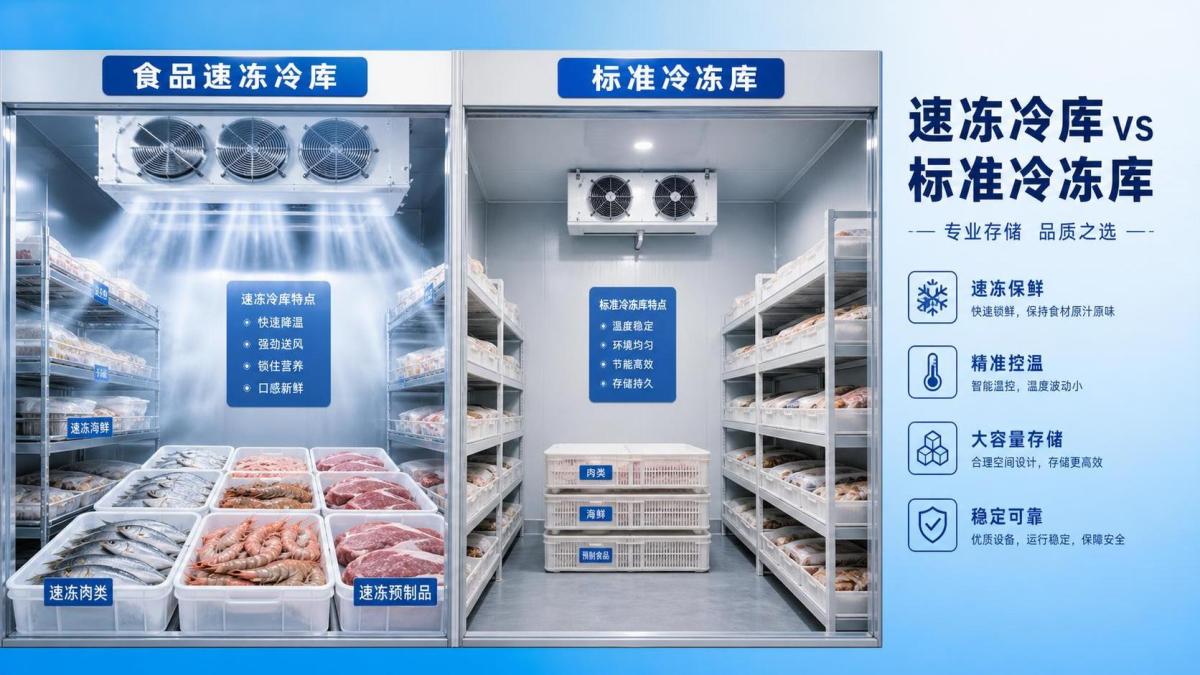
This is also where many procurement discussions go off track. Some buyers assume that setting a standard freezer room to a lower temperature makes it equivalent to a blast or quick-freezing system. It does not. Room temperature alone does not define freezing performance. Product load, air velocity, evaporator selection, condensing capacity, door opening frequency, stacking pattern, and target pull-down time all influence the actual freezing curve.
Product Quality Is Not the Same as Lowest Temperature
Decision-makers often focus on the final storage setpoint because it is easy to specify. The harder but more useful metric is how fast the product core moves from its incoming temperature to a stable frozen state. For example, products with higher water content and stronger texture sensitivity tend to benefit more from quick freezing. That includes fish fillets, shrimp, premium meat cuts, dumplings, and ready meals where shape and mouthfeel affect sell-through. By contrast, products with lower texture sensitivity, or products already individually frozen upstream, may not justify the extra capital and operating intensity of a quick-freezing cold room.
The quality question also depends on packaging. Bulk-packed cartons freeze more slowly than spaced trays or single-layer loading. A business may choose a quick-freezing room not because the product is delicate in theory, but because packaging density and throughput targets make a standard freezer room too slow in reality.
What the Equipment Side Tells You
A freezing room is only as good as the system behind it. In cold storage engineering, heat rejection capacity, evaporator-air match, refrigerant circuit design, and insulation quality all affect whether the room performs as designed under load. That is one reason experienced buyers evaluate the refrigeration package as a whole rather than treating the room panel, condensing side, and air cooler as separate purchases.
On the condensing side, compact and efficient heat exchange can matter especially where footprint, refrigerant charge, or dynamic load response are concerns. An example is H-Type Condenser 401, which uses 7mm copper tubes and hydrophilic aluminum foil to improve heat transfer area within a compact structure. With models 401C and 401D offering heat exchange capacities such as 7.42 kW and 8.27 kW in one operating series, this kind of component logic is relevant when a project needs stable thermal performance without wasting installation space. It does not decide the room type by itself, but it illustrates why system matching matters more than a headline temperature number.
When a Standard Freezer Room Is the Better Decision
There are many cases where a standard freezer room protects business value better than a quick-freezing room. If your upstream supplier has already frozen the product correctly, then your main task is maintaining low, even, reliable storage conditions. In that setting, extra freezing power may sit underused while increasing investment and possibly energy cost. The same applies to distribution centers whose main challenge is stock rotation, not first-stage freezing.
A standard freezer room can also be the right choice when product margins are modest and minor texture variation does not materially affect customer acceptance. Some industrial raw materials and secondary processed goods fall into this category. The point is not that quality is irrelevant; it is that quality risk must be weighed against load pattern, throughput, and return on equipment.
A More Useful Selection Logic
For a selection decision, four questions usually reveal the answer faster than a long specification sheet:
- Does the product enter the room fresh, warm, or already frozen?
- Is post-thaw texture or drip loss commercially important?
- What is the required throughput per batch or per day?
- Will storage stability or freezing speed create more financial impact?
If the first two answers point to fresh product and strict quality retention, the quick-freezing cold room is usually the stronger option. If the operation is mainly frozen storage with moderate turnover, a standard freezer room is often the more disciplined investment.
Manufacturers with long project experience tend to treat this as a system-engineering problem, not a catalog choice. Companies such as Shandong Boer Refrigeration Equipment Co., Ltd., which work across condensing units, modular cold rooms, insulated panels, doors, and related cold storage components, are closer to the practical reality of these decisions: product quality is protected by correct thermal design, not by product naming alone.
So which saves more product quality? In most first-stage freezing applications, the quick-freezing cold room does. But that answer only holds when the room is being asked to freeze, not simply to store. For decision-makers, the most reliable path is to match the room type to the product’s thermal journey, then verify that the refrigeration system can support that duty under real loading conditions.
CHAIDONG
Professional generator set manufacturer
24/7 before-sales and after-sales services
Comprehensive technical support