






V-Type Condenser vs Flat Condenser: Which Fits Limited Roof Space?
Start with the real constraint, not the roof drawing
When roof space is limited, the V-Type Condenser usually gets shortlisted quickly because the footprint looks smaller on paper. That is often the right instinct, but it is also where many projects go wrong. A condenser is not just a rectangle on the layout. It needs clear air intake, clean discharge, service access, structural support, and enough room to keep performance stable in summer. If you only compare plan dimensions, you can end up choosing the unit that fits the roof but hurts the system.
For project managers and engineering leads, the practical question is this: are you short on footprint, short on height, short on maintenance space, or short on all three? A V-type and a flat condenser solve different problems, even when both can technically be installed.
What to check before you compare V-Type Condenser and flat condenser options
- Available roof footprint after deducting walkways, parapets, cable trays, and pipe routing.
- Height restrictions from screens, nearby structures, or planning requirements.
- Required heat rejection capacity at the actual design ambient, not a nominal catalog point.
- Maintenance access for fan motors, coil cleaning, electrical checks, and safe lifting.
- Airflow path, especially whether hot discharge air can recirculate.
- Roof load distribution and whether point loads create a structural issue.
- Noise limits at the property line or near occupied spaces below.
This first pass usually narrows the answer faster than a long specification meeting.
Where the V-Type Condenser usually wins
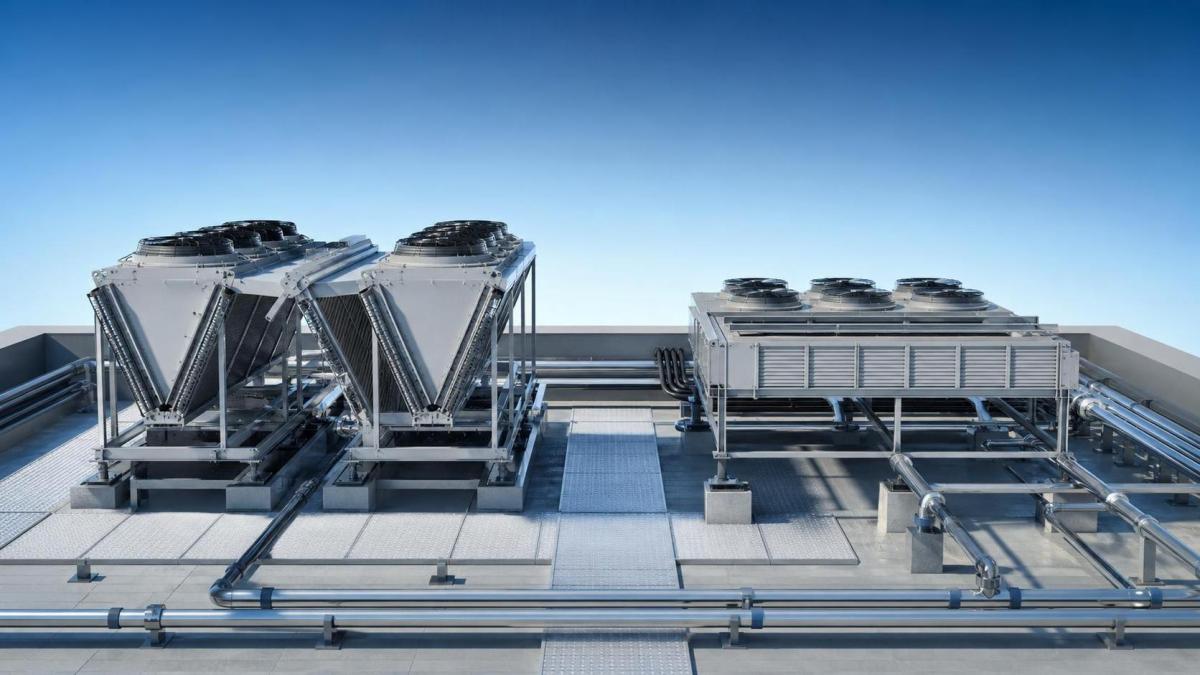
A V-Type Condenser is typically the better choice when the project is squeezed for footprint but still has enough vertical clearance. Because the coil faces are arranged in a V, you can get a relatively large heat exchange area without spreading the unit too wide across the roof. That matters on cold storage retrofits, mixed-use buildings, and sites where the roof is already crowded with ducts, vents, or solar equipment.
It also helps when pipe runs need to stay compact. A tighter equipment cluster can simplify routing and reduce the feeling that the roof has become a mechanical yard. For larger refrigeration systems, that can be a meaningful coordination advantage.
The common mistake is assuming smaller footprint means easier installation. In reality, a V-type unit can become harder to handle if the crane pick is awkward, the service side is boxed in, or the roof screen cuts off discharge air. If your available height is marginal, the space saving can disappear once clearances are respected.
Where a flat condenser is the better call
Flat condensers make more sense when height is the tighter limit, when roof appearance matters, or when service teams need straightforward top and side access. They are easier to understand in layout reviews because the airflow pattern is usually simpler and the unit profile is lower. On some roofs, that lower profile is the difference between a clean approval and a redesign.
They can also be the safer choice if you know coil cleaning will be frequent. Dust, grease, cottonwood, or industrial fallout changes the maintenance picture fast. A layout that looks compact on day one can become expensive when technicians cannot comfortably reach the coil surfaces six months later.
The tradeoff is obvious: flat units usually need more roof area for the same job. If your site is truly footprint-limited, that may end the discussion immediately.
A quick decision table for shortlist meetings
Do not judge performance by shape alone
This is where selection work gets more serious. Shape influences airflow and layout, but it does not automatically decide efficiency or reliability. You still need to compare coil area, fan arrangement, design ambient, fin spacing, motor specification, and the way the condenser will interact with the condensing unit.
On projects using a centralized refrigeration setup, the condenser choice should support the control strategy and operating profile of the plant. For example, a compact system built around a Parallel Condensing Unit may reduce equipment sprawl and simplify capacity staging, especially where partial-load operation matters. The listed model ZFI180KQE-TRD-523*4 is specified at -45℃/35℃ with 99.04KW refrigerating output and a COP of 1.22, and parallel configurations can also help with redundancy, online maintenance, and space efficiency. That does not mean it automatically favors a V-type layout, but it does mean the condenser should be reviewed as part of the whole plant package, not as an isolated rooftop item.
The checks that prevent painful rework later
Air path: Look at nearby walls, screens, and upper-level structures. If hot air can roll back into the coil, condensing temperature rises and the roof “fit” stops looking smart.
Service envelope: Ask where a technician stands, where panels open, and how coils are cleaned. Many rooftop selections are approved by people who will never service them.
Structural load: Total weight matters, but so does how it is distributed. A unit that saves area may concentrate load more aggressively.
Noise path: Fan noise can reflect off parapets and neighboring structures. Taller equipment is not always louder, but it can behave differently in the built environment.
Future expansion: If the cooling load may grow, leave a path for added condenser capacity or plant-side modular growth. This matters even more when the refrigeration side is designed around 2-8 compressor parallel arrangements or staged redundancy.
What usually leads to the right decision
Choose a V-Type Condenser when roof footprint is the hard limit, vertical clearance is acceptable, and you can maintain clean airflow and workable service access. Choose a flat condenser when height, simplicity of maintenance, or approval constraints are more important than saving plan area.
If the project team is split, do one practical exercise: mark the true install zone, the maintenance zone, and the no-build zone on the roof plan. Then compare both condenser types using the actual system duty, not a generic capacity line. That usually settles the debate faster than arguing over shape. In tight refrigeration projects, the best answer is rarely the unit that only fits the drawing. It is the one that still performs, can still be serviced, and does not create avoidable operating cost after handover.
CHAIDONG
Professional generator set manufacturer
24/7 before-sales and after-sales services
Comprehensive technical support