






What 2026 Efficiency Trends Could Influence V-Type Condenser Design?
Why efficiency in a V-Type Condenser will mean more than heat rejection in 2026
A V-Type Condenser is often discussed as if its value comes down to one thing: how much heat it can reject per square meter. That is too narrow for 2026. In real refrigeration projects, enterprise buyers are no longer judging condenser efficiency by nameplate capacity alone. They are looking at how the condenser behaves across seasonal load swings, how much fan energy it consumes to maintain condensing pressure, how well it fits into limited plant space, and how stable it remains after months of dust, oil residue, wind exposure, and partial maintenance neglect.
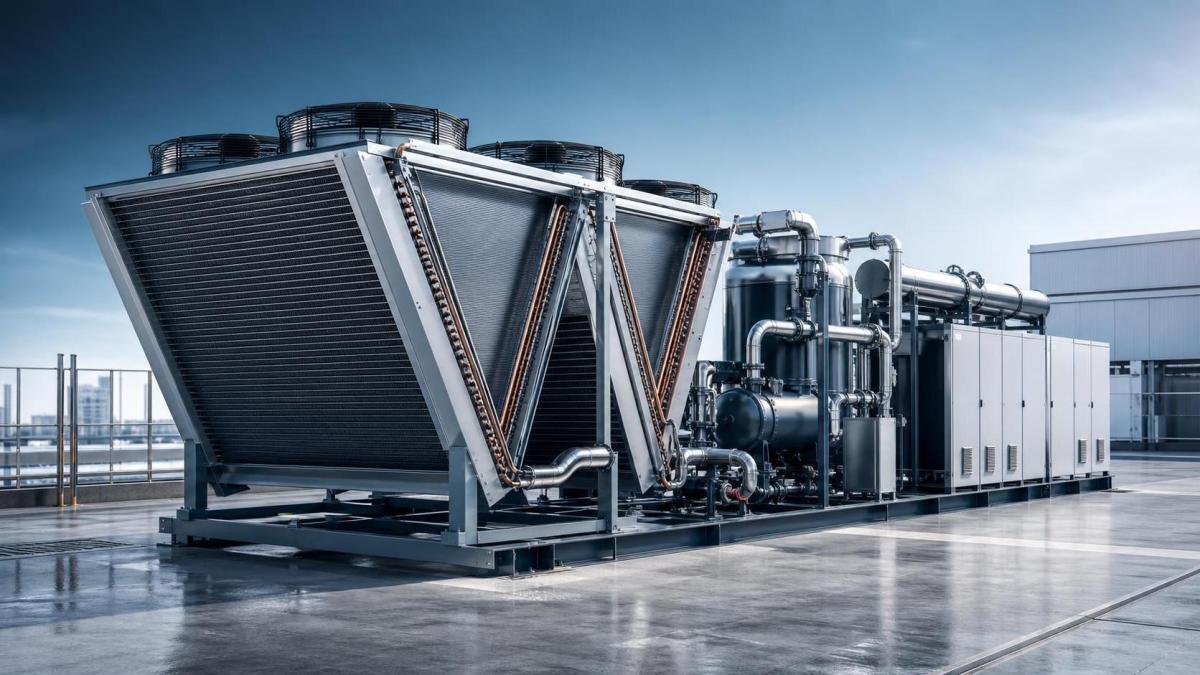
The reason the V-shaped layout keeps attracting attention is practical. Compared with flat or single-sided arrangements, it gives designers more coil surface within a relatively compact footprint, while also creating a workable path for axial fan airflow. That geometry can improve land-use efficiency and support large-capacity outdoor installations where roof or yard space is expensive. But the trend line for 2026 suggests that the market will reward not just compactness, but controllable efficiency under real operating conditions.
The shift from rated efficiency to operating efficiency
One of the biggest changes in buying behavior is the move away from comparing condensers only at a single design point. Operators have learned that a refrigeration system rarely lives at its nominal condition. Ambient temperature changes, product pull-down cycles vary, and part-load operation is common in commercial cold storage, food processing, and distribution environments. In that context, a V-Type Condenser that performs well only at peak summer conditions may still waste energy across the rest of the year.
This is why airflow management is becoming a central efficiency topic. Fan selection, blade design, motor control logic, coil face velocity, and the risk of air recirculation are all under closer scrutiny. A condenser with strong theoretical heat transfer can underperform if hot discharge air is drawn back into the coil inlet, or if fan staging is too coarse to match real load. In 2026, buyers are likely to ask more detailed questions about EC fan compatibility, variable-speed control, and how the unit maintains stable condensing temperatures without running all fans harder than necessary.
That is also where the V-shape has both an advantage and a design challenge. The form helps expand effective coil area, but it also makes airflow balance more sensitive to fan arrangement and installation surroundings. Units placed near walls, parapets, or congested mechanical yards can lose some of their theoretical advantage if the site layout is ignored.
Space efficiency is now part of energy efficiency
Another 2026 trend is that energy efficiency is being evaluated alongside site efficiency. This matters for cold chain expansion, retrofit projects, and urban facilities where every square meter of usable area has cost implications. A V-Type Condenser is attractive because it can provide substantial exchange area without requiring the long, open footprint of some conventional layouts.
Still, decision-makers should be careful with a common misunderstanding: compact does not automatically mean efficient. If tighter packaging leads to difficult cleaning access, poor service clearance, or uneven airflow across the coil banks, the operating result may move in the wrong direction over time. The better question is whether the condenser keeps its performance after installation realities are considered. Good design in 2026 will increasingly mean balancing footprint, serviceability, and fan energy rather than maximizing one at the expense of the others.
Material and coil design will matter more as standards tighten
Rising efficiency expectations are also pushing attention toward material choices and manufacturing precision. In condensers, that usually means closer review of tube expansion quality, fin-to-tube contact, coil cleanliness, corrosion resistance, and structural durability. These are not cosmetic details. Small inconsistencies in coil manufacturing can show up later as reduced heat transfer, unstable refrigerant behavior, or shortened service life in coastal, humid, or polluted environments.
For buyers comparing suppliers, this is where production capability becomes relevant. Companies with automated tube processing, controlled expansion methods, and high-precision testing are generally better positioned to deliver repeatable coil performance than workshops relying heavily on inconsistent manual processes. Shandong Boer Refrigeration Equipment, for example, manufactures across a broad refrigeration product line with automated and standardized production equipment, and that kind of manufacturing discipline tends to matter more as efficiency targets become less forgiving.
There is also a wider system lesson here. Condenser efficiency is not isolated from evaporator performance, refrigerant management, or defrost strategy. In cold rooms and commercial refrigeration projects, designers increasingly look at the whole thermal path rather than a single component in isolation. A unit such as Commercial Ceiling-Mounted Evaporator 403D, with options for different fin spacing, optimized refrigerant distribution, and airflow reach up to 30 m depending on condition, reflects the same market direction: efficiency is being engineered through better match between component design and actual working environment, not through headline capacity alone.
Smart controls are moving from optional to expected
By 2026, many buyers will treat control compatibility as part of condenser efficiency. The logic is straightforward. If a V-Type Condenser cannot communicate well with the broader refrigeration control system, then even a strong mechanical design may operate inefficiently. Fan cycling that is too aggressive can increase wear. Speed control that is too conservative can hold condensing pressure higher than needed. Poor sensor placement can distort ambient response.
This does not mean every project needs a complex digital platform. It means buyers should examine whether the condenser can support sensible staging, variable-speed fans, alarm feedback, and operating transparency. In medium and large installations, these control details often influence total energy consumption more than brochure comparisons suggest.
The market is paying more attention to lifecycle reliability
Another important trend is that efficiency claims are being tested against maintenance reality. A condenser that starts efficient but loses performance quickly because of fouling, vibration, poor casing rigidity, or difficult cleaning access is becoming harder to justify. This is especially true in food logistics, industrial refrigeration, and export-oriented facilities that cannot afford unstable temperature control or high service interruption risk.
That is why procurement teams are asking more about quality assurance, testing discipline, and certification history. Certifications such as CE, CB, LVD, EMC, UL, ISO9001, and energy-related compliance do not by themselves prove that one condenser is better than another, but they do help buyers screen for manufacturing maturity and market readiness. For global purchasers, supplier consistency and export experience can be just as important as the coil drawing.
What buyers should actually compare
If 2026 efficiency trends continue in the current direction, the most useful comparison points for a V-Type Condenser will be these:
- How the unit performs under part-load and varying ambient conditions, not only at one rating point.
- Whether airflow design reduces recirculation risk and supports stable fan energy use.
- How much service space and cleaning access the installation really needs.
- What manufacturing controls support consistent fin-to-tube contact and long-term coil integrity.
- Whether the condenser integrates cleanly with variable-speed and monitoring controls.
- How credible the supplier is in quality assurance, export compliance, and after-sales support.
In other words, the conversation is moving beyond “Is this condenser efficient?” to “Efficient under what conditions, for how long, and at what operating cost?” That is the more useful question. For enterprise decision-makers planning refrigeration investments in 2026, the V-Type Condenser remains a strong option, but only when its geometry, controls, materials, and maintenance logic are evaluated as one system decision rather than a standalone heat exchanger purchase.
CHAIDONG
Professional generator set manufacturer
24/7 before-sales and after-sales services
Comprehensive technical support