






What Affects the Operating Cost of a Quick-Freezing Cold Room Most?
Start with the number that actually matters: cost per kilogram frozen
When finance teams review a quick-freezing cold room, the quoted purchase price is usually the easiest number to compare and often the least useful on its own. Operating cost is what shapes the real payback. In practice, the biggest drivers are not mysterious: heat entering the room, how efficiently the refrigeration system removes that heat, how often the room is forced to recover from bad loading habits, and how much money gets lost when uptime becomes unstable.
A better way to review a proposal is to ask one simple question all the way through: how much electricity, maintenance, and product-handling loss will this room create for each kilogram of product frozen? That frame usually exposes the expensive mistakes quickly.
Check the envelope before you check the compressor
If the insulation package is weak, the rest of the system spends its life compensating for it. For a quick-freezing cold room, panel quality, panel thickness, joint sealing, vapor barrier integrity, and door leakage all affect operating cost every hour of every day.
- Look at the panel construction, not just the stated temperature range.
- Ask how corners, joints, floor connections, and door frames are sealed.
- Check whether frequent forklift or cart traffic will keep doors open longer than the design assumption.
- Review whether strip curtains, rapid doors, or air curtains are included where turnover is high.
A common purchasing mistake is to accept a lower panel specification because the compressor can be upsized. That usually reduces capital pain on paper and increases power cost for the next several years. For finance, this is one of the easiest places to reject false savings.
Do not approve capacity without matching it to the freezing duty
A quick-freezing cold room is not a standard storage room with a lower setpoint. Its operating cost depends heavily on the actual freezing load: product entry temperature, target core temperature, daily throughput, batch size, loading pattern, packaging form, and pull-down time requirement.
If a supplier sizes the system only by room volume, the quote is incomplete. What matters is the heat that must be removed from the product within the required time window. Undersizing leads to long run times and unstable temperatures. Oversizing can also be expensive, especially when it causes inefficient cycling at partial load.
Ask the vendor to show the design basis in plain terms: product type, inbound temperature, target freezing temperature, batch frequency, room loading schedule, and ambient condition. If those inputs are missing, the operating cost forecast is not reliable.
The compressor matters, but system matching matters more
Buyers often focus on compressor brand first. That matters, but it is only part of the cost picture. A good compressor in a poorly matched system still wastes electricity. What you want to see is proper pairing between compressor, evaporator, condenser, expansion control, and refrigerant circuit layout.
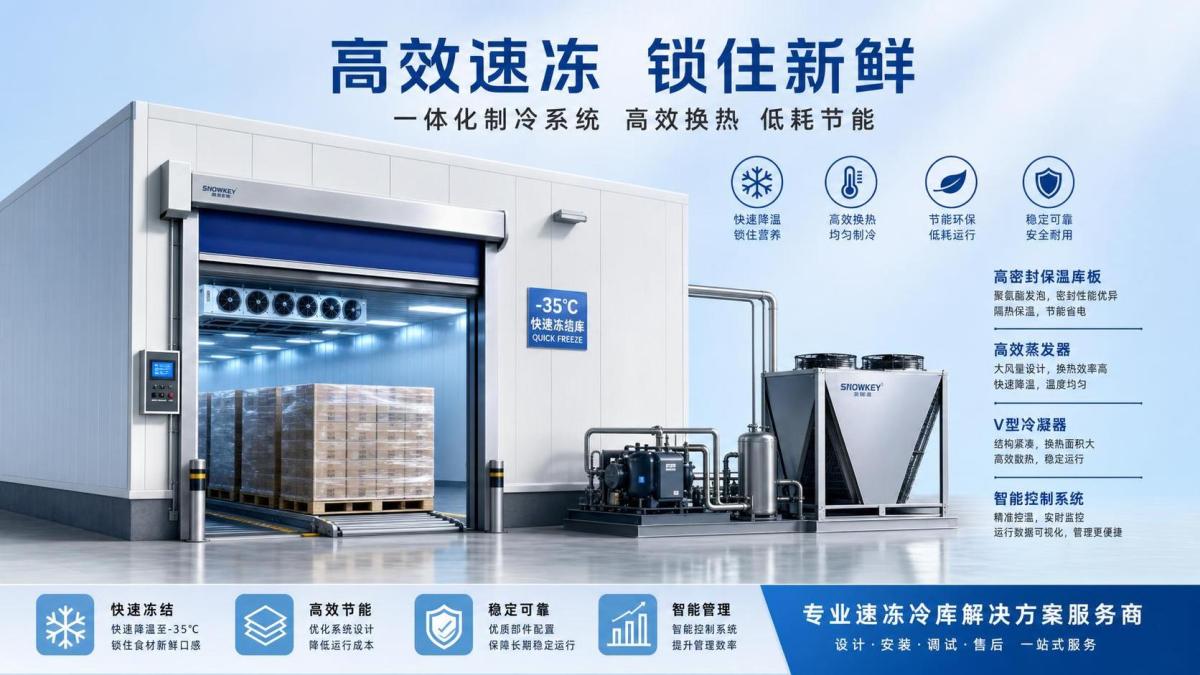
This is where condensing performance deserves more attention than it usually gets. When the condenser cannot reject heat efficiently, head pressure rises, compressor power rises with it, and the room becomes more expensive to run. In compact machine rooms, rooftop layouts, or sites with limited footprint, condenser selection can make a measurable difference to annual energy use. For example, a V-Type Condenser with a V-shaped airflow path, high-density finned tubes, and multi-circuit design may help improve heat exchange uniformity while controlling pressure drop, especially where space is tight. That is relevant to cost review because better heat rejection generally reduces the burden on the compressor side.
Look hard at ambient conditions and installation constraints
Two proposals can look similar on paper and perform very differently once installed. Ambient temperature, ventilation around the condenser, altitude, salt exposure, and contamination from nearby dust or chemicals all change operating behavior.
This is especially important for outdoor condensers. If the site is coastal or chemically aggressive, material choice affects more than service life. Corrosion reduces heat transfer and gradually pushes operating cost upward. If a unit is intended for rooftop or small outdoor installation, check whether the design addresses airflow recirculation and maintenance access. A cramped layout often turns a decent machine into an expensive one.
Defrost strategy is a hidden cost line
In a quick-freezing cold room, frost is not a side issue. Once the evaporator surface starts to ice up, heat transfer drops, fan performance changes, run time extends, and energy use climbs. Then operators compensate by lowering settings, which usually makes the problem worse.
Review how defrost is controlled, how often it is expected to run, and what triggers it. Too little defrost hurts efficiency. Too much defrost wastes power and interrupts temperature stability. Finance teams should ask for the expected operating logic under the actual loading pattern, not under ideal empty-room conditions.
Temperature stability affects product loss, not just utility bills
This is where cost analysis often gets too narrow. A quick-freezing cold room with poor temperature control may still freeze product, but it can do so unevenly, slowly, or with excessive dehydration. The financial consequence is not limited to electricity. It can show up as lower product yield, rejected batches, slower processing flow, and disputes between production and procurement over what the room was supposed to deliver.
So when comparing quotations, do not ask only for design temperature. Ask how the system maintains temperature under door openings, peak loading, and repeated product entry. That is where lifecycle cost starts to separate strong proposals from cheap ones.
Maintenance frequency should be priced into the approval, not treated as an afterthought
A room that needs frequent coil cleaning, repeated refrigerant adjustment, or hard-to-access fan service is more expensive than it first appears. This is true even if the spare parts are ordinary. Downtime, callout cost, and lost production time usually outweigh the line item for parts.
Compare bids with a short approval checklist
Before approving any quick-freezing cold room purchase, finance can cut through most of the noise with a short review list:
- Confirm the freezing duty basis, not just room size.
- Check insulation details, door strategy, and air leakage control.
- Review condenser and compressor matching under local ambient conditions.
- Ask how defrost and temperature control behave during real production cycles.
- Price maintenance access, cleaning frequency, and expected downtime risk.
- Compare total operating logic, not equipment names alone.
If you need to choose where to spend and where to hold the line, protect the envelope, system matching, and heat rejection efficiency first. Those three usually have the longest shadow over operating cost. After that, review control stability and serviceability. That order leads to better approvals and fewer surprises after commissioning.
CHAIDONG
Professional generator set manufacturer
24/7 before-sales and after-sales services
Comprehensive technical support