






What Airflow Conditions Make a V-Type Condenser More Efficient?
What Airflow Conditions Make a V-Type Condenser More Efficient?
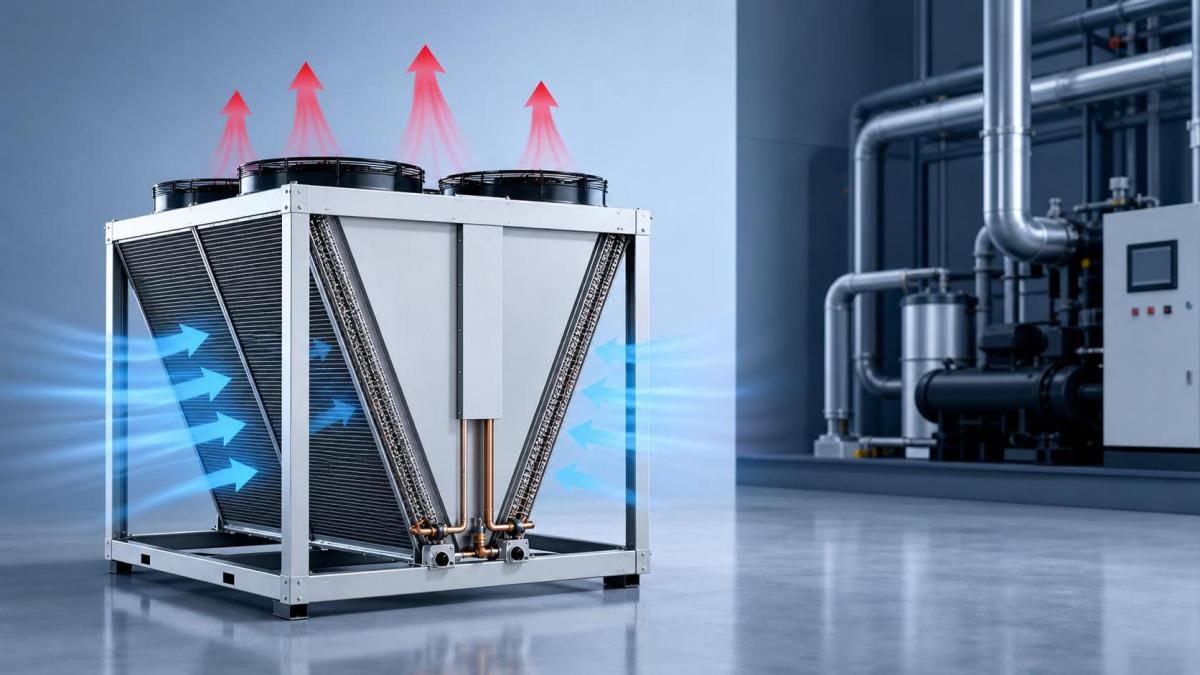
The efficiency of a V-Type Condenser is not decided by coil surface area alone. In real refrigeration projects, airflow quality often matters just as much as heat transfer area, fan quantity, or refrigerant circuit design. A V-frame can be highly effective because it pulls air through two inclined coil faces and uses the shared discharge zone above them. But that geometry only works well when the incoming air is stable, evenly distributed, and allowed to leave the unit without being drawn back in.
This is where technical evaluations often go wrong. A condenser may meet design expectations on paper, yet underperform in the field because the air around it is hot, turbulent, restricted, or already contaminated by its own discharge. When people ask whether a V-Type Condenser is “more efficient,” the more precise question is: under what airflow conditions does the V arrangement actually convert its structural advantage into lower condensing temperature and better system stability?
Uniform intake matters more than peak air volume
A common assumption is that higher fan power automatically means better condenser performance. It does not, especially with a V-Type Condenser. What matters first is whether both coil faces receive reasonably even air intake. If one side pulls clean ambient air while the other side faces a wall, hot equipment exhaust, or a congested service corridor, the effective coil utilization becomes uneven. Part of the heat exchange surface works near design condition, while another part operates with elevated entering air temperature or lower face velocity.
That imbalance raises condensing pressure faster than many operators expect. Even if the fans are still moving a large total air volume, the useful heat rejection per square meter of coil drops because air does not pass uniformly through the finned surface. In technical terms, a well-performing V-type unit prefers balanced face loading over isolated high-velocity zones.
For this reason, installation clearance is not a minor civil detail. The unit needs enough open space at the coil inlets to avoid dead zones and enough discharge space above the fan deck to prevent flow choking. In commercial refrigeration and cold storage sites, this becomes especially relevant where multiple outdoor units are placed side by side to save footprint.
The best air is cool, dry enough, and not already disturbed
A V-Type Condenser performs best when it draws in ambient air that is close to the actual outdoor condition, not air that has already been heated by nearby condensers, generators, walls, or sun-loaded surfaces. This sounds obvious, but recirculation remains one of the most persistent field problems. Because the discharge air leaves upward from the center of the V, poor site layout can create a loop in which warm air rolls back toward one or both coil faces. Once that happens, the condenser is no longer rejecting heat against true ambient temperature. It is effectively working against its own exhaust.
The penalty can be significant in hot weather, especially in compact plant yards or rooftop installations with parapet walls. The issue is not unique to V-type designs, but the shape makes airflow management more sensitive because the two coil banks share an aerodynamic relationship. If discharge air cannot rise and disperse cleanly, the intended advantage of the V geometry weakens.
Humidity is a secondary factor for dry condensers compared with ambient dry-bulb temperature, yet moisture still matters indirectly. In dusty or greasy environments, humid air can make fin surfaces accumulate deposits more aggressively. Once fouling builds up, static resistance increases and the fan must work harder to move the same air mass. Efficiency loss then comes not from the weather itself, but from the way the environment changes coil cleanliness over time.
Face velocity should be adequate, not excessive
There is also a practical upper limit to helpful airflow. Very low face velocity reduces heat rejection because not enough air crosses the fin pack. Excessively high localized velocity can also become inefficient if it increases fan energy consumption disproportionately, creates non-uniform pressure fields across the coil, or pushes more dirt into the fins. Technical evaluation should therefore consider the balance between airside pressure drop, fan selection, fin spacing, and expected site contamination.
This is why two condensers with similar nominal capacity may behave differently in service. The better unit is often the one whose fan and coil geometry are matched to realistic airflow resistance, not just ideal test conditions. Manufacturers with stable production control typically pay close attention to tube expansion quality, fin alignment, and casing tolerances because those details affect how consistently air is drawn through the coil bank. In refrigeration manufacturing, this is not cosmetic workmanship; it directly influences thermal performance repeatability.
Clean fins and clear pathways are part of the airflow condition
People often treat airflow as an environmental variable only, but for condensers it also includes the condition of the coil itself. Bent fins, blocked inlets, drifting plastic film, packaging residue, cottonwood, dust, and oil-laden debris all reduce the effective air passage area. In a V-Type Condenser, this can affect one coil face more than the other, which brings back the same imbalance problem discussed earlier.
A useful field check is simple: if fan motors are operating normally but head pressure trends upward in warm periods, the evaluator should not look only at refrigerant charge or control settings. Airside inspection is equally important. Uneven dirt loading, poor wash access, or shields installed too close to the coil can undermine a technically sound condenser selection.
This matters in containerized and modular cold chain deployments as well. In applications such as temporary warehousing, remote site operations, or food transit logistics, compact systems are often chosen because they can be deployed quickly. A solution like Containerized Cold Storage can integrate refrigeration equipment, insulated structure, and controls in a transportable format, but the condenser side still depends on proper external airflow. Plug-and-play does not remove the need for intake clearance, discharge space, and maintenance access.
What technical evaluators should actually check
When assessing whether airflow conditions are suitable for a V-Type Condenser, these points are usually more meaningful than broad claims about “high efficiency”:
- Whether both coil faces have similar exposure to ambient intake air
- Whether nearby walls, roofs, or adjacent units create recirculation risk
- Whether discharge air has a clear upward escape path
- Whether fin spacing matches the site’s expected dust and fouling level
- Whether service access allows regular coil cleaning without partial neglect
- Whether fan selection is matched to real airside resistance rather than nominal airflow alone
These checks are often more useful than comparing catalog dimensions in isolation. In practice, the strongest V-type installations are the ones where airflow has been treated as a system condition, not just a fan specification.
A final judgment standard
A V-Type Condenser is more efficient when it can inhale cool, unobstructed air evenly across both coil faces, maintain enough face velocity without excessive resistance, and discharge hot air without recirculation. If any one of those conditions is compromised, the V arrangement may still function, but it will not deliver the full advantage implied by its design.
For technical evaluation, that is the right lens to use. Do not ask only whether the condenser is large enough. Ask whether the surrounding airflow lets the coil operate as intended. In commercial refrigeration and cold storage systems, that distinction often separates acceptable performance from consistently efficient operation.
CHAIDONG
Professional generator set manufacturer
24/7 before-sales and after-sales services
Comprehensive technical support