






What Spare Parts Should Be Prioritized for an H-Type Condenser 402CD?
Start with the parts that stop the unit, not the parts that merely reduce efficiency
For dealers, distributors, and service-oriented agents, the real question behind H-Type Condenser 402CD spare parts is simple: which items create immediate downtime when they fail, and which ones can wait for the next shipment. That distinction matters more than building a long parts list. If a customer’s cold room is losing temperature, nobody cares that your warehouse has cosmetic panels or extra brackets. They care that the fan starts, the coil can reject heat, and the control side can safely bring the condenser back online.
A practical stocking plan usually works in three layers: shutdown parts, high-wear parts, and low-cost accessories that save a technician from making a second trip. If you organize your purchasing that way, you reduce both service delays and dead inventory.
Priority one: fan motors and fan blades
If you only have budget for a few critical items, start here. On an air-cooled condenser, a failed fan motor quickly turns into head pressure problems, nuisance trips, and product temperature complaints downstream. In hot weather, the time window gets even shorter.
Do not stock motors by rough appearance alone. Match voltage, frequency, mounting pattern, rotation direction if specified, shaft size, and power rating from the unit nameplate or original part data. A close-looking motor that draws the wrong current or runs at the wrong speed creates more problems than it solves.
- Keep at least one fan motor per active service region if the model turnover is steady.
- Store matching fan blades with the motor, especially if the blade hub is not a universal fit.
- Check whether your market sees more motor burnout or blade damage from transport and installation handling. The answer changes your stocking ratio.
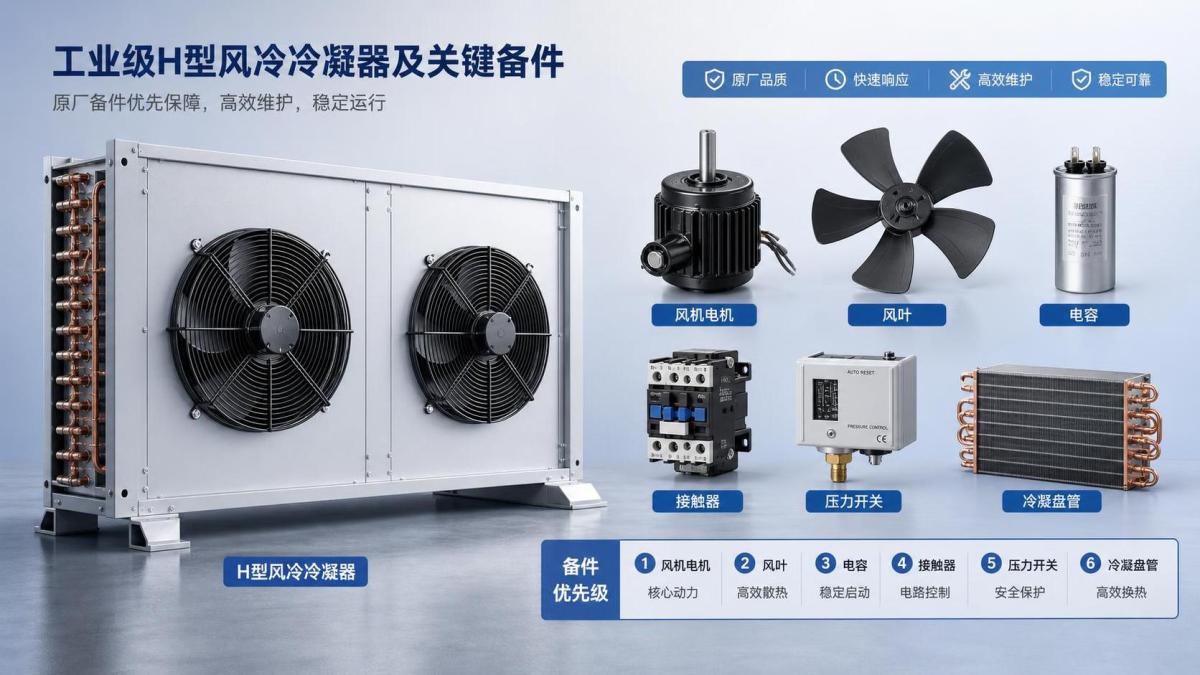
Next in line: contactors, overloads, capacitors, and relays
Electrical parts are small, cheap to store, and often responsible for the fastest field repairs. That makes them excellent inventory candidates. For the H-Type Condenser 402CD, these are not glamorous parts, but they are usually the difference between same-day service and a return visit.
Capacitors deserve special attention if the condenser fan motor uses them. They fail often enough, they are inexpensive, and technicians usually want exact capacitance and voltage rating on hand. Contactors and overload protectors also move quickly in service stock because they are exposed to switching wear, heat, and unstable site power.
One common purchasing mistake is buying “universal” electrical stock without checking enclosure fit, terminal arrangement, or coil voltage. The part may be electrically suitable but still waste time on site because the wiring layout or panel space does not match.
Coils are expensive, but delay hurts more when lead times are long
You do not usually stock condenser coils as heavily as motors or capacitors, but you should make a deliberate decision about them. Coil damage from corrosion, impact, or poor cleaning practices is less frequent than electrical failure, yet when it happens the replacement cycle is longer and the freight cost is higher.
For fast-moving models, it can make sense to hold at least limited coil stock or secure a short replenishment agreement with the manufacturer. This is especially relevant if your customers serve coastal areas, food processing zones, or locations with dirty air, where fin blockage and tube damage show up more often. If you cannot justify physical stock, keep complete coil drawings, dimensions, tube layout records, and connection details ready for immediate reorder.
Do not overlook pressure controls and sensors
A condenser can be mechanically fine and still remain down because of a failed pressure switch, temperature sensor, or protection device. These parts are easy to ignore during purchasing because they are not visually prominent. In field service, they are often the hidden cause behind intermittent shutdowns.
When reviewing stock, separate “control compatibility” from “physical compatibility.” The thread or connector may fit, but the cut-in/cut-out range or signal type may not. For procurement teams, that means every sensor or switch should be linked to the unit’s actual control logic, not just to the condenser family name.
Small hardware often saves the service call
Mounting feet, anti-vibration pads, fasteners, terminal blocks, connectors, protective grilles, and junction box accessories rarely make anyone’s “top spare parts” list. They should. These are exactly the items that turn a one-hour repair into a two-day delay because the core part is available but cannot be fitted safely or cleanly.
This is where experienced distributors usually outperform price-only traders. They build service kits around the common failure parts. A replacement fan motor without matching capacitor, bolts, connectors, and grille hardware is not really a ready-to-install solution.
Build your stock list from failure impact and replenishment speed
A useful way to decide what to buy is to score each part against two questions: how quickly does failure stop the refrigeration system, and how hard is the part to replace from your current supply chain? That gives you a far better purchasing sequence than simply ordering the most expensive items first.
Check neighboring equipment before locking the spare parts budget
This is where many agents lose margin. They buy parts only for the condenser and forget the condensing unit around it. If your customer base uses compact commercial cold storage packages, the condenser spare strategy should align with the full unit configuration, including compressor protection and fan control. For example, a Spiral Condenser Unit 3p used in small-to-medium cold storage facilities combines condenser, fan, electrical control, and protection modules in one system. In that setup, stocking decisions around fan-side electrical parts become even more important because one failed control component can stop the whole package, not just reduce heat rejection.
If the site uses refrigerants such as R404A or R507A and operates in the -10 to +5°C range on the storage side, service expectations are usually tied to temperature stability, not just equipment uptime. That shifts value toward fast replacement parts and ready-to-fit kits.
What experienced buyers usually document before placing a reorder
- Unit model and nameplate details for the H-Type Condenser 402CD
- Motor voltage and current data
- Blade dimensions and hub type
- Electrical schematic or control box component list
- Coil dimensions and connection sizes
- Whether the failure occurred in transport, commissioning, or normal operation
That last point matters. Transport-related damage pushes you toward blades, guards, panels, and brackets. In-service failures push you more toward motors, capacitors, contactors, and controls. If you do not separate those causes, your stock profile gets distorted very quickly.
A workable buying order
For most distributors, the safest order is this: fan motors and matching blades first, electrical consumables next, pressure controls after that, then selected coil stock if your sales volume and lead times justify it. Add small installation hardware alongside every fast-moving repair item. That is usually the most cost-aware way to support the H-Type Condenser 402CD without tying up too much cash in slow inventory.
If you need one rule to use across purchasing decisions, use this one: prioritize the spare part that turns a site outage into a same-day fix, provided you can match it accurately to the original specification. That is the stock that protects both your service reputation and your inventory budget.
CHAIDONG
Professional generator set manufacturer
24/7 before-sales and after-sales services
Comprehensive technical support