






What cold room temperature is needed for frozen meat storage?
Selecting the right Cold Room Temperature for frozen meat is not simply a matter of choosing the lowest possible setting. For most commercial frozen meat storage, the practical benchmark is -18°C or below. This temperature is widely used because it keeps meat in a fully frozen state and slows the physical and biochemical changes that gradually affect texture, color, flavor, and shelf life.
That said, a freezer setpoint is only one part of the answer. The actual temperature experienced by meat cartons, pallets, and individual products can differ from the number displayed on a controller. Door openings, warm incoming goods, poor air circulation, evaporator defrost cycles, and overloaded storage racks can all create warmer pockets inside the room. In real operation, stable temperature control matters more than chasing an unnecessarily low setpoint.
The usual frozen meat storage temperature
For long-term storage of frozen beef, pork, poultry, lamb, and many processed meat products, a cold room operating at -18°C or lower is generally the expected baseline. Many facilities use a setpoint slightly below this level, such as -20°C or -22°C, to provide a buffer against normal temperature fluctuations during loading, unloading, and defrosting.
The reason for the buffer is straightforward. If a room is set exactly at -18°C, its air temperature may temporarily rise when staff enter repeatedly, when a truck is unloaded, or when a large quantity of newly frozen product is brought in. A slightly lower operating target helps keep the product core temperature within the intended frozen range.
For products requiring deeper frozen storage, especially where storage periods are extended or product quality specifications are stricter, a range from -25°C to -18°C is often considered. Deep cold storage at approximately -35°C to -25°C may be used for particular logistics, processing, or rapid-freezing-related requirements, but it should not be selected automatically. Lower temperatures increase refrigeration load and energy consumption, so the choice should match the product plan rather than a general assumption that colder is always better.
Air temperature is not the same as meat temperature
One common mistake is relying only on the cold room display. The controller usually measures air temperature at one location, while meat stored near doors, under ceiling airflow, or in tightly packed pallet rows may respond differently. Large cartons of meat also cool and warm slowly. If products arrive warmer than the room target, the room air may recover quickly while the center of the pallet remains above the desired temperature for much longer.
This is why frozen meat should enter storage already frozen whenever possible. A storage room is designed to maintain product temperature, not necessarily to remove the heat from a large volume of unfrozen or partially frozen meat. Using a holding freezer as a blast freezer can overload the refrigeration system, increase frost accumulation on the evaporator, and cause temperature swings across existing stock.
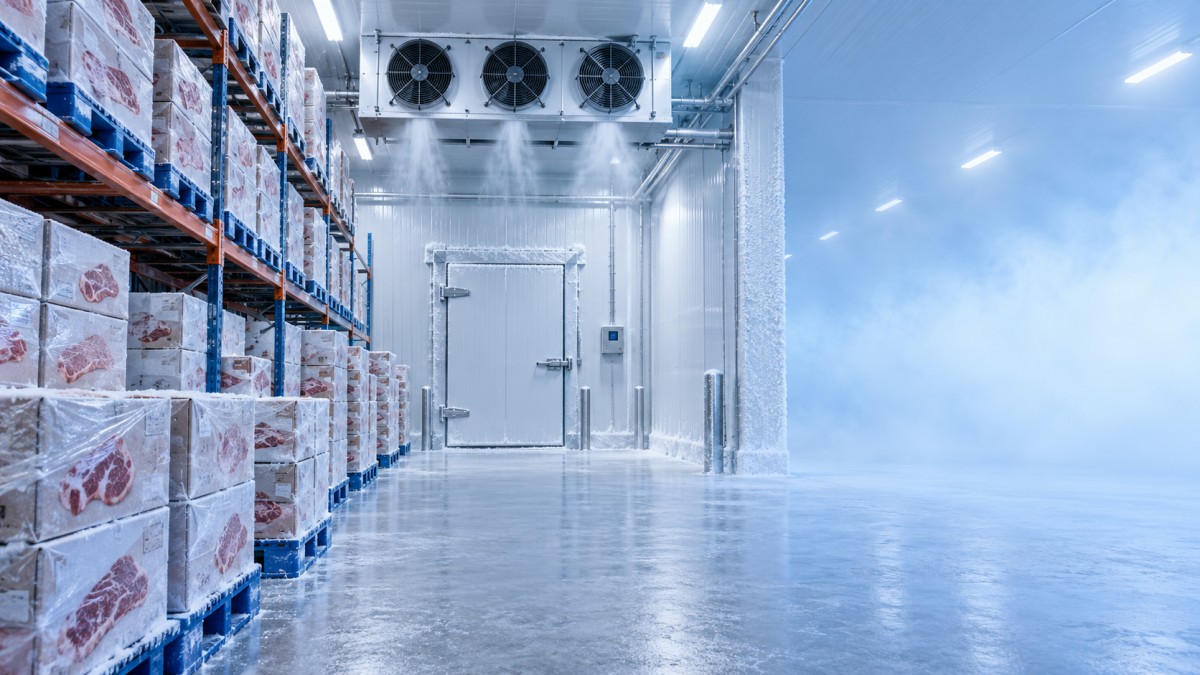
For warehouse operators, it is sensible to monitor more than one point. Room sensors, return-air conditions, product probes for selected loads, and temperature records near high-traffic doors can reveal issues that a single wall-mounted controller will miss. The goal is not to create unnecessary paperwork; it is to find out whether stored meat is consistently protected during the busiest parts of the day.
How meat type, packaging, and storage duration affect the decision
Different meats all need to remain frozen, but their storage requirements are not identical. Poultry portions in retail packaging, vacuum-packed beef cuts, bulk pork cartons, and processed products may have different turnover rates, packaging barriers, and quality expectations. A facility serving rapid distribution can often focus on steady operation around the standard frozen range. A warehouse holding strategic inventory for much longer needs tighter attention to temperature stability, packaging integrity, and stock rotation.
Packaging matters because exposed meat loses moisture more easily. Freezer burn is often linked not only to storage time but also to inadequate wrapping, damaged cartons, open pallet covers, or excessive airflow around product. Dropping the room temperature may help in some circumstances, but it will not correct poor packaging or repeated thaw-and-refreeze exposure.
Product stacking deserves the same level of attention. Pallets should not block evaporator discharge or return airflow. Very dense loading can create warm zones in the center of the room, while cartons placed directly in strong discharge air may experience dehydration. Good frozen storage is a balance: enough airflow to maintain uniform conditions, without treating every pallet like it is sitting inside a wind tunnel.
Temperature stability during loading and dispatch
In many meat warehouses, the weakest point is not the refrigeration unit; it is the loading door. A freezer may run steadily overnight, then lose control during several hours of frequent forklift movement and truck loading. Warm, humid outside air enters the room, frost builds on coils, and the refrigeration system has to work harder just as product movement is at its peak.
Practical measures include using strip curtains or insulated doors, organizing orders before doors are opened, minimizing waiting time at the dock, and separating receiving from long-term storage where the project layout permits. Defrost scheduling should also be reviewed carefully. Defrost is necessary, but poorly timed defrost cycles can coincide with busy receiving periods and make temperature recovery more difficult.
For facilities that handle both chilled and frozen goods, multi-temperature zoning is often more useful than trying to make one room serve every function. Refrigerated products may require conditions above freezing, while frozen meat needs a reliably sub-zero environment. Separating these workflows reduces door traffic, reduces cross-interference, and makes operating discipline easier.
Choosing a cold room system for frozen meat
A cold room designed for frozen meat should be sized around more than storage volume. Designers need to consider the daily amount of product entering the room, product entry temperature, pallet configuration, loading frequency, ambient conditions, door size, insulation thickness, and the desired pull-down or recovery time. A system that looks adequate on paper can struggle if the actual warehouse operation has more door openings or warmer incoming loads than originally assumed.
This is where integrated equipment selection becomes important. The condensing unit, evaporator, insulated panels, cold storage doors, controls, and drainage details need to work together. Shandong Boer Refrigeration Equipment Co., Ltd. manufactures components and systems including air coolers, condensers, condensing units, prefabricated cold rooms, polyurethane sandwich panels, and cold storage doors. For a frozen meat project, this type of coordinated approach can simplify matching the enclosure and refrigeration equipment to the intended temperature zone.
For larger distribution operations, Cold Chain Logistics Cold Storage and Functional Cold Storage can be configured with separate refrigerated, frozen, and deep-cold areas. Its stated frozen storage range of -25°C to -18°C aligns with the needs of many frozen meat logistics applications, while modular construction can be useful where future expansion is likely. The right layout still depends on product turnover and handling flow, not on room size alone.
A sensible operating target
If the question is simply, “What temperature should a frozen meat cold room be?” the answer is -18°C or colder. In practice, many operators choose a lower setpoint to protect against normal fluctuations. But the better question is whether the meat itself stays fully frozen, consistently, from receiving through storage and dispatch.
Before finalizing a Cold Room Temperature, confirm the required storage duration, incoming product condition, local food-control requirements, packaging format, expected door activity, and monitoring method. A stable -20°C room with disciplined loading practices is generally more dependable than a nominally colder room that is overloaded, poorly sealed, or constantly exposed to warm air.
CHAIDONG
Professional generator set manufacturer
24/7 before-sales and after-sales services
Comprehensive technical support