






What to test before accepting a cold room manufacturer's installation
A cold room reaching its setpoint does not prove it is ready for handover. Before accepting a cold room manufacturer's installation, require evidence that temperatures remain within the agreed limits, the system recovers from normal operating disturbances, and safety functions work. A controller displaying the right number cannot reveal warm storage zones, leaking doors, blocked drains, or an alarm that never reaches its intended recipient.
Acceptance should combine witnessed tests with recorded results. Agree on the conditions and pass criteria before testing begins, so defects can be separated from changes in operating requirements.
Establish what the installation must demonstrate
Use the approved design, equipment schedule, and contract specification as the acceptance baseline. Record the storage temperature range, product entering temperature, loading pattern, expected door activity, and design ambient conditions. Identify whether the room is intended to hold already chilled or frozen goods or also remove heat from incoming products.
These duties differ. A freezer designed to store frozen cartons may struggle with warm deliveries even when its equipment works correctly. Likewise, an empty room cooling quickly says little about its ability to handle daily stock turnover.
For a configurable system such as Shandong Boer Refrigeration's Conventional Prefabricated Cold Storage Facility, acceptance should follow the selected room dimensions, panel thickness, temperature duty, and electrical configuration. A product family's available configurations do not establish what one installed room can achieve.
Prepare a test sheet showing each requirement, test method, acceptance limit, responsible party, and required evidence. Use applicable local requirements and the contractually adopted standards; certification documents alone cannot demonstrate correct installation.
Inspect the enclosure before judging refrigeration performance
Check panel joints, corners, ceiling connections, floor interfaces, and service penetrations for damage, gaps, and incomplete sealing. The enclosure must limit both heat gain and moisture entry. Moisture entering through a poorly sealed joint can cause persistent ice, condensation, and insulation deterioration.
- Doors: Check alignment, hinges, closers, latches, and continuous gasket contact. Test the internal release with the door closed under controlled conditions, keeping another person outside.
- Thresholds and floors: Inspect seals, floor condition, and suitability for the specified trolley or forklift traffic. Check floor heating and frost protection where included in the design.
- Pressure equalization: Where fitted, verify that the vent operates and its heater works. Excessive door resistance after closing can indicate a pressure equalization problem.
- Air passages: Confirm that evaporator clearances and intended storage boundaries match the layout. Shelving or cartons must not obstruct supply or return airflow.
Repeat the inspection after the room has cooled. Some defects become visible only when temperature differences produce sweating or frost. Persistent condensation needs investigation rather than acceptance as a normal feature of refrigeration.
Measure temperature across the usable storage space
Use independent instruments with current calibration records to check the controller reading and map the room. Place sensors at representative heights and locations, including potential warm areas near doors, corners, and positions far from the evaporator. Keep sensors away from direct discharge air unless that position is specifically being investigated.
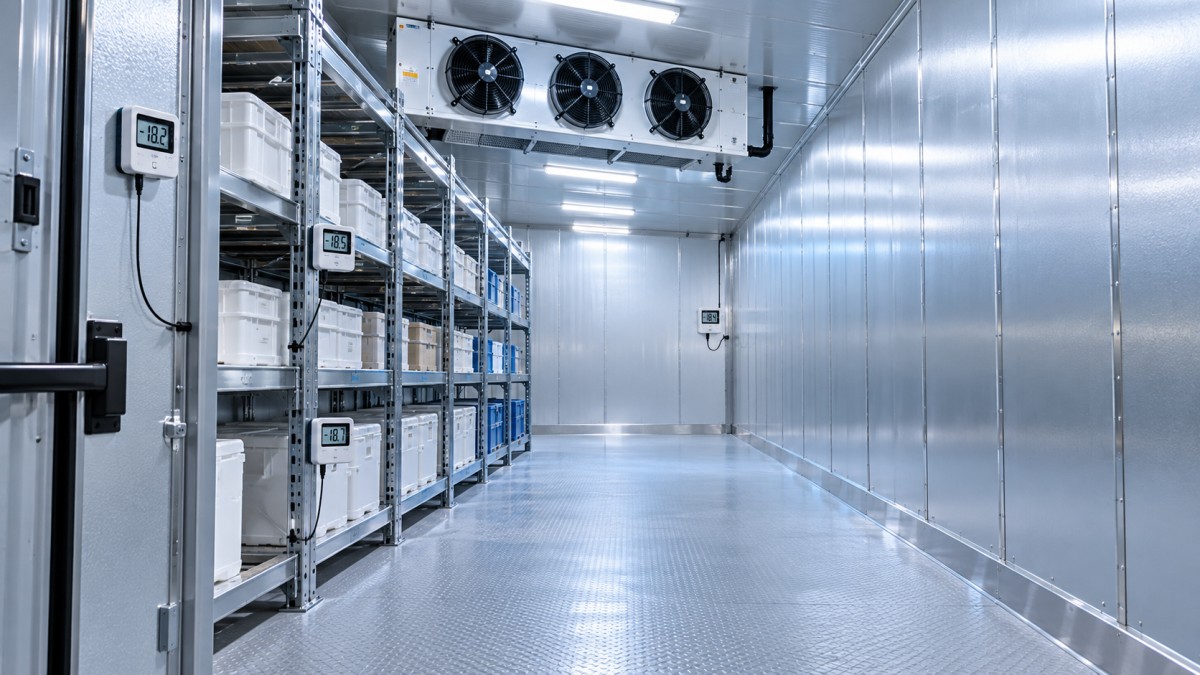
Record sensor locations on a room drawing, together with the loading arrangement and instrument identification. The number of sensors should reflect the room's size, geometry, and compartment layout; one logger beside the control probe cannot establish temperature uniformity.
Allow conditions to stabilize, then record enough operating cycles to capture compressor cycling and relevant defrost events. Evaluate the warmest and coldest usable storage locations against the agreed limits. An acceptable average can hide a warm corner or a location cold enough to damage fresh produce.
Distinguish air temperature from product temperature. Air responds quickly to door openings and defrost, while stored goods change temperature more slowly. Where product protection is part of acceptance, use agreed representative product measurements or suitable simulants alongside air measurements. An empty-room map is useful, but loaded verification may still be necessary because stock changes airflow.
Test pull-down and recovery under defined conditions
Pull-down time has meaning only when the starting conditions are recorded. Note the initial room temperature, outdoor or condenser inlet conditions, load quantity, product entering temperature where relevant, and door position. Define whether completion means reaching the controller setpoint or bringing all specified measurement locations within range.
Follow this with a recovery test representing agreed operation. A distribution room may need a defined door-opening sequence; a storage room receiving prechilled goods may need a representative loading event. Use suitable test loads where exposing saleable stock would create unnecessary risk.
Record both the maximum temperature excursion and the recovery time. If performance falls short, investigate airflow, refrigerant system operation, condenser ventilation, door leakage, and control settings before concluding that additional capacity is required. If testing occurs in mild weather, record that limitation and define any outstanding verification against the design ambient conditions.
Witness a complete defrost cycle and drainage test
Initiate defrost through the approved control procedure and observe the full sequence: initiation, heating or other defrost action, termination, drainage period, and fan restart. Check that the sequence matches the design and does not return warm, moisture-laden air to the room prematurely.
Confirm that water leaves the drain pan freely and reaches the intended discharge point without leakage or pooling. Inspect pipe slope, supports, insulation, and drain heating where specified. Drain traps and discharge arrangements must suit the room temperature and drainage design; a water-filled trap in a freezing location can become a blockage.
A manually initiated cycle on a clean coil proves the sequence operates, but it does not establish that the schedule will control frost during normal use. Review subsequent operation for remaining ice, excessive frost accumulation, and unacceptable temperature excursions.
Prove alarms, electrical protections, and refrigeration integrity
Have qualified personnel test electrical and refrigerant safety functions using approved procedures. Review the electrical test records and confirm that the installed supply matches equipment requirements. Verify protective earthing, isolation, phase sequence where relevant, and protection settings against the approved design.
Refrigeration commissioning records should identify the refrigerant and document pressure testing, evacuation, charging, and leak checks as applicable. Operating pressures, temperatures, and compressor current should be assessed against equipment guidance under the recorded test conditions. A running compressor alone is insufficient evidence of correct commissioning.
Never prove a protective device by deliberately creating a dangerous pressure or electrical fault. Where remote monitoring is supplied, test the complete notification path. A warning on the local display does not prove that an off-site recipient receives it.
Make the handover record support the acceptance decision
Require the cold room manufacturer and installer to provide temperature logs, sensor locations, test conditions, commissioning results, alarm settings, and the final defect list. Include as-built drawings, wiring diagrams, equipment identification, operating instructions, maintenance requirements, and warranty terms. Record the agreed warranty start date and service contact arrangements.
Demonstrate routine operation to the people who will use the room: safe entry and release, loading clearances, alarm response, cleaning, and permitted control adjustments. Record outstanding defects with responsible parties, correction dates, and retest requirements.
Unresolved safety defects or failure to meet agreed storage temperatures should prevent operational acceptance. Minor outstanding work can be documented through the contractual handover process. Sign-off should identify what passed, under which conditions, and what remains outstanding, giving everyone a usable baseline when the room enters service.
CHAIDONG
Professional generator set manufacturer
24/7 before-sales and after-sales services
Comprehensive technical support