






When is a cold room temperature alarm setpoint too wide?
When Is a Cold Room Temperature Alarm Setpoint Too Wide?
A Cold Room Temperature alarm setpoint is too wide when it allows stored products to move outside their acceptable temperature condition for long enough that quality, safety, traceability, or operational control is compromised before anyone is notified. The problem is not simply whether an alarm eventually sounds. It is whether the warning arrives early enough for staff to investigate, protect stock, and correct the cause.
For quality control and safety managers, a broad alarm band can create a false sense of security. The refrigeration system may appear stable on a controller display while warm zones near doors, ceilings, evaporator discharge paths, or densely packed pallets experience conditions that are materially different from the sensor location. Conversely, alarm limits that are too narrow can generate repeated nuisance alarms during defrost, loading activity, or normal compressor cycling. Good alarm design sits between these two failures.
There Is No Universal “Correct” Alarm Range
The room control setpoint and the alarm threshold should not be treated as the same number. A room may be controlled at a nominal temperature, but the high alarm must reflect the maximum allowable condition for the product, the expected temperature variation within the room, sensor accuracy, and the time needed for personnel to act. The low alarm also needs its own logic, particularly where freezing damage, package stress, or unintended product hardening is a concern.
A setpoint becomes questionable when it is chosen only because it “stops alarms.” For example, widening a high-temperature alarm after frequent door-opening events may hide a genuine capacity problem, poor air distribution, damaged door seals, excessive infiltration, or an evaporator affected by frost. Silencing the symptom is not temperature control.
The acceptable range must be based on the stored commodity and the site’s own quality plan. Chilled fresh food, pharmaceutical materials, flowers, dairy products, and frozen goods do not tolerate the same excursion pattern. Product specifications, customer agreements, internal HACCP-based procedures where applicable, and local regulatory requirements should be reviewed before alarm limits are finalized.
Signs That the Alarm Band Is Too Wide
Several operating patterns deserve attention. A room that records repeated temperature rises close to the alarm threshold without triggering an investigation may already be operating with too little safety margin. So may a room where a high alarm only occurs after product temperature has had time to change significantly. Ambient air reacts faster than product cores, but a slow air-temperature trend can still be an early warning of refrigeration failure.
- The high alarm sits close to the maximum product temperature permitted by the quality specification, leaving no response margin.
- Alarm limits were inherited from an old controller setting rather than verified against the current room load and product mix.
- The system experiences warm excursions during defrost or loading, but no one has confirmed whether those excursions are normal at all sensor locations.
- One room sensor is used to represent a large or irregular space with multiple doors, racking layouts, or airflow obstructions.
- Alarm delays are long enough that a cooling failure can continue unnoticed well beyond a practical intervention window.
A wide threshold and a long delay are especially risky together. The first determines how far temperature can drift; the second determines how long the drift can continue. These settings should be assessed as a pair, not approved separately.
Start with Temperature Mapping, Not Controller Defaults
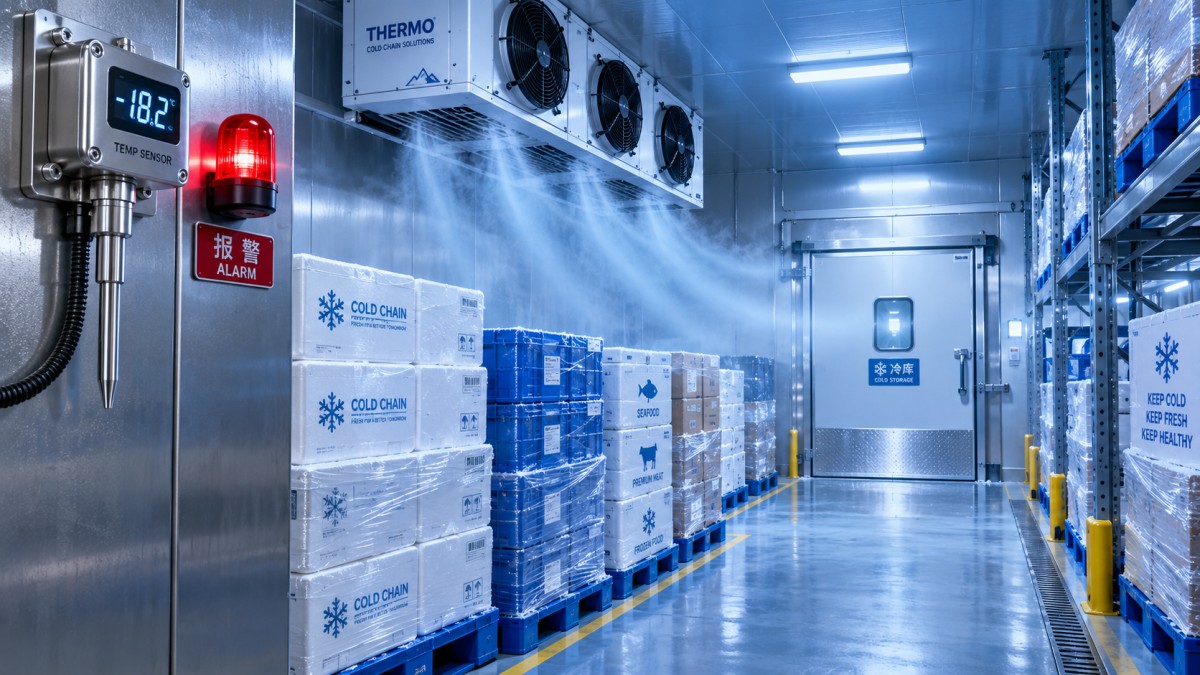
Before selecting alarm limits, establish how the room actually behaves. Temperature mapping during representative operation can reveal stratification, door-related warm zones, short-circuit airflow, and areas that recover slowly after loading. A sensor mounted in the return-air path may show a stable Cold Room Temperature while pallets at the far end of the room receive less effective circulation.
Mapping should reflect the real operating condition: product load, racking, normal door use, defrost events, and the expected season where outdoor conditions influence the system. The point is not to chase perfect uniformity. It is to understand the difference between normal variation and variation that threatens the product or signals an equipment issue.
Once the warmest and coldest credible zones are understood, alarm thresholds can be set with a defined margin. This is also the time to review probe placement, calibration arrangements, data logging intervals, power-loss notification, and escalation routing. A technically sensible setpoint is ineffective if an alert reaches an unmonitored phone or email account.
Airflow Changes the Alarm Decision
In rapid-freezing and quick-freezing operations, airflow is not a secondary detail. Inadequate circulation can create a misleading contrast between the sensor reading and the condition of materials deeper in the load. Excessive frost on the coil, blocked fan discharge, an unsuitable evaporator arrangement, or product stacked too close to the air path can all reduce heat transfer and widen room variation.
For low-height rapid freezing chambers, equipment selection should therefore be considered alongside monitoring design. The The Floor-Standing Counterflow Rapid Cooling/Frozen Air Cooler is designed for this type of chamber and uses positive-pressure air delivery to distribute air cooled through finned tubes toward frozen materials. Its two ø630 fans and high-airflow configuration are intended to meet circulation needs in quick-freezing warehouses. The straight-line tube arrangement is also designed to reduce frost thickness and extend defrosting intervals, which can help make temperature behavior easier to manage. However, installation geometry, loading pattern, and defrost strategy still need project-specific review.
This is why alarm decisions should not be made solely by the controls team. Quality personnel understand product limits; refrigeration engineers assess capacity, coil performance, airflow, and defrost; operations staff understand door traffic and loading peaks. Bringing these views together produces alarm settings that people can defend during an audit or incident review.
Avoid Nuisance Alarms Without Creating Blind Spots
Nuisance alarms are a real operational problem. If staff receive too many alerts that resolve on their own, response discipline weakens. The answer is usually better alarm logic, not a much wider temperature range. Defrost suppression can be used where it is properly configured and limited to the verified defrost period. Door-open alarms may be more useful than a broad high-temperature alarm for identifying operational causes. A staged alert can also help: an early warning prompts a check, while a higher threshold or longer confirmed excursion triggers escalation.
Alarm delay should account for brief, expected disturbances but should not mask a compressor trip, fan failure, refrigerant issue, or prolonged door opening. Review historical trends before changing it. If alarms occur at the same time every day, the root cause may be a loading routine or defrost schedule. If the rise is irregular and recovery is slow, the system needs closer technical investigation.
A Practical Review Before Approving Setpoints
When reviewing an alarm configuration, ask four direct questions: What is the product’s acceptable temperature condition? Where is the warmest credible point in the room? How long can that point remain outside target conditions before stock disposition becomes uncertain? And how quickly can the site realistically respond at all operating hours?
The answers should be documented with the selected setpoint, delay, probe location, and response procedure. Revisit them after a major change in product type, racking, storage density, door use, refrigeration capacity, or control system. Alarm settings are not permanent commissioning values; they are part of an active quality-control system.
Shandong Boer Refrigeration Equipment Co., Ltd., established in 2014, supports cold storage projects with air coolers, condensing units, prefabricated rooms, insulated panels, and cold room doors. Its manufacturing base in Shandong uses standardized production and testing processes, while its product portfolio is used in more than 30 countries and regions. For projects where temperature alarms are difficult to rationalize, the most useful next step is often a combined review of room layout, evaporator selection, airflow path, operating load, and monitoring points—not merely another adjustment to the controller.
CHAIDONG
Professional generator set manufacturer
24/7 before-sales and after-sales services
Comprehensive technical support