






When is a dual-discharge cold room air cooler the right choice?
When is a dual-discharge cold room air cooler the right choice?
Choosing a dual-discharge cold room air cooler requires more than matching cooling capacity to room volume. A Bilateral Cold Air Fan is worth considering when ceiling height, aisle layout, and product placement favor two-way air distribution, particularly in processing rooms where occupied-zone air velocity matters. Its suitability depends on airflow coverage, discharge velocity, evaporating temperature, humidity requirements, and defrost strategy—not simply the number of outlets.
The practical question is whether two opposing discharge paths fit the room better than one longer air stream. If they do, this configuration can be a sensible choice. If racks, partitions, or equipment obstruct those paths, an otherwise adequate evaporator may leave warm pockets and uncomfortable working positions.
Start with the room layout, not the capacity table
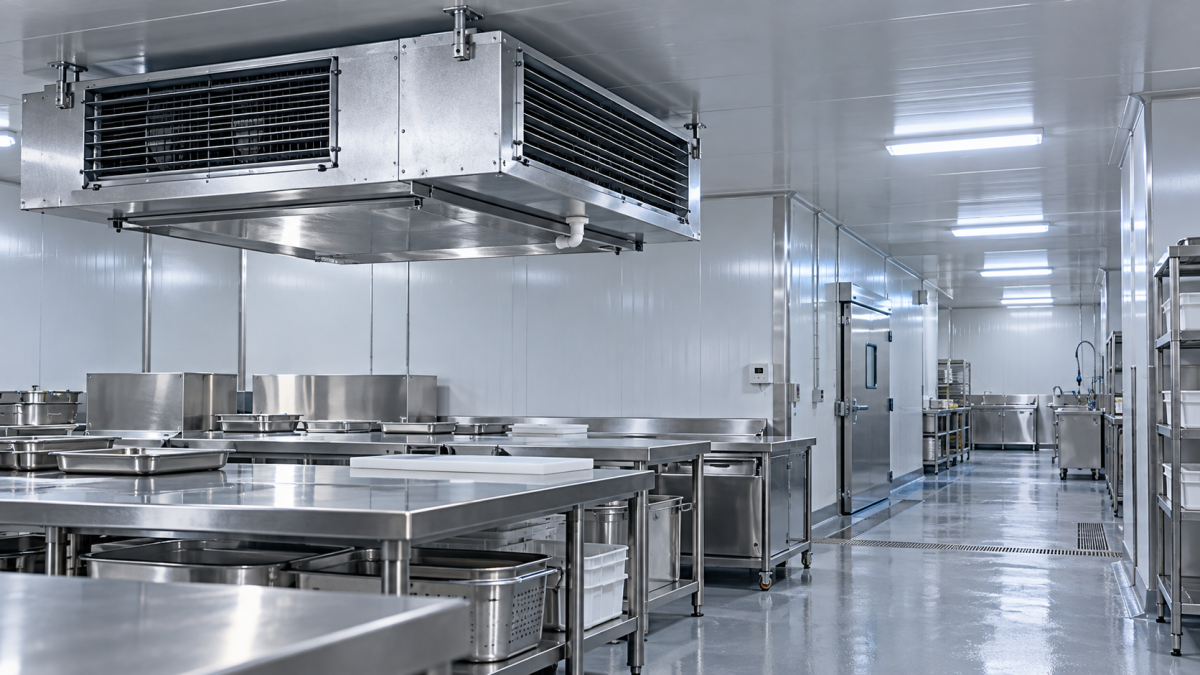
Dual-discharge evaporators typically supply air in opposite directions from a ceiling-mounted position. They deserve consideration in relatively low-ceilinged preparation rooms, chilled packing areas, and open processing spaces where a central location can serve both sides. However, confirm the actual intake and discharge arrangement on the manufacturer’s drawing; product names alone do not establish the airflow pattern.
Picture a chilled preparation room with worktables on either side of a central service zone. A two-way unit may fit that arrangement better than an end-mounted cooler blowing along the entire room. Now add a tall partition or densely stacked packaging beside one outlet: that advantage can disappear. Air may return to the intake before reaching the intended cooling zone.
Check the layout in both plan and section. Mark the underside of the cooler, maximum storage height, workstations, lighting, pipework, and service access. Low-profile equipment still needs clear space for air movement, drain fall, and coil cleaning.
A long, narrow warehouse with tall racks may instead favor directional unit coolers aligned with aisles. A room divided into separate working bays may need several smaller evaporators. Two discharge directions do not automatically provide complete coverage.
Two outlets do not guarantee gentle airflow
The appeal in occupied rooms is understandable: distributing air across two sides can help avoid relying on one concentrated stream. But a Bilateral Cold Air Fan is not inherently draft-free. Outlet area, fan speed, mounting height, discharge angle, and surrounding obstructions determine what workers and products actually experience.
Ask for air-throw data and the terminal velocity used to define that throw. A stated distance without its velocity criterion is difficult to compare. Also establish whether the figures represent each side or the complete unit, and whether the published airflow applies to the proposed fan setting.
For exposed food, excessive local velocity can increase surface drying. Reducing fan speed may help, but it also changes heat transfer and coverage. For personnel, assess air speed at standing positions rather than judging comfort from the room thermostat. One acceptable temperature reading cannot reveal a cold stream across a packing bench.
Compare capacity at the conditions you will actually operate
A common selection mistake is comparing catalog capacities that use different rating conditions. Require the proposed cooling duty at the specified room temperature, refrigerant, evaporating temperature, and applicable superheat conditions. Clarify whether the figure is gross coil capacity or net useful capacity after fan heat.
The temperature difference between room air and refrigerant evaporation also matters. A larger difference can increase capacity from a given coil, but generally encourages greater moisture removal. Where unpackaged produce or other moisture-sensitive goods are involved, coil selection and humidity control need to be considered together. Two-way discharge cannot compensate for an unsuitable evaporating temperature.
Separate holding duty from pull-down duty. Keeping already chilled goods at temperature is different from receiving warm product throughout a shift. Product entry temperature, loading schedule, people, lighting, machinery, transmission, and infiltration all belong in the load calculation. Room volume alone is not a reliable sizing method.
Door traffic can change the selection
In a busy cold-chain workshop, doorway infiltration may be a major source of both heat and moisture. Selecting a larger evaporator without addressing frequent openings can leave the underlying problem untouched: repeated frost accumulation, defrost interruptions, and uneven conditions near the entrance.
A self-returning Double-acting Impact Door can be considered alongside the refrigeration design where bidirectional traffic is required. Its insulated polyurethane panel and low-temperature-resistant seals are relevant to separating conditioned spaces. Available panel thicknesses include 100, 150, and 200 mm, but thickness alone does not establish whole-door thermal performance or leakage.
Check closing behavior, seal contact, traffic clearance, and suitability for the temperature difference across the opening. A door that returns closed can limit unnecessary open time; it cannot eliminate air exchange during passage. Avoid directing a discharge stream through the doorway, and assess any proposed air curtain separately.
Defrost and cleaning deserve space in the decision
A cooler that fits neatly above production equipment can still be awkward to operate. In chilled rooms, off-cycle defrost may be feasible under suitable conditions. Lower-temperature applications often require an active defrost method. Confirm the expected frost load, available heating method, termination control, drainage, and fan restart sequence rather than assuming a standard package will suit.
Delayed fan restart helps avoid distributing residual water after defrost. Drain routing and any required freeze protection need equal attention. In processing areas, inspect access to both coil faces, the drain pan, fans, and nearby ceiling surfaces. If cleaning requires dismantling fixed production equipment, reconsider the location before installation.
What to request before approving the unit
A useful technical submission should make the selection traceable, not merely repeat a model number. Request:
- Selected duty and rating conditions, with fan input and operating speed.
- Airflow per discharge side, throw criteria, and required installation clearances.
- Coil fin spacing, materials, and compatibility with the intended cleaning regime.
- Defrost method, electrical load, drainage details, and control sequence.
- A room-layout drawing showing airflow paths and maintenance access.
Shandong Boer Refrigeration Equipment Co., Ltd., established in 2014, manufactures air coolers, condensing units, modular cold rooms, panels, and doors. That system-wide product scope makes coordinated review possible, but the project submission should still demonstrate how the selected components work together. Manufacturer credentials do not replace model-specific performance data.
Choose a dual-discharge cooler when both air paths remain useful under real loading conditions, occupied-zone velocities are acceptable, and the coil meets temperature and moisture requirements at the proposed operating point. If one side is obstructed, long aisle throw dominates, or maintenance access is compromised, reconsider the configuration before increasing capacity. More cooling power will not correct the wrong airflow layout.