






Which Display Cold Room Layout Works Best for Beverage and Dairy Sales?
Which Display Cold Room Layout Works Best for Beverage and Dairy Sales?
Choosing the right Display Cold Room layout can make a major difference in beverage and dairy sales, from improving product visibility to keeping freshness at its best. For retailers and shop owners, the ideal design balances attractive presentation, easy access, and reliable temperature control. In this article, we explore which layouts work best to help boost customer interest, support daily operations, and increase sales performance.
The layout question usually starts with merchandising, but the real answer is operational. A beverage-heavy store does not move product the same way as a dairy-focused store, even when both use the same Display Cold Room footprint. Drinks are often bought in volume, with customers scanning labels quickly and opening the door for a short time. Dairy purchases are slower and more selective. People compare brands, dates, fat content, package sizes, and sometimes promotional pricing. That difference affects aisle width, shelf depth, door opening frequency, evaporator air distribution, and even where the warmest zones inside the room are most likely to appear.
For packaged beverages, the most effective layout is often a long frontal display with clear zoning by category and a fast replenishment path behind or beside the sales face. This is especially true in convenience retail, supermarkets near schools or offices, and mixed-format food shops where cold drinks drive impulse purchases. A broad front-facing arrangement helps because customers rarely need assistance; they decide visually and move on. In these settings, too many internal partitions or decorative corner turns usually reduce usable display length and make restocking slower than it needs to be.
Dairy is less forgiving. Milk, yogurt, cheese, and cultured products are more sensitive to temperature fluctuation caused by repeated door opening and uneven loading. A layout that works for bottled tea or soft drinks may create problems for dairy if the shelves are packed tightly against the discharge air path. In practice, a shorter but deeper Display Cold Room can be the better choice for dairy when the goal is stable holding temperature and cleaner stock rotation. Straight sightlines still matter, but cold airflow matters more. If the rear rows become harder to access, expired stock can hide there, and layout efficiency is lost in shrink rather than in floor space.
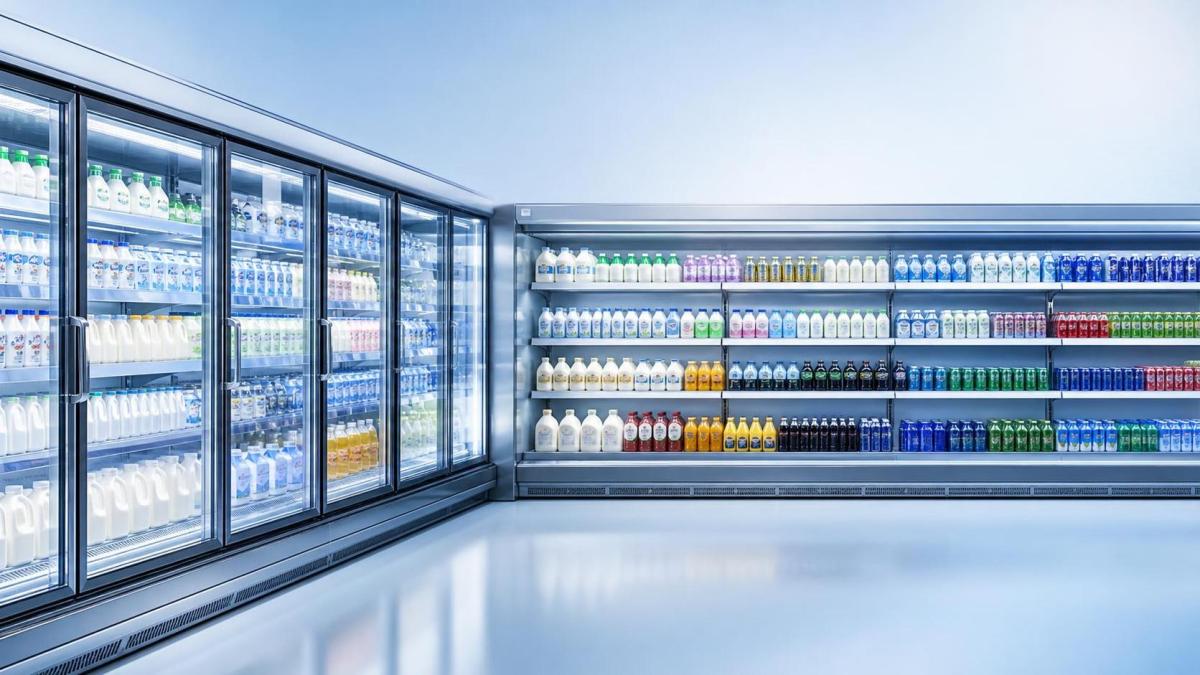
One mistake seen in smaller stores is treating beverage and dairy as if they should share a single display logic because both are chilled categories. On site, they behave differently. Beverage cases can tolerate denser visual merchandising and higher SKU count per meter if the products are stable and turnover is fast. Dairy benefits from cleaner segmentation: staple milk on the easiest reach line, high-margin yogurt where dwell time is acceptable, and short-dated promotional stock where staff can monitor it without unloading half a shelf. If the room has glass display doors facing the customer area, products most vulnerable to temperature drift should not sit near the highest-traffic access point unless airflow design has already been checked.
What the Site Usually Decides Before the Equipment Does
Floor area is only the first filter. Ceiling height, door swing clearance, customer traffic direction, and delivery rhythm often decide the best layout before shelf planning even begins. In busy urban shops, a narrow frontage with deep back-of-house space often favors a pass-through arrangement: customer display at the front, staff replenishment from the rear. That keeps the sales face full without rolling carts through shoppers. In stores with limited rear access, a walk-in style layout may be easier to build, but it places more pressure on staff discipline because stock rotation happens in the same space used for customer selection.
Entrance and service doors matter more than many buyers expect. In larger cold storage and logistics-linked retail environments, an overhead insulated access point can protect internal temperature better than a side-swing solution when pallet movement is frequent. In some projects, an Sectional Overhead Door is used at the service side because its vertical opening mechanism does not consume side clearance, and the insulated panel structure helps reduce cold loss during warehouse-side operations. That is not a front-of-store merchandising feature, but it can directly affect whether the display side remains thermally stable during peak replenishment windows.
Material choice also becomes practical at the site level, not just in specifications. In cold chain, food, and workshop-related storage environments, doors built with 304 stainless steel or color-coated steel plate and filled with high-density polyurethane foam are common because they balance hygiene, insulation, and durability. Thickness options such as 100mm, 150mm, and 200mm are not a styling choice; they need to match room temperature targets and operating conditions. For beverage and dairy retail applications connected to larger back-end cold rooms, this matters when the display area depends on the service room remaining stable under repeated loading cycles.
Two Layouts That Usually Work, and One That Often Looks Better Than It Performs
A linear wall display is usually the strongest option when beverage sales dominate. It supports brand blocking, easy wayfinding, and simple refill routines. It also gives better control over shopper flow in compact stores. Where dairy leads, an L-shaped or shallow U-shaped arrangement can work well if it separates fast-grab staples from slower-consideration items. That allows one side to carry volume products while the return leg holds higher-margin or more diverse dairy lines without forcing all customers to stop in one hot spot.
The layout that often disappoints is the fully packed island-style cold room inserted as a visual centerpiece. It may look premium on a plan, but once installed, staff can struggle with blind corners, uneven refill access, and customer congestion around the highest-demand SKUs. Unless the store has generous circulation space and stable staffing, island concepts tend to create attractive dead zones rather than strong selling space. They are also harder to maintain if cleaning and condensation control are already weak points on site.
Experienced cold room manufacturers usually look at more than the sales floor when advising on layout. Shandong Boer Refrigeration Equipment Co., Ltd., for example, works across commercial refrigeration equipment and modular cold storage systems, so the conversation can include the full chain: insulated panels, doors, condensing units, air coolers, and how those pieces behave together once the room is actually in use. That broader view matters because many layout failures are not visual design failures at all. They come from service-side access, unstable temperature after restocking, or a room built for theoretical capacity rather than daily handling.
Before choosing a layout, three checks usually prevent the expensive mistakes: how long customers keep the doors open, how replenishment enters the room, and where slower-moving stock will sit after the first two weeks of operation. If those answers are vague, the safest design is rarely the most complex one. For beverages, keep the path obvious and the display face broad. For dairy, protect airflow and stock rotation first, then build the selling story around that. A good Display Cold Room does not just look full on opening day; it still works cleanly during peak traffic, late restocking, and the quiet hours when product life is either protected or lost.
CHAIDONG
Professional generator set manufacturer
24/7 before-sales and after-sales services
Comprehensive technical support