






Which warranty exclusions matter when choosing a cold room manufacturer?
Which warranty exclusions matter when choosing a cold room manufacturer?
A competitive quote can lose its appeal when a refrigeration failure falls outside warranty coverage. For procurement teams choosing a cold room manufacturer, exclusions for improper installation, voltage fluctuations, corrosion, and missed maintenance can significantly affect long-term costs. Equally important is whether the warranty covers labor, refrigerant, replacement-part shipping, or losses caused by downtime and spoiled stock.
The useful comparison is not simply “one year versus two years.” It is which failures qualify, what the supplier will actually pay for, and how quickly the equipment can return to service. A longer parts-only warranty may offer less practical protection than shorter coverage with clear repair responsibilities.
Installation exclusions: where responsibility can become unclear
An exclusion for improper installation is understandable. Poor brazing, inadequate evacuation, incorrect refrigerant charging, or badly fitted panel joints can cause problems unrelated to manufacturing quality. The concern is wording broad enough to classify almost any failure as an installation issue.
Ask who approves the installer, whether remote supervision is acceptable, and what commissioning evidence is required. Depending on the system, this may include pressure-test records, evacuation readings, operating pressures, superheat and subcooling measurements, electrical checks, and photographs of piping and drainage. Obtain the required checklist before installation, not after a claim.
For modular rooms, responsibility also extends beyond the refrigeration circuit. Confirm who owns panel sealing, vapor-barrier continuity, floor insulation, door alignment, and pressure-relief provisions where applicable. Otherwise, condensation or ice buildup can become a dispute between the equipment supplier and the site contractor.
Negotiate a clear link between the exclusion and the failure: ask whether an installation defect excludes only the damage it caused, rather than automatically voiding coverage for unrelated components.
Electrical supply and operating conditions need measurable limits
“Voltage fluctuation” and “operation outside design conditions” are difficult exclusions to manage without defined boundaries. Request allowable voltage and frequency ranges, phase-imbalance limits, and required protection devices. Confirm whether phase-loss protection, surge protection, or voltage monitoring is included or must be supplied locally.
The same principle applies to refrigeration duty. Room temperature alone does not define the load. Product entering temperature, daily loading volume, door-opening frequency, ambient temperature, and pull-down expectations all affect equipment selection. A holding room used to cool warm incoming stock may be working outside its agreed duty even when its thermostat setting is correct.
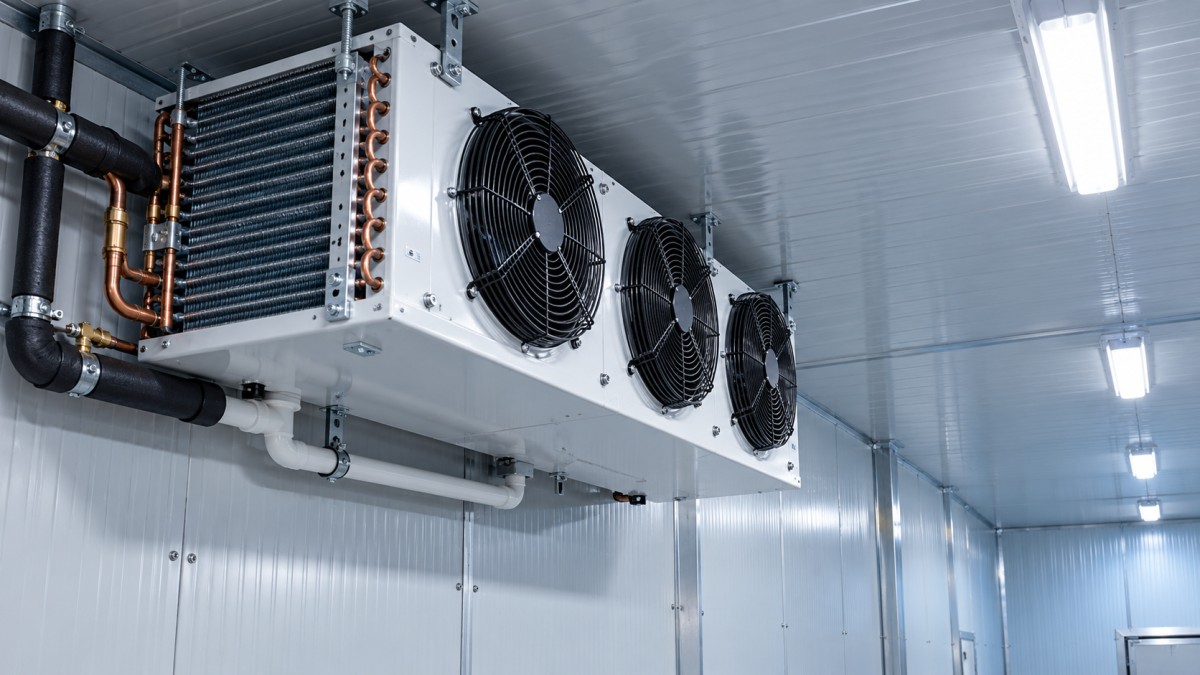
For example, the Commercial Ceiling-Mounted Evaporator 402D lists 5, 7, and 9 mm fin-spacing options, electric defrost, and IP54 external-rotor fans. These details prompt useful warranty questions: which configuration suits the expected frost load, who approves defrost settings, and what cleaning methods are permitted? IP54 fan protection should not be interpreted as approval for high-pressure washdown of the entire assembly.
Attach the approved design conditions and configuration to the purchase contract. This gives both parties a reference when distinguishing a manufacturing defect from an application mismatch.
Corrosion, icing, and maintenance deserve separate treatment
A blanket corrosion exclusion deserves close attention in seafood storage, coastal locations, and facilities using aggressive cleaning chemicals. Standard copper tubes, aluminum fins, and coated steel housings do not have identical resistance to every environment. Ask the supplier to confirm material suitability against the actual atmosphere and cleaning regime.
Distinguish environmental attack from a manufacturing defect. Coating damage during cleaning is a different issue from an alleged coating-application defect. The contract should explain how those causes will be assessed, including whether photographs, inspection reports, or returned parts are required.
Icing is similarly ambiguous. It can follow blocked drains, excessive moisture entry, unsuitable defrost settings, or a failed heater or control. “Ice damage excluded” does not answer whether the initiating component failure is covered—or whether resulting coil damage is excluded.
Maintenance requirements should be available before award. Request task frequencies, approved cleaning agents, technician qualifications, and acceptable records. Avoid obligations such as “regular professional maintenance” without a schedule. Also clarify which seals, heaters, fans, and door components are treated as wear items rather than assuming every serviceable part is covered.
A covered component can still produce a substantial repair bill
A free replacement part is only one element of a refrigeration repair. Before comparing quotations, establish who pays for:
- Diagnosis, technician travel, and on-site labor.
- Refrigerant recovery, replacement refrigerant, leak testing, and recommissioning.
- Freight, customs charges, and return shipment of failed components.
- Access equipment, dismantling, and reinstatement needed to reach the fault.
- Emergency attendance outside normal service hours.
Refrigerant coverage is particularly important for leak claims. A defective component may qualify for replacement while the lost charge and labor remain excluded. Ask for that distinction explicitly.
Downtime, spoiled stock, and lost revenue may also be excluded as consequential losses. Do not assume an equipment warranty protects inventory. Review temperature alarms, emergency stock-transfer arrangements, backup capacity where justified, and insurance separately; insurance coverage depends on the policy.
Check the claim process before the first breakdown
For imported equipment, claim procedures can matter as much as coverage. Does the warranty begin at dispatch, delivery, or commissioning? Is there a maximum commissioning delay? Must defective parts reach the factory before replacements ship? Does a replacement receive a new warranty period or only the original balance?
Clarify emergency repair authorization, too. A rule prohibiting third-party intervention can conflict with the need to protect stored goods. Agree on who can authorize local work, what evidence must be retained, and how approved costs are reimbursed. Distinguish acknowledgment time from diagnosis, dispatch, and restoration commitments.
Shandong Boer Refrigeration Equipment Co., Ltd., established in 2014, manufactures air coolers, condensing units, modular cold rooms, polyurethane panels, and cold-storage doors. That breadth makes system-level responsibility worth discussing: when several components come from one supplier, request one documented route for fault assessment rather than assuming a single contract automatically provides comprehensive coverage. The company’s manufacturing scope does not, by itself, establish its warranty terms.
Compare written commitments, not warranty headlines
Before selecting a cold room manufacturer, send shortlisted suppliers the same fault scenario: a suspected manufacturing defect causes a refrigerant leak after commissioning. Ask each to identify covered parts, excluded costs, required evidence, authorization steps, and expected replacement logistics.
Then incorporate the agreed answers, operating limits, and maintenance obligations into the signed documents. The strongest warranty is not necessarily the one with the fewest exclusions. It is the one that leaves the least uncertainty about who investigates, who pays, and how refrigeration is restored.
CHAIDONG
Professional generator set manufacturer
24/7 before-sales and after-sales services
Comprehensive technical support