






Why cold room temperature rises during the defrost cycle
A cold room warms during defrost because refrigeration is intentionally paused while heat is introduced or allowed to enter the evaporator coil. Frost must be removed to restore airflow and heat-transfer capacity, yet the process temporarily adds sensible heat to the air and surrounding components. A short rise in room air temperature is therefore expected. The concern begins when the temperature rise is excessive, lasts too long, repeats too frequently, or does not recover after the refrigeration cycle resumes.
The displayed temperature alone can be misleading. A probe near the evaporator discharge, close to a door, or directly in the fan air stream reacts much faster than product located in the center of the room. Stored goods also have thermal mass: tightly stacked frozen products change temperature much more slowly than the air around them. Before treating a defrost event as a fault, compare the room sensor trend, coil condition, defrost duration, fan sequence, and pull-down time after defrost.
Why defrost adds heat to the room
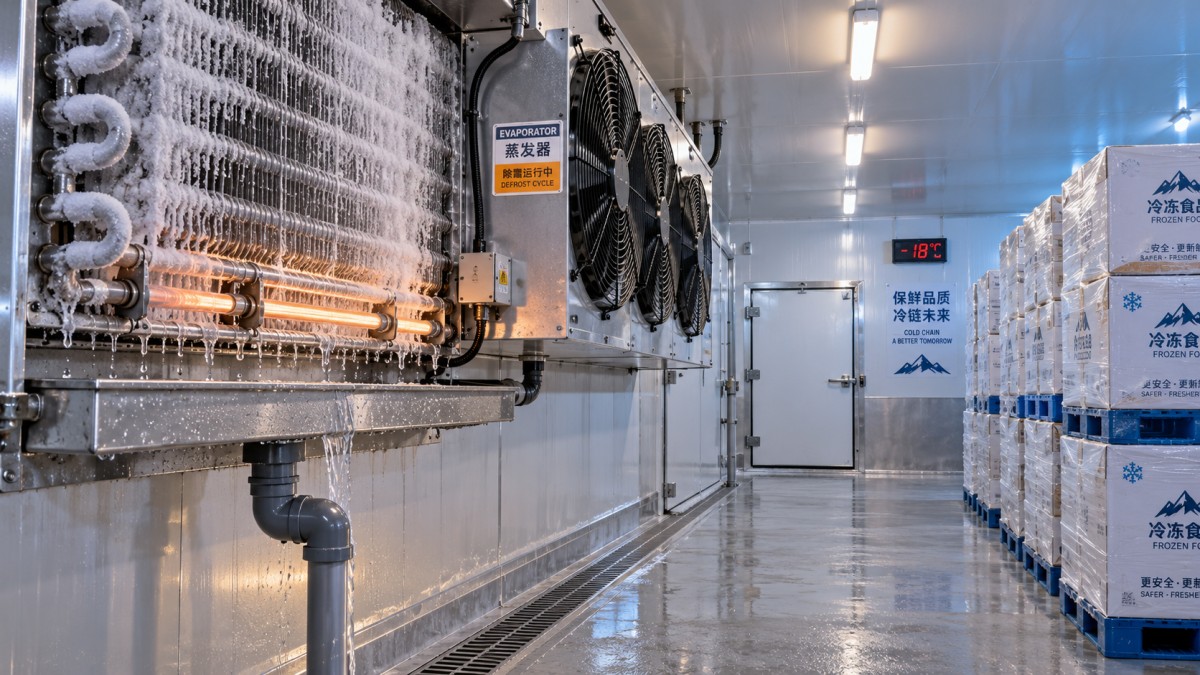
During electric defrost, heaters installed in or around the evaporator coil melt accumulated frost. Heat first warms the coil surface and ice, but part of it migrates into the room air, drain pan, coil casing, and nearby panels. If evaporator fans continue running while the coil is warm, they distribute that heat rapidly across the cold room. This can create a sharp reading at the room sensor even when the stored load remains stable.
Hot-gas defrost produces a similar result through a different path. Discharge gas is routed through the evaporator to release heat and melt frost. The coil and piping can become warmer than the room, especially near the end of the cycle. The refrigeration controller normally terminates defrost by temperature, time, pressure logic, or a combination of these conditions. A timer set longer than the coil actually requires continues adding heat after the frost has already melted.
Off-cycle defrost is common in higher-temperature applications. The compressor stops and the coil warms naturally. Its temperature effect is usually gentler than electric or hot-gas defrost, but it can still be noticeable where the door opens frequently, humidity is high, or the evaporator has limited coil surface.
Fan control changes the shape of the temperature rise
Evaporator fan behavior is one of the clearest ways to distinguish a normal defrost temperature increase from a control issue. In many low-temperature rooms, fans stop during defrost. They remain off for a drip period after the heaters or hot gas stop, allowing meltwater to drain before refrigeration restarts. A fan-delay control then waits until the coil becomes cold enough to avoid blowing warm, moist air into the room.
If fans restart too early, the room can warm quickly and moisture may be carried from the coil into the storage area. This often appears as a brief warm-air event followed by frost on cartons, product packaging, ceiling surfaces, or the evaporator itself. If the fans never stop during electric defrost, verify the controller output, fan relay or contactor, wiring, and any manual override setting. A failed fan-delay sensor can create the same symptom even when the defrost heater and refrigeration circuit are operating correctly.
Fan operation also affects the sensor response. A return-air sensor generally sees the average room condition more slowly than a sensor mounted in the supply-air path. When reviewing controller data, identify the sensor location before deciding that the full cold room experienced the displayed peak.
Drainage faults can make a normal defrost look abnormal
Defrost water must leave the evaporator promptly. A blocked drain, missing drain-trap heat, poorly insulated drain line, or frozen drain outlet leaves water in the pan or below the coil. That water can refreeze at the next refrigeration cycle, increasing frost accumulation and extending the next defrost. The result is a repeating pattern: longer defrost, higher room temperature, reduced airflow, then even heavier ice formation.
Look for ice under the coil, a full drain pan, water marks around the drain connection, or a solid ice plug at the point where the drain line passes through the insulated envelope. The drain line needs continuous fall, appropriate insulation where it crosses warm or humid spaces, and heat tracing where the application requires it. Repeatedly clearing ice without correcting the drain path only delays the same failure.
Door openings during or immediately after defrost add another complication. Warm humid air enters while the evaporator is warm and unable to remove moisture efficiently. In a room with frequent traffic, a defrost scheduled during the busiest loading period can create a larger temperature peak than the same defrost performed during a quiet period.
When a rise is within the expected range
A normal event has a recognizable sequence: frost is removed, defrost ends, meltwater drains, fans wait for the coil to cool, refrigeration restarts, and the room returns to its control band without prolonged compressor operation or repeated defrost calls. The air temperature may peak briefly, while product temperature remains essentially unchanged. A coil that is clean after defrost and develops an even frost pattern during refrigeration is also a positive sign.
The room size, stored mass, loading condition, evaporator capacity, insulation quality, and control settings all affect recovery. A lightly loaded room changes air temperature quickly. A room containing large quantities of frozen product responds more slowly, but poor air circulation through tightly packed product can still delay pull-down. For a modular installation such as a Conventional Prefabricated Cold Storage Facility, panel joints, door sealing, and penetrations around pipes and cables should be included in the assessment when recovery remains slow. Heat leakage through these points becomes more visible while the refrigeration system is temporarily unavailable during defrost.
Patterns that point to a fault
A high room temperature after every defrost does not automatically mean the heater is oversized. Start with the time trend. If temperature rises only during defrost but falls normally once refrigeration starts, review defrost termination and fan delay first. If it rises during defrost and remains high long afterward, investigate the refrigeration restart sequence, airflow, and system capacity.
- Defrost runs to the maximum time on every cycle: the termination sensor may be misplaced, poorly clamped, open circuit, incorrectly calibrated, or unable to see the true coil temperature. A thick ice layer can also delay heat transfer to the sensor.
- The coil is still heavily iced after defrost: verify heater continuity, heater contactor operation, hot-gas valve function where fitted, actual supply voltage, and the defrost interval. Do not increase defrost duration until the failed heating path or water source has been identified.
- The coil is clear but room temperature remains elevated: inspect fan cut-in temperature, compressor start command, liquid-line solenoid action, suction pressure control, condenser condition, and airflow across the evaporator after restart.
- Only one area of the room warms: examine air throw, blocked evaporator discharge, high product stacking, damaged strip curtains, door leakage, or a sensor placed in a local warm-air path.
- Defrost occurs too often: excess moisture infiltration, damaged door gaskets, an unsealed panel penetration, frequent door opening, or warm product loading may be creating frost faster than the evaporator can manage.
Use measurements that separate cause from symptom
Record the start and end of defrost, heater or hot-gas operation, fan stop and restart times, coil temperature, room-air temperature, and the time required to return to setpoint. One complete cycle is more useful than a single alarm reading. Compare those values with a cycle taken when the room is operating normally, rather than relying only on controller defaults.
Measure coil temperature at the defrost termination sensor and, where possible, at another point on the coil. A sensor near a heater may indicate completion while a remote section remains iced. Conversely, a sensor fixed to a cold section with poor contact may keep heaters energized after most frost has gone. Confirm that the sensor is firmly attached to clean tubing and insulated from warm surrounding air when the control design calls for it.
Airflow should be checked after the drip period, not only before defrost. Fans can run electrically while moving little air because of ice on blades, damaged fan guards, a slipping blade hub, blocked coil passages, or a failed motor. Reduced airflow makes the coil colder during refrigeration, encourages frost, and lengthens recovery after each defrost.
Correct the control sequence before changing the setpoint
Lowering the room setpoint to compensate for a defrost spike usually increases run time and can mask the underlying issue. It may also encourage excessive frosting if the evaporator operates at a lower coil temperature. Adjustments should follow the physical condition of the coil and the actual load profile.
Set defrost frequency according to moisture load, door activity, product loading, and observed frost formation. Set the maximum defrost time as a protective limit, while allowing an accurately positioned termination control to end the cycle when the coil is clear. Maintain a sufficient drip period to remove water, then use fan delay to prevent warm coil air from entering the room. After any setting change, observe several complete cycles because a single clean cycle may be followed by drainage or frosting problems later.
A temporary rise in Cold Room Temperature is part of effective frost removal. The acceptable limit is defined by the recovery behavior, coil condition, airflow, and product protection, rather than by the highest air-temperature reading alone.
CHAIDONG
Professional generator set manufacturer
24/7 before-sales and after-sales services
Comprehensive technical support