






Why is one side of a dual-discharge cold room air cooler blowing weakly?
Why is one side of a dual-discharge cold room air cooler blowing weakly?
When one side of a dual-discharge cold room air cooler blows weakly, uneven temperatures and longer cooling cycles can quickly trigger service calls. The key is to distinguish restricted airflow from a fan fault—not simply replace parts. A Bilateral Cold Air Fan can develop uneven discharge because of localized icing, blocked outlets, incorrect fan rotation, or motor problems, depending on its construction. Start by confirming the airflow arrangement, then work through restrictions, defrost performance, and fan operation.
Confirm what “one side” means before opening the unit
Dual discharge describes the air delivery pattern, not necessarily two independent fan systems. Some units share a central fan arrangement and split airflow through opposite coil faces; others use separate fans or sections. Check the assembly drawing. A weak outlet on a shared-fan unit points toward unequal resistance, although internal damage or fan problems can also affect distribution.
Ask when the symptom appeared. Weak airflow immediately after motor replacement suggests rotation, blade selection, or wiring. A problem that develops gradually between defrosts suggests icing. A complaint following stock rearrangement deserves a clearance check before electrical testing.
Do not judge by hand feel alone. With guards fitted and operation safe, compare air velocity at equivalent points across both outlets, using the same distance and instrument orientation. Record several readings rather than comparing two isolated spots. Outlet angle and turbulence can otherwise create a misleading difference.
Isolate safely, then inspect the entire air path
Before removing guards or panels, isolate and lock out the relevant supplies, including separate fan and defrost circuits where fitted. Verify isolation and wait for rotating parts to stop. Electrical measurements under power should be performed only by qualified personnel using appropriate procedures. Protect stored food during any extended shutdown.
Inspect both the discharge and return-air routes. Cartons, wrapping film, shelving, dirty fins, or ice inside a guard can restrict one side. A clear outlet does not guarantee a clear air path: stock below the cooler may obstruct its intake, while nearby walls can cause discharged air to recirculate.
Check for bent fins, displaced baffles, loose panels, and packaging left inside the casing. Compare installation clearances with the manufacturer's drawing rather than applying a universal distance. Photograph the original condition before cleaning or moving anything.
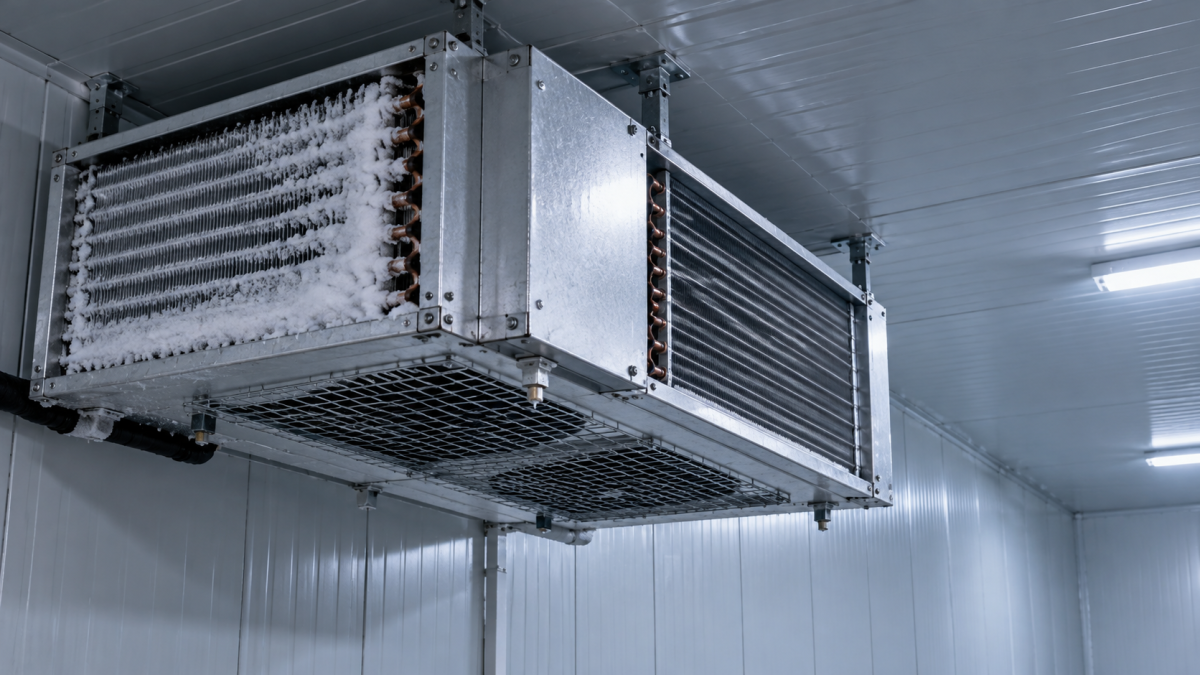
If ice is restricting one side, find out why it returns
A heavily frosted coil section increases air resistance and can divert airflow toward the clearer outlet. Check the coil depth, not just its visible face. Ice may remain between fins after the surface appears clear. Do not chip it away with sharp tools or apply uncontrolled heat; tubing, coatings, and wiring can be damaged.
Use the approved defrost procedure, then inspect drainage and confirm that meltwater leaves the tray. Where electric defrost is fitted, investigate:
- Failed heater sections, damaged connections, or a control fault preventing full operation.
- A displaced or inaccurate termination sensor ending defrost too early.
- Blocked drains or failed drain heaters allowing water to refreeze.
- Incorrect drip time or fan restart settings carrying moisture back onto cold surfaces.
Door leakage and frequent openings also increase moisture loading. If airflow recovers after defrost but weakens again during operation, replacing the fan is unlikely to solve the underlying problem. Record where frost first returns and how it develops through the operating cycle.
Check fan performance against the actual motor design
With power isolated, inspect blades for damage, loose hubs, rubbing marks, and incorrect positioning within the fan ring. Check bearing condition according to the motor manufacturer's instructions. A replacement impeller with the wrong pitch or handedness may fit physically yet deliver substantially different airflow.
During a controlled operational check, verify rotation against the equipment marking. Rotation correction depends on motor type. Changing phase sequence may reverse a suitable three-phase motor, but it is not a universal remedy for single-phase or electronically commutated motors. Never alter the entire unit's phase sequence merely to correct one fan; other components may be affected.
Compare supply voltage, operating current, speed where measurable, and control signals with the nameplate and wiring diagram. Check a capacitor only where that motor design uses one, following safe discharge procedures. For EC fans, inspect speed commands and fault indications. Current alone does not establish airflow: its relationship to loading depends on the fan and motor characteristics.
Keep airflow faults separate from refrigeration faults
Weak air movement is not the same as insufficiently cold discharge air. Low refrigerant charge or an expansion-control problem can reduce cooling capacity without directly reducing fan delivery. However, abnormal refrigerant distribution may produce uneven coil temperatures and icing that eventually restrict airflow.
If the air path is clear and fan performance is correct, examine the frost pattern, refrigerant pressures, superheat, and sensor readings under stable conditions. Interpret them against the refrigerant, operating load, and manufacturer's commissioning data. Do not add refrigerant simply because one outlet feels weak.
Use system documentation to avoid mismatched repairs
Shandong Boer Refrigeration Equipment Co., Ltd., established in 2014, manufactures air coolers, condensing units, and modular cold rooms. That equipment range makes system matching relevant to troubleshooting: the fan assembly, evaporator, defrost controls, and refrigeration source need to be checked as a coordinated installation, not as unrelated replacement parts.
For example, its Integrated Cold Storage Cold Source uses a standardized cooling-source approach intended to reduce on-site component matching. Published information includes a −10 to +5°C application range and remote IoT monitoring capability. Where fitted, operating trends can help establish whether airflow complaints follow defrost events or temperature excursions.
Confirm the supplied configuration before changing settings. The product information references both electric and refrigerant-based defrost arrangements; the installed unit's wiring diagram and model-specific manual must determine the service procedure.
Verify the repair through an operating cycle
After reassembly, repeat the outlet velocity measurements at the original locations. Check fan noise, current, drainage, and room temperatures away from the controller sensor. Where icing caused the restriction, observe defrost and subsequent cooling rather than closing the job after a brief restart.
Balanced discharge should be assessed against the unit's design, not an assumed perfect split. Leave a service record with measurement locations, readings, photographs, settings changed, and parts replaced. If the fault remains unresolved, send those records with the model, serial number, wiring diagram, and stock-layout details to the equipment supplier. That evidence is more useful than a report stating only that one side still feels weak.