






Cold Room Equipment: Complete Guide to Refrigeration Systems & Components
Cold room equipment is responsible for removing heat, maintaining the required storage temperature, and ensuring stable operation of a temperature-controlled storage system. A complete cold room typically includes a refrigeration system, condensing unit, evaporator, condenser, refrigeration controls, temperature sensors, electrical components, and other supporting equipment.
Different cold rooms have different refrigeration requirements. A small commercial cold room may use a compact refrigeration unit, while a large industrial cold storage facility may require multiple refrigeration systems and more advanced temperature control.
Choosing the right equipment requires consideration of room size, storage temperature, product load, ambient conditions, door opening frequency, operating schedule, and required cooling capacity.
Cold Room Refrigeration System: Components, Types & Selection
The refrigeration system is the core of a cold room. Its primary function is to remove heat from the storage space and maintain the required temperature.
A typical refrigeration system includes:
Compressor
Condenser
Expansion device
Evaporator
Refrigerant
Controls and sensors
The refrigeration cycle transfers heat from inside the cold room to the surrounding environment.
Common Refrigeration System Types
Cold room refrigeration systems can be configured in different ways depending on capacity and application.
Small commercial rooms may use compact or self-contained systems, while larger facilities may use separate condensing units and evaporators or centralized refrigeration systems.
The correct configuration depends on the required temperature, room size, product load, ambient temperature, and operating conditions.
Cold Room Condensing Unit: Types, Capacity & Selection Guide
The condensing unit is an important part of the refrigeration system. It normally includes the compressor, condenser, and related refrigeration components.
Its role is to compress refrigerant and reject heat from the refrigeration cycle.
Condensing Unit Types
Depending on the application, cold rooms may use different compressor and condensing unit configurations, including systems based on piston, scroll, screw, or other compressor technologies.
The appropriate type depends on the required cooling capacity, operating temperature, refrigerant, and application.
Condensing Unit Capacity
Capacity should not be selected based only on cold room volume.
The calculation should also consider:
Product heat load
Ambient temperature
Door opening frequency
Insulation performance
Target temperature
Pull-down requirements
Operating hours
Correct sizing helps the refrigeration system maintain stable temperatures without unnecessary energy consumption.
Cold Room Evaporator: Types, Capacity & Selection Guide
The evaporator is installed inside the cold room and transfers heat from the room air to the refrigerant.
As warm air passes through the evaporator, heat is absorbed by the refrigerant, reducing the temperature of the storage space.
Evaporator Types
Different evaporator configurations are available for different cold room applications.
Selection depends on:
Cold room size
Storage temperature
Required airflow
Product type
Installation position
Refrigeration capacity
For larger cold rooms, multiple evaporators may be required to achieve more uniform air distribution.
Evaporator Capacity
An evaporator should be matched with the refrigeration system and actual heat load.
An improperly selected evaporator can lead to poor airflow, uneven temperature distribution, excessive frost, or reduced refrigeration efficiency.
Air Cooled Condenser For Cold Rooms: Types & Applications
An air-cooled condenser removes heat from the refrigerant and transfers it to the surrounding air.
It is widely used in commercial and industrial cold room refrigeration systems because it does not require a separate water-cooling system.
How Air-Cooled Condensers Work
High-temperature refrigerant enters the condenser after leaving the compressor. Fans move ambient air across the condenser coil, allowing heat to be released before the refrigerant continues through the refrigeration cycle.
Air-Cooled Condenser Applications
Air-cooled condensers can be used for:
Walk-in cold rooms
Freezer rooms
Commercial refrigeration
Food storage
Supermarkets
Industrial cold storage
Cold chain facilities
When selecting a condenser, ambient temperature, airflow, installation location, heat rejection capacity, and maintenance access should be considered.
Cold Room Refrigeration Unit: How To Choose The Right System
A cold room refrigeration unit integrates key refrigeration components into a system designed to provide the required cooling performance.
The right system depends on the complete operating conditions rather than room dimensions alone.
Key Selection Factors
Before selecting a refrigeration unit, buyers should determine:
Cold room size – Room volume affects the basic refrigeration requirement.
Target temperature – Chiller, freezer, and deep-freezing applications require different refrigeration conditions.
Product load – Products entering the room can introduce significant heat.
Ambient temperature – Higher outdoor temperatures can increase condenser load.
Door opening frequency – Frequent access increases heat infiltration.
Insulation – Panel material, thickness, and sealing affect heat transfer.
Operating schedule – Continuous and intermittent operation may require different system configurations.
A properly selected refrigeration unit can provide stable cooling while avoiding unnecessary equipment and energy costs.
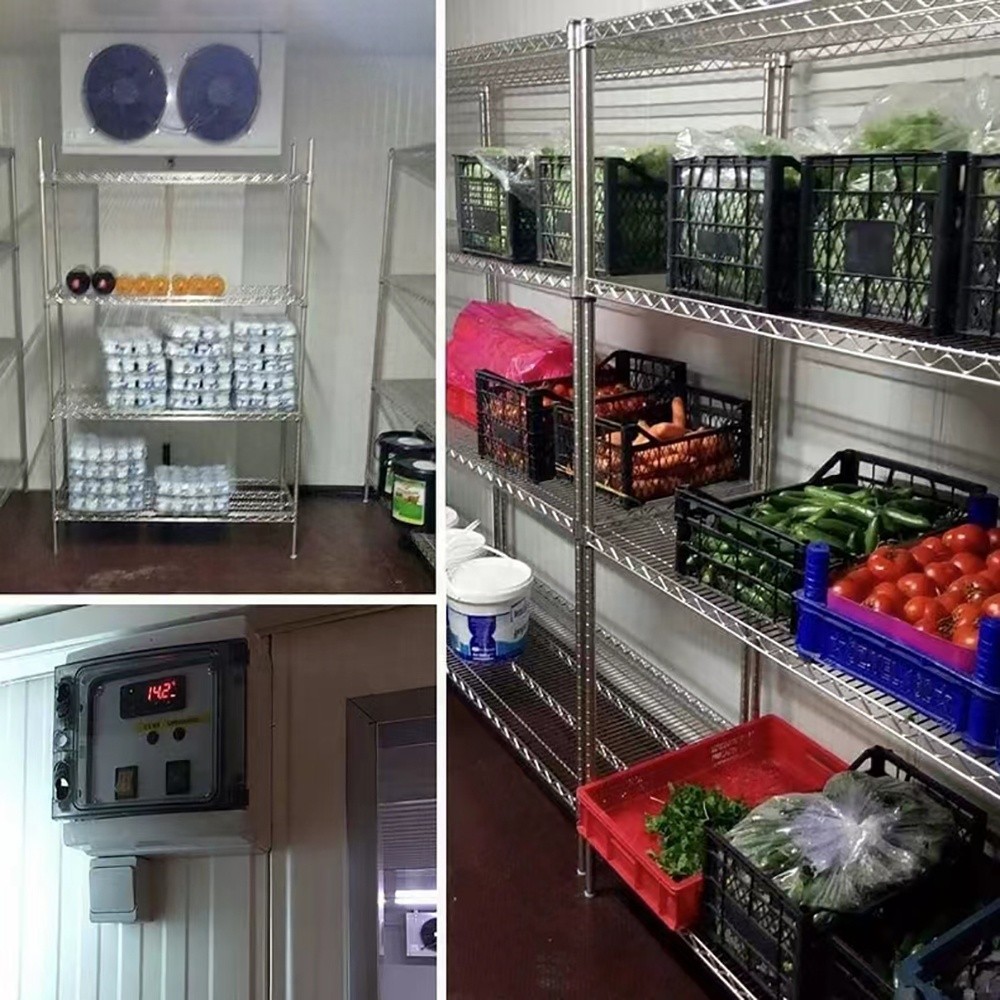
Cold Room Temperature Control System: Components & Functions
Temperature control is essential for maintaining stable storage conditions and protecting temperature-sensitive products.
A typical temperature control system may include:
Temperature controller
Temperature sensors
Thermostats
Electrical control components
Defrost controls
Alarms
Monitoring devices
Temperature Sensors
Sensors continuously measure the temperature inside the cold room and provide information to the control system.
Accurate sensor positioning is important because temperature can vary between different areas of a large storage room.
Temperature Controllers
The controller compares the measured temperature with the target setting and manages refrigeration operation accordingly.
Advanced systems may also provide alarms, data recording, remote monitoring, and other functions.
Defrost Control
Freezer rooms can experience frost accumulation on evaporator coils. A suitable defrost system helps maintain airflow and heat transfer performance.
The defrost method and frequency should be selected according to the operating temperature and system configuration.
How Cold Room Equipment Works Together
Cold room equipment should be considered as an integrated refrigeration system rather than a collection of independent components.
The basic refrigeration process can be summarized as:
Compressor → Condenser → Expansion Device → Evaporator → Compressor
The compressor circulates refrigerant through the system, the condenser releases heat, the expansion device reduces refrigerant pressure, and the evaporator absorbs heat from inside the cold room.
The temperature control system monitors operating conditions and helps regulate the refrigeration equipment.
For a complete cold room, the refrigeration equipment must also work together with insulated panels, doors, electrical systems, drainage, and airflow management.
How To Select Cold Room Equipment
The equipment selection process should start with the actual application.
Step 1: Determine The Required Temperature
Identify whether the application requires chilled, frozen, or deep-frozen storage.
Step 2: Calculate The Heat Load
Consider room dimensions, product load, door opening, ambient temperature, insulation, lighting, personnel, and other heat sources.
Step 3: Select The Refrigeration System
Choose an appropriate system configuration based on the required cooling capacity and operating conditions.
Step 4: Match The Condensing Unit And Evaporator
The condensing unit and evaporator should be properly matched to the refrigeration capacity and target operating temperature.
Step 5: Select Temperature Controls
Choose suitable controllers, sensors, defrost systems, and monitoring functions according to the application.
Step 6: Consider Energy Efficiency And Maintenance
Equipment efficiency, service accessibility, spare parts, maintenance requirements, and expected operating costs should be evaluated before purchasing.
Cold Room Equipment For Different Applications
Different applications require different equipment configurations.
Commercial cold rooms generally require compact, reliable, and easy-to-maintain refrigeration systems.
Freezer rooms require equipment capable of operating efficiently at lower temperatures and may require dedicated defrost systems.
Industrial cold rooms often require larger refrigeration capacity, multiple evaporators, advanced controls, and higher system redundancy.
Blast freezing rooms require high refrigeration capacity and strong airflow to rapidly reduce product temperature.
Pharmaceutical cold rooms may require more precise temperature control, monitoring, alarms, and additional reliability features.
The equipment should therefore be selected according to the actual application rather than using the same configuration for every cold room.
Cold Room Equipment Selection Checklist
Conclusion
Cold room equipment forms the core of a reliable temperature-controlled storage system. The refrigeration system, condensing unit, evaporator, air-cooled condenser, refrigeration unit, and temperature control system must be properly matched to work efficiently.
Equipment selection should be based on cold room size, required temperature, product heat load, ambient conditions, insulation, door usage, and operating requirements.
By selecting compatible refrigeration components and properly matching system capacity to the application, businesses can achieve stable temperature control, efficient refrigeration performance, and reliable long-term cold room operation.
CHAIDONG
Professional generator set manufacturer
24/7 before-sales and after-sales services
Comprehensive technical support