






Air-Cooler Purchase Guide: Comparing Price, Capacity, and Maintenance Needs
Start with the cost that actually matters
Buying an Air-Cooler on unit price alone usually creates problems later: unstable room temperature, higher power use, more defrost interruptions, or maintenance that eats up the savings. Procurement teams usually get the best result when they compare three things together instead of separately: required cooling capacity, total running cost, and the service burden the site can realistically handle.
That sounds obvious, but in practice many quotations are still reviewed line by line, with the lowest equipment price getting too much attention. A better approach is to treat the purchase as a cold room performance decision, not just a component purchase.
Check the real duty before you compare models
Before asking for a final quote, confirm what the Air-Cooler will actually face in operation. Capacity comparisons are meaningless if one supplier is sizing for a chilled room and another is sizing for a freezer, or if one assumes light product turnover while your site has frequent door opening.
- Room temperature range
- Product type and incoming product temperature
- Daily loading pattern and door opening frequency
- Humidity level and frost risk
- Required pull-down speed
- Evaporating temperature used for the selection
One common mistake is comparing nominal capacity values without checking the rating condition behind them. If the test condition changes, the number changes too. When you review quotations, ask each supplier to show the selection condition clearly on the datasheet or offer sheet. That is the only way to make a fair comparison.
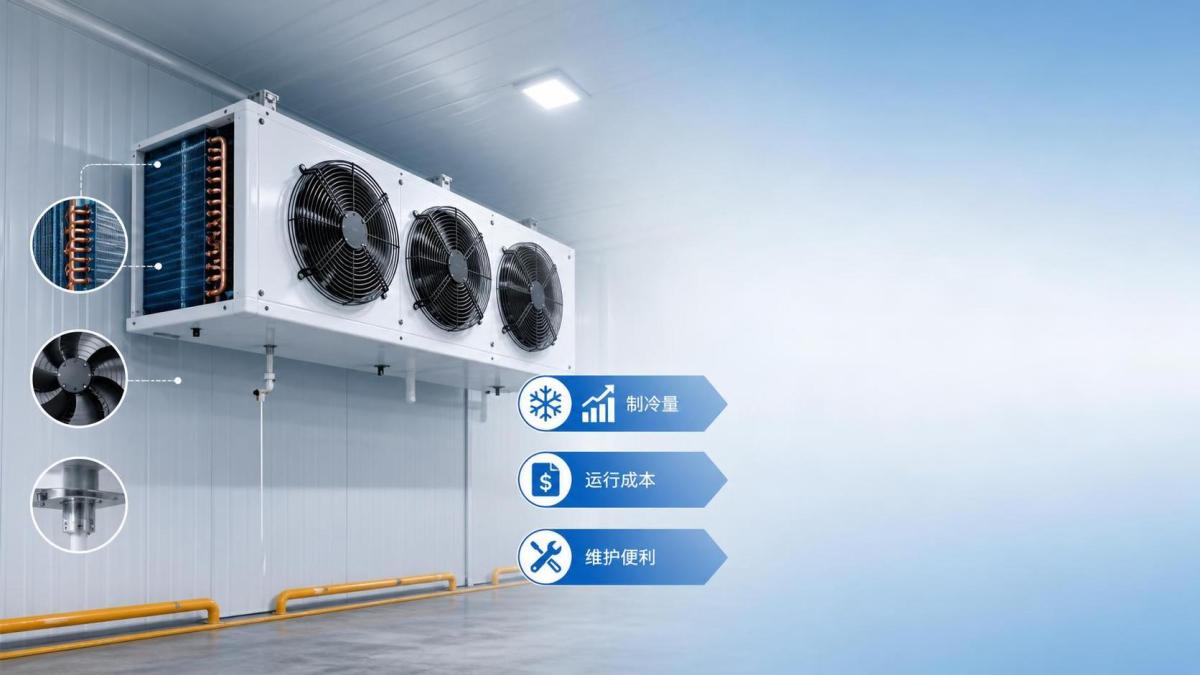
Do not oversimplify capacity
More capacity is not automatically better. An oversized Air-Cooler may look safer on paper, but it can create unnecessary fan power draw, stronger air throw than the stored goods need, and poor humidity control in some rooms. Undersizing is worse, of course: long compressor run time, weak pull-down, and trouble holding temperature during busy periods.
What matters is usable capacity under your actual operating condition. For procurement, that means checking not only the quoted refrigeration duty but also fan quantity, air volume, fin spacing, and defrost arrangement. In low-temperature rooms, fin spacing and defrost design often affect day-to-day performance as much as the headline capacity number.
Compare price in three layers
A useful quote comparison sheet separates cost into three layers:
This is where many purchasing decisions improve quickly. Once service and energy are visible, the “cheap” option is often less attractive.
Look closely at maintenance access, not just maintenance theory
Every supplier will say the equipment is easy to maintain. The useful question is simpler: what does a technician have to remove, open, or shut down to clean the coil, inspect the fans, and work on the defrost system?
For buyers, this is not a small detail. If maintenance takes too long, sites delay it. Then airflow drops, frosting gets worse, power use rises, and product temperature control becomes less stable. Ask for drawings or photos that show service access points. If the installation space is tight, check clearances before approval, not after delivery.
Match the Air-Cooler to the room envelope
Procurement teams sometimes evaluate the evaporator in isolation, even though cold room panel quality strongly affects how hard that unit has to work. If the room envelope allows heat gain, moisture ingress, or condensation around joints, the Air-Cooler ends up carrying a load that should have been controlled by the structure.
In projects where insulation selection is still open, it makes sense to review prefabricated panel performance alongside evaporator sizing. For example, PU Panel options used in cold chain, pharmaceutical, and food rooms are available in thicknesses from 50 mm to 200 mm and are designed for thermal insulation, moisture resistance, and modular installation. When panel thermal conductivity, water absorption, and joint quality are handled properly, the refrigeration load estimate is easier to trust, and equipment selection becomes more accurate.
Ask what is included in the selection, not just what is certified
Certifications matter, but they do not replace a proper technical review. A supplier may have broad product certifications and solid manufacturing capability, which is useful, but your buying decision still depends on the exact configuration being quoted. Check the model, motor specification, coil material, voltage, defrost type, and any control components listed in the offer.
If your market or project requires specific compliance documents, do not stop at a general statement. Ask for the exact certificate or technical file tied to the quoted product family and verify that the product description, standard scope, and electrical specification match your purchase documents.
Watch the hidden reasons one quote is lower
When one supplier is significantly below the others, there is usually a reason. Sometimes it is good manufacturing efficiency. Sometimes it is a thinner specification. Review these points before treating the lower price as a win:
- Are the fan motors comparable in type and quantity?
- Is the coil face area similar, or was performance pushed through a more aggressive rating assumption?
- Is defrost included, and if so, which method?
- Are mounting parts, drain pan heaters, or control items excluded?
- Is the casing material appropriate for the room environment?
This review takes a little time, but it prevents the classic problem of buying a cheaper unit and then spending the difference on modifications, extra service visits, or earlier replacement.
Use a short decision sequence before placing the order
A practical buying sequence works well here:
- Confirm operating condition and room load assumptions.
- Standardize the comparison basis across all suppliers.
- Check installation and maintenance access against the site layout.
- Review operating cost drivers, especially fan power and defrost impact.
- Verify the exact quoted configuration and supporting documents.
- Only then compare final commercial terms.
If you follow that order, price becomes easier to judge because it is attached to a clear scope. That is usually the difference between a purchase that looks economical on paper and one that stays economical after the cold room starts running.
CHAIDONG
Professional generator set manufacturer
24/7 before-sales and after-sales services
Comprehensive technical support