






Choosing a cold room temperature for dairy storage
Selecting the right Cold Room Temperature for dairy storage is not simply a matter of setting a controller to “cold.” Milk, yogurt, cheese, butter, cream, and frozen dairy products react differently to temperature fluctuation, air movement, humidity, and loading conditions. A room that is cold enough on paper may still create costly quality losses if warm product enters too quickly, doors remain open during picking, or the evaporator cannot maintain an even temperature across the room.
For technical evaluators, the objective is clear: maintain food safety and intended shelf life while avoiding overcooling, excess dehydration, frosting, and unnecessary energy use. The right setpoint should be chosen as part of a complete storage design, not as an isolated number.
Begin with the dairy product, not the refrigeration equipment
Dairy is often grouped under “chilled food,” but that category is too broad for a reliable cold room specification. A fresh milk room, a cheese maturation room, and a frozen ice cream store may all use refrigeration, yet their practical requirements are very different.
These ranges are planning references, not replacements for the dairy producer’s validated storage specification, local food regulations, or HACCP plan. If a product label requires storage below a stated temperature, the cold room must be designed to hold that requirement under the worst expected operating condition—not only when the room is empty and the door is closed.
Why the setpoint is not the same as product temperature
A common purchasing mistake is to specify a room setpoint based only on the target product temperature. In reality, the air temperature may need to operate slightly below the product target so that newly loaded dairy cartons, crates, or pallets can pull down within the required time. The correct difference depends on incoming product temperature, packaging density, daily throughput, stacking arrangement, and airflow access.
For example, a room intended to keep pre-chilled milk at +2 to +4°C has a very different refrigeration load from a room receiving product at +10°C several times each day. The second room is partly a holding room and partly a pull-down application. It needs enough capacity to recover quickly without creating excessive cold air velocity around exposed products.
This distinction matters most in busy supermarkets, central kitchens, food factories, and logistics warehouses. During a technical review, ask: “What is the warmest product that will enter the room, how much enters at one time, and how many times per day?” Those answers usually influence equipment selection more than the room volume alone.
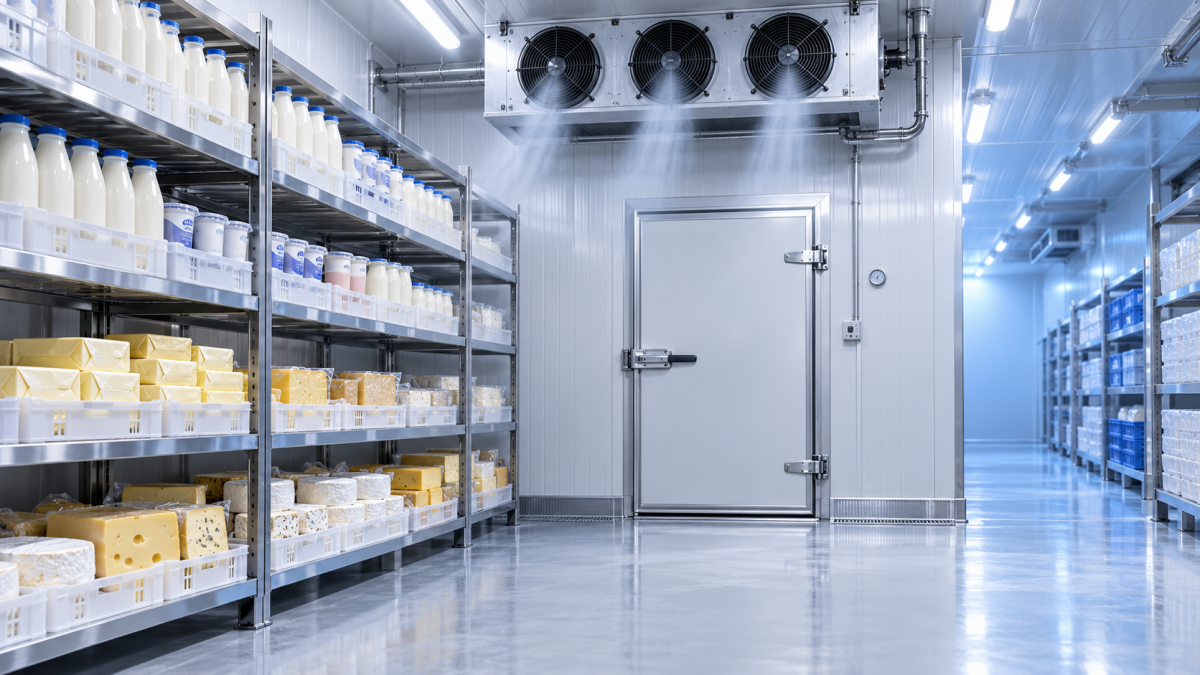
Choose a Cold Room Temperature band that remains stable in real operation
For many chilled dairy applications, a room air target around +2°C to +4°C is a practical starting point. It provides a safety margin for products requiring chilled storage while reducing the risk of accidental freezing near evaporator discharge zones. However, the final operating band should account for controller differential, sensor placement, defrost cycles, and air-temperature variation within the room.
A room controlled at +2°C may cycle between lower and higher air temperatures depending on the control strategy. If the sensor is installed in an area with unusually cold supply air or unusually warm return air, the displayed reading can give a false impression of overall room conditions. Technical teams should position sensors where they reflect representative return-air conditions and use independent product-temperature checks during commissioning.
Temperature mapping is especially valuable for dairy rooms with high racks, deep pallet rows, or long air throws. A location near the door, directly under an evaporator, or at the far end of a densely packed room may behave differently from the controller sensor location. Mapping reveals whether the specified Cold Room Temperature is being achieved where the dairy products actually sit.
Airflow and humidity can protect—or damage—dairy quality
Refrigeration capacity alone does not determine storage performance. Strong airflow improves heat transfer and helps recover after door openings, but excessive direct air movement can dry cheese surfaces, disturb lightweight packaging, or create localized cold spots. For butter and cheese, this can affect appearance and texture before there is any obvious food-safety failure.
Air distribution should be evaluated alongside pallet layout. Leave adequate clearance between stored goods, walls, and the evaporator discharge path. Do not allow cartons to block the return-air route. A room filled to its theoretical cubic capacity may have poor circulation and uneven product temperatures.
Humidity deserves the same practical attention. Dairy products with permeable packaging or exposed surfaces can lose moisture in a dry room. Conversely, frequent door openings in humid ambient conditions may cause condensation on packaging, slippery floors, and heavier frost accumulation on the evaporator. Well-sized insulation panels, vapor-tight joints, suitable cold storage doors, and disciplined loading procedures all reduce this burden on the refrigeration system.
Size the system for the difficult day, not the ideal day
When evaluating a refrigeration solution, calculate or verify the load created by transmission through panels, product pull-down, personnel, lighting, fan motors, defrosting, door openings, and infiltration air. Ambient design temperature is important: equipment selected for a mild day may struggle during summer condensing conditions.
For medium-temperature dairy rooms operating between -10 and +5°C, an integrated package can simplify matching between the condensing unit, evaporator, controls, and expansion components. The Integrated Cold Storage Cold Source is designed for this medium-temperature application range and combines the condensing unit, air cooler evaporator, expansion valve, and control elements into a coordinated refrigeration unit.
For an evaluator, the value of this approach is not merely shorter installation time. Factory-matched components can reduce risks created by incompatible field selections, incorrect valve matching, or incomplete on-site commissioning. The system uses a Copeland hermetic scroll compressor, supports 380V/50Hz/3-phase power, and is intended for applications such as restaurants, small wholesalers, supermarkets, food production facilities, central kitchens, and logistics-oriented warehouses. Its remote IoT cold storage control box can also support operational-data monitoring, which is useful where temperature records and alarm response form part of daily quality control.
Defrosting should be assessed as part of temperature stability
Every evaporator eventually accumulates frost. The question is how defrosting affects room temperature, product exposure, drainage, and energy use. Electric heating defrosting is commonly applied in cold storage configurations, but its schedule must reflect actual moisture load rather than habit. Too few defrost cycles reduce heat-transfer performance; too many cycles introduce unnecessary heat and operating cost.
Review defrost termination controls, drain arrangement, and post-defrost fan delay. If fans restart before the coil is sufficiently cold, warmer moist air can be blown into the room. If drain lines are poorly protected, ice formation can create maintenance interruptions. For dairy operations with frequent access, these details can make the difference between a stable room and a room that constantly “chases” its setpoint.
A short decision checklist before approving the design
- Confirm the required product temperature from the manufacturer’s specification and applicable food-safety rules.
- Separate chilled holding from rapid pull-down or blast-chilling duties where loading temperatures are high.
- Define the maximum daily intake, peak delivery size, door-opening frequency, and expected occupancy level.
- Check temperature uniformity at pallet level, not only at the control-panel display.
- Review insulation thickness, door type, floor insulation, vapor sealing, and ambient summer conditions.
- Verify airflow paths and keep stored dairy away from direct evaporator discharge where possible.
- Specify alarms, data logging, and response procedures for temperature excursions and power interruptions.
The most dependable dairy cold room is rarely the one with the lowest setpoint. It is the one that holds the required product condition consistently through deliveries, picking periods, defrost cycles, and seasonal ambient changes. By defining the dairy load first and then matching the room envelope, airflow, controls, and refrigeration capacity to that duty, technical evaluators can select a Cold Room Temperature strategy that supports both product quality and sensible operating costs.