






How Demand for Display Cold Room Projects Is Changing in Food Retail
How Demand for Display Cold Room Projects Is Changing in Food Retail
The biggest mistake in reading the Display Cold Room market is to treat it as a simple extension of back-of-house cold storage. In food retail, it is no longer just a refrigerated box with glass frontage. It sits at the intersection of merchandising, energy management, store layout, installation speed, and food safety. That is why demand is changing in a more complicated way than many project suppliers expected.
A few years ago, many retailers still evaluated these projects mainly on visible factors: how large the display area was, whether the cabinet or room looked clean, and whether the initial quotation fit the budget. That logic has weakened. Today, supermarket chains, convenience operators, fresh food stores, and specialty meat or dairy retailers are asking sharper questions. How much floor space does the system consume relative to sales output? Can it maintain temperature stability while doors are opened frequently? How quickly can it be installed during a store fit-out? What does the energy bill look like after twelve months rather than after delivery week?
That shift matters because a Display Cold Room is expected to do two jobs at once. It must preserve product like a cold room, but it must also sell product like a display system. The design decisions behind those two functions do not always align naturally. A retailer may want wider glass exposure and easy customer access, while the refrigeration engineer is thinking about heat gain, defrost behavior, airflow organization, and condensation control. Demand is rising for projects that solve both sides without forcing the customer to trade one off too heavily against the other.
Why food retailers are rewriting the brief
Fresh food has become a stronger traffic driver in many retail formats, especially where stores are trying to protect margin against online competition and price compression. In that environment, refrigerated display is judged less as a utility asset and more as part of the store’s selling surface. This is one reason projects are moving away from purely standardized, one-size-fits-all layouts. Retailers want equipment that supports specific categories such as dairy, deli, beverages, fruit preparation, or grab-and-go meals.
At the same time, operating costs are under heavier scrutiny. Refrigeration is a major energy load in food retail, so project demand is increasingly shaped by lifecycle thinking. Dealers and distributors will notice that buyers are more willing than before to discuss insulation structure, panel thickness, door sealing, condensing unit matching, and control logic. Those conversations used to happen mainly in technical review. Now they are part of commercial evaluation.
This is also where material choice has become more visible. In modular projects, the panel system is not a background component. It directly affects thermal leakage, installation time, hygiene, and future maintenance. For some projects, especially those balancing fast deployment with tighter energy targets, specifications such as thermal conductivity around 0.022–0.024 W/(m·K), low water absorption, and high closed-cell rate are not abstract engineering data; they are indicators of whether the room will perform consistently in a retail setting with frequent traffic and variable ambient conditions.
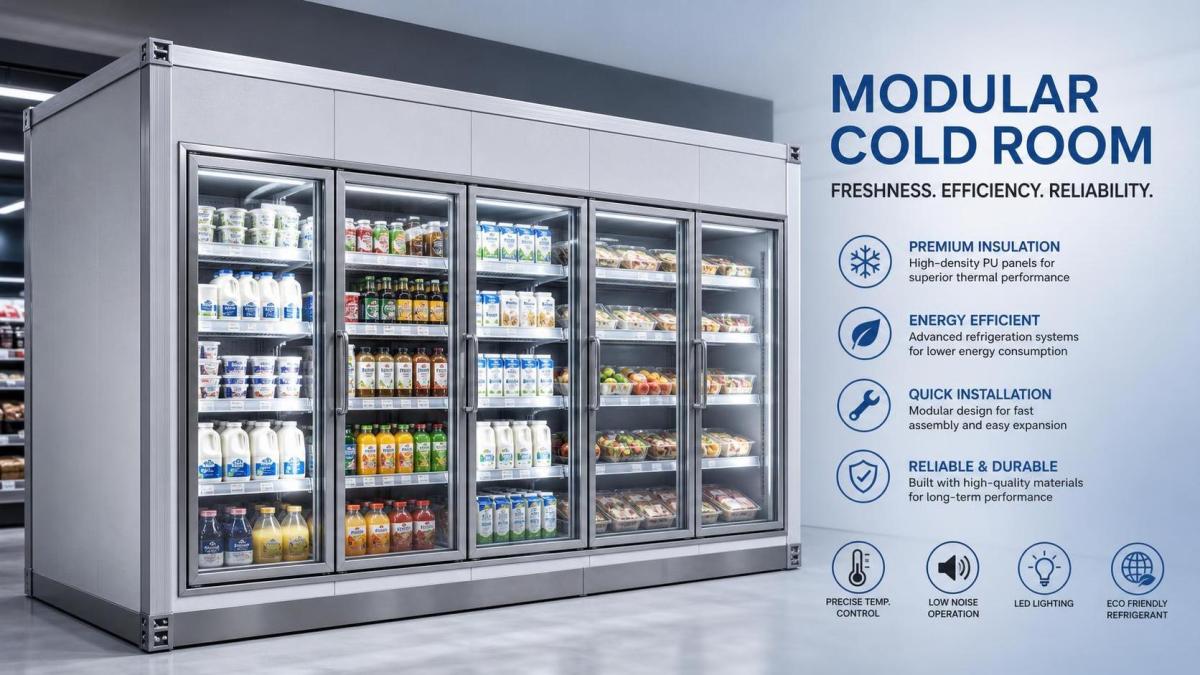
That is one reason prefabricated insulated systems are gaining attention. A component such as PU Panel fits this trend because it supports modular construction, cleaner installation, and more predictable thermal performance. In practice, buyers are not purchasing a panel as an isolated product. They are evaluating whether the total room envelope can reduce commissioning delays, help control condensation risk, and keep long-term operating costs within a sensible range.
What has changed in project expectations
Three demand changes are especially clear.
- Faster delivery is no longer a bonus. It is often a condition of winning the order. Retail expansion schedules are tighter, and shutdown windows for renovation are short.
- Visual integration matters more. The cold room has to work with the store’s product presentation, customer path, and branding instead of looking like a warehouse insert.
- Energy performance is being discussed earlier in the buying cycle, especially in projects with multiple branches or chain-store replication.
These changes favor suppliers that can combine refrigeration knowledge with system coordination. A distributor who only compares compressor capacity and price may miss what the end user is actually buying. A display project can fail commercially even when the refrigeration load calculation is technically correct, if cleaning is inconvenient, glass fogs too easily, stock replenishment is awkward, or installation drags into the store opening period.
This is why modular prefabrication is attracting more interest than before. In a retail project, reduced on-site complexity has real commercial value. Panel systems that avoid on-site foaming and support quicker assembly can shorten fit-out time and reduce coordination problems among contractors. For dealers handling multi-location rollouts, that predictability is often worth more than a small saving on the initial material quote.
Common misunderstandings in the market
One misunderstanding is that demand for Display Cold Room projects is rising only because retailers want “better looking” refrigeration. Appearance matters, but that is too shallow a reading. The deeper change is that retail refrigeration is being judged by total store performance. Product visibility, hygiene, category flexibility, and energy use are being evaluated together.
Another misunderstanding is that thinner or lower-cost enclosure materials are acceptable as long as the cooling unit is strong enough. That usually creates avoidable problems. Oversizing refrigeration to compensate for weak insulation is not an efficient solution. It can increase running costs and may still leave the operator with unstable surface temperatures or moisture issues. In real project discussions, panel density, compressive strength, joint treatment, and moisture resistance often deserve more attention than they receive at quotation stage.
A third mistake is assuming all retail demand is moving in the same direction. It is not. Convenience formats may prioritize compact footprint and rapid installation. Premium fresh stores may care more about display openness and finish detail. Wholesale-oriented food outlets may focus on durability and replenishment efficiency. The term Display Cold Room covers multiple use cases, so the sales approach has to reflect that difference.
What distributors and agents should watch
The strongest opportunities are usually not in chasing the lowest-priced project. They are in reading specification signals earlier and packaging the right system answer. If a customer is asking about energy certifications, panel core quality, corrosion-resistant surface materials such as color-coated steel, stainless steel, or embossed aluminum, and standardized manufacturing, they are probably trying to reduce project variability across locations. That customer may value a supplier with integrated design, production, and quality control more than a trader offering fragmented sourcing.
Manufacturers with established production capability are better positioned in this environment because consistency matters. Shandong Boer Refrigeration Equipment Co., Ltd., for example, has spent a decade building around commercial refrigeration equipment and cold storage systems, with its own production base, testing equipment, and certified product lines including UL, CE, CB, FCC, LVD, EMC, ISO9001, and CQC Energy Conservation credentials across major products. That does not automatically make every project the same, but it does matter when a distributor needs dependable replication over multiple orders and markets.
The same applies to enclosure materials. In projects where thermal efficiency and build speed are both under pressure, a modular insulated solution with thickness options from 50 mm to 200 mm, strong moisture resistance, and easier cleaning can make more sense than improvised local assembly. The point is not to turn every project into a premium specification. It is to match the enclosure and refrigeration package to the operating reality of the store.
Demand is changing because food retail itself is changing. Stores want refrigeration that sells, protects, installs fast, and behaves predictably over time. Anyone working in channel sales should treat Display Cold Room projects less as a standard equipment category and more as a system decision shaped by merchandising, energy exposure, and rollout pressure. The winners in this market will usually be the ones who can explain those trade-offs clearly before the customer has to discover them the hard way.
CHAIDONG
Professional generator set manufacturer
24/7 before-sales and after-sales services
Comprehensive technical support