






How fin spacing affects frost buildup in dual-discharge air coolers
Wider fin spacing generally allows a dual-discharge air cooler to operate longer before frost restricts airflow. Tighter spacing provides more heat-transfer surface within a given coil envelope, but leaves less room for frost to accumulate. For a Bilateral Cold Air Fan serving a humid cold room, that clearance can determine whether the unit maintains useful air circulation between defrost cycles.
Spacing alone, however, does not determine how quickly frost forms. Moisture entering the room, coil surface temperature, airflow distribution, and defrost effectiveness all influence the result. Technical evaluators should distinguish between the rate of frost accumulation and the time it takes that frost to obstruct the coil. Wider spacing mainly improves tolerance to accumulation; it does not remove the moisture load.
Why a small loss of clearance can become a large airflow problem
Frost develops when moisture in the air deposits or freezes on sufficiently cold coil surfaces. As it grows on adjacent fins, the open passage between them narrows. Air encounters greater resistance, and the operating point of the fan and coil changes. With a fixed-speed fan, this generally reduces airflow through the cooler.
The effect becomes more severe as frost bridges neighboring surfaces. A coil may still contain substantial open space overall while particular passages are already obstructed. Air then shifts toward less restricted areas, leaving an uneven pattern of heat transfer and further frost growth.
For a simplified geometric illustration, if the initial clear gap between fins is g and frost grows to thickness δ on each opposing surface, the remaining clearance is approximately g − 2δ. Actual frost is irregular and porous, so this is not a pressure-drop calculation. It does show why the same frost thickness consumes a larger share of a narrow passage.
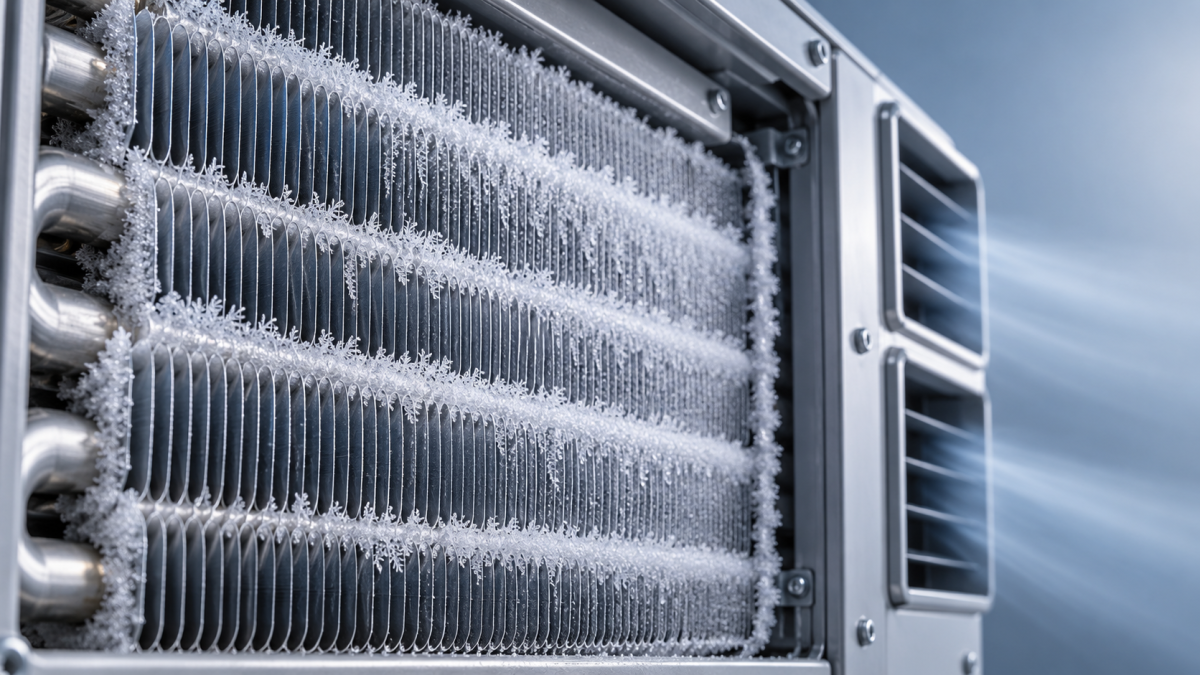
Check what a supplier means by “fin spacing.” Fin pitch may describe the distance between corresponding points on adjacent fins, whereas clear spacing excludes fin thickness. Comparisons become misleading when one drawing specifies pitch and another specifies the open gap.
Tighter spacing can improve clean-coil performance by increasing surface area, but the gain is not proportional to fin count. Fin efficiency, air velocity, tube arrangement, and air resistance also matter. Once frost develops, both its thermal resistance and the loss of airflow can erode that initial advantage.
What the dual-discharge arrangement changes
A dual-discharge cooler distributes air in two directions, making balanced delivery important to room temperature uniformity. Fin spacing affects the coil passages in much the same way as in other evaporators, but uneven frosting can have consequences across both discharge paths.
The internal airflow arrangement varies by design. Evaluators should establish how return air reaches the heat exchanger, whether the two discharge paths use separate coil sections, and how the fans interact with those sections. Two outlets do not guarantee equal air delivery throughout a refrigeration cycle.
If one part of the cooler receives more moisture or has a different air velocity, frost can accumulate unevenly. Depending on the internal arrangement, the resulting resistance may reduce one discharge more than the other. A room sensor may continue to show an acceptable temperature while circulation near particular racks or product zones deteriorates.
Coil depth also deserves attention. A wider fin pitch at the entering face does not guarantee unrestricted airflow through deeper rows. Ask whether spacing is uniform through the coil or varies by section, and inspect where frost first becomes restrictive. The relevant observation is airflow through the complete heat exchanger, not simply the appearance of its exposed face.
Choose spacing against the moisture load and operating cycle
A freezer with frequent door openings presents a different selection problem from a room holding sealed, already chilled products with limited access. In the first case, incoming warm, moist air can make frost tolerance a major constraint. In the second, closer spacing may remain practical if the cooler maintains adequate airflow throughout the intended operating interval.
Four conditions deserve particular attention:
- Moisture entry: Consider door opening duration, incoming air conditions, leakage, exposed wet products, and cleaning activity. Room relative humidity alone does not describe the total moisture reaching the coil.
- Coil operating temperature: Room temperature and refrigerant evaporating temperature influence how much of the surface remains below freezing and how moisture collects. A larger temperature difference can increase clean-coil capacity while changing frosting behavior.
- Required time between defrosts: A coil that performs well immediately after defrost may lose useful airflow before the next scheduled cycle. Assess performance over the full operating period.
- Available installation space: Wider spacing reduces fin count within the same envelope. Maintaining capacity may require changes to coil dimensions, tube arrangement, or airflow, each with installation and operating implications.
Door condition belongs in this assessment because it influences the moisture load that fin spacing must accommodate. For example, a Manual sliding door with an insulated panel and a well-seated perimeter seal can help limit infiltration while closed. Opening duration and closing discipline still govern moisture entry during access. Increasing fin spacing cannot compensate indefinitely for a doorway that remains open during repeated handling operations.
There is therefore no defensible universal pitch based only on the label “chiller” or “freezer.” Wider spacing is a stronger candidate where moisture input is high, frost-related airflow loss is demonstrated, or long uninterrupted cooling periods are necessary. Closer spacing deserves consideration where moisture is controlled and compact heat-transfer capacity matters, provided its operating margin is verified.
Compare performance between defrosts, not just catalog capacity
A useful comparison starts with capacity ratings at equivalent conditions. Entering air temperature, humidity assumptions, refrigerant conditions, airflow, and the treatment of fan heat can all affect the stated result. Ask for the applicable rating method and test conditions; a nominal capacity figure does not establish resistance to frost blockage.
For shortlisted units, request evidence showing how airflow and cooling output change during a representative frosting cycle. Where such data are unavailable, define the operating conditions and acceptance criteria for a site trial. Useful observations include coil air pressure drop, airflow or discharge velocity at consistent locations, room temperature distribution, and the time required to recover after defrost.
Keep fan operation consistent when comparing results. A speed-controlled fan may increase speed as resistance rises, temporarily maintaining airflow while consuming more power. A fixed-speed unit may show the airflow reduction sooner. Neither behavior can be assessed adequately from fan nameplate power alone.
Defrost quality can also obscure the spacing comparison. Residual ice from incomplete defrost reduces the clearance available at the start of the next cycle. Poor drainage or unsuitable restart timing can allow retained water to refreeze. Before attributing short operating intervals to narrow fins, inspect the coil after defrost and confirm that ice is removed and water drains properly.
Wider spacing may extend the interval before airflow becomes unacceptable, but it does not guarantee shorter defrosts or lower total energy use. Those outcomes depend on accumulated ice, the termination control, drainage, fan operation, and the cooling required to restore room conditions.
The selection should ultimately state an operating requirement: maintain the required cooling duty and acceptable delivery in both discharge directions until the planned defrost, under a defined moisture load. If a tighter coil meets that requirement, additional spacing may offer little practical benefit. If airflow collapses early despite effective defrost and controlled infiltration, greater clearance becomes a justified design change.