






How to Estimate Fan Power Costs for a V-Type Condenser
What numbers do you actually need to estimate fan power cost?
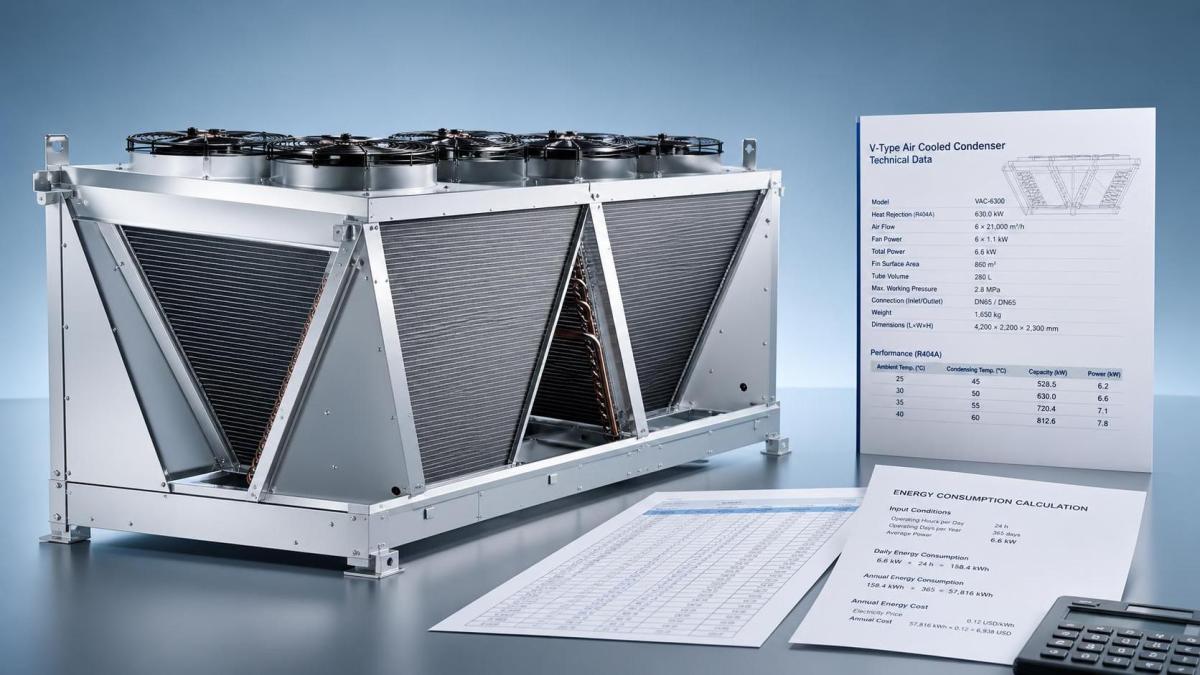
If you are reviewing a V-Type Condenser purchase, the fan power cost estimate should start with four inputs: total fan motor power in kW, expected daily operating hours, local electricity price, and annual operating days. That sounds simple, but this is where many budget sheets already go wrong. People often use the compressor running time as a shortcut, even though condenser fans may cycle differently depending on ambient temperature, head pressure control, and load variation.
The basic formula is:
Annual fan electricity cost = Total fan power (kW) x Operating hours per year x Electricity rate
For example, if a unit uses four fans rated at 0.55 kW each, total fan power is 2.2 kW. If the fans run an average of 14 hours a day for 330 days a year, that is 4,620 operating hours. At an electricity rate of $0.12/kWh, the annual fan cost is about $554.40.
That number is not the full operating cost of the condenser, but it gives finance teams a clean baseline for comparing models.
Why do fan costs deserve attention in procurement review?
Because the purchase price difference between two condensers can look small, while the operating gap keeps showing up every month. In cold storage projects, especially those planned for multi-year use, a modest reduction in fan energy can materially affect total ownership cost. This matters even more when the equipment is installed in facilities that run long hours, such as food storage, pharmaceutical rooms, logistics cold storage, or workshop cold rooms.
A finance approver usually does not need a deep thermodynamic explanation. What matters is whether the quoted condenser achieves the required heat rejection with reasonable fan input, and whether the supplier has presented the rating conditions clearly enough to make that claim meaningful.
Which supplier documents should you check before trusting the estimate?
Do not rely on a single line in a quotation that says “fan power: 2.2 kW.” You need the context behind it. Ask for the technical datasheet and check these items:
- Number of fans and motor power per fan
- Rated voltage and frequency
- Design condensing temperature or rating condition
- Air volume or airflow performance
- Whether the unit uses fixed-speed or speed-controlled fans
- Any stated power tolerance or operating range
This matters because two V-Type Condenser models can show similar capacity on paper while using different fan arrangements. Without consistent rating conditions, a cost comparison is weak from the start.
Is nameplate motor power enough for a realistic budget?
Not always. Nameplate power is a good starting point, but it may overstate or understate real annual consumption depending on control strategy. If the condenser uses fan cycling or variable speed control, actual energy use can be lower than simply multiplying full-load power by all scheduled hours. On the other hand, if the site has high ambient temperatures for long periods, the fans may run closer to full duty than expected.
For procurement approval, it is practical to build two scenarios:
- A conservative case using full installed fan power.
- An operating case using estimated average runtime or average load based on site conditions.
This gives management a range instead of a single fragile number.
What are the most common mistakes when comparing condenser fan costs?
The biggest mistake is comparing power without comparing capacity under the same condition. A lower fan kW figure is not automatically better if the coil is smaller or the unit needs harsher operating conditions to deliver the same result.
Other frequent errors include:
- Using an electricity rate that does not match the actual facility tariff
- Ignoring seasonal operating patterns
- Assuming 24/7 fan operation without checking control logic
- Leaving out maintenance-related energy penalties, such as fouled coils or airflow obstruction
- Looking only at condenser fans while ignoring system details that affect refrigeration load
That last point is easy to miss. In a cold storage project, poor door sealing or frequent warm-air ingress can increase heat load and force longer fan operation. Components such as an Manual sliding door can matter here when the application involves frequent access. A door panel with a dense polyurethane foam core, a precise fit with the frame, and a magnetic sealing strip helps reduce cold leakage. That does not change the motor rating of the condenser fans, but it can affect how often the system has to work to remove added heat.
How should a finance team compare two quotations quickly?
A simple comparison table usually works better than long technical notes. Keep it focused on the cost drivers that actually change the decision.
From there, you can estimate the payback period of the higher-efficiency option. If the more expensive condenser saves enough in fan energy over the expected service life, the premium may be justified. If the savings are small, you may decide the lower capital cost is the better use of budget.
When does a higher fan power figure still make economic sense?
When it supports a better overall operating balance. A condenser with slightly higher fan input may still be the stronger buy if it offers more stable heat rejection under the site’s design conditions, reduces system stress, or avoids undersizing risk. Cheap power numbers can be misleading if they come with thinner performance margin.
This is especially relevant in hot climates, demanding duty cycles, or facilities where uptime matters more than a narrow equipment price gap. Finance teams should ask one direct question: does the extra fan energy buy useful performance security, or is it just an inefficient design? The answer should come from side-by-side technical data, not sales language.
What is a sensible approval rule before signing off?
Approve based on comparable capacity, documented fan power, site-based operating hours, and a local electricity tariff that matches the real project. If any one of those is missing, the estimate is weak. A V-Type Condenser should be judged on operating cost in context, not on a standalone motor figure copied from a quote.
A practical rule is simple: if the supplier cannot show how fan power relates to rating condition and expected operation, the number is not ready for financial approval. Once those inputs are clear, the cost estimate becomes straightforward, and the procurement decision gets much easier to defend.
CHAIDONG
Professional generator set manufacturer
24/7 before-sales and after-sales services
Comprehensive technical support