






How to Evaluate Noise and Air Discharge in an H-Type Condenser 402CD
Start with the site reality, not the catalog
When a buyer asks about noise and air discharge on an H-Type Condenser 402CD, the real question is usually broader: will this unit behave well in the actual project, or will it create complaints, airflow problems, and extra cost after installation? For commercial evaluation, that is the right lens. You are not just checking whether the condenser can run. You are checking whether it can run quietly enough, reject heat cleanly enough, and fit the building layout without forcing expensive corrections later.
A useful review starts with three fixed points: where the unit will sit, what surrounds it, and what the operating pattern looks like across the day. Noise and discharge performance change a lot between an open industrial yard, a rooftop near offices, and a loading-area wall close to people and traffic routes.
Check the installation environment before you compare equipment
Many poor buying decisions happen because people evaluate the condenser as a standalone product. That misses the main risk. Noise level and hot-air discharge are strongly shaped by the installation environment.
- Measure the distance to offices, property lines, staff walkways, and nearby residences if the project is in a mixed-use area.
- Look for walls, screens, overhangs, or adjacent equipment that can reflect sound or trap discharged hot air.
- Identify whether several condensers will run side by side. Combined noise and recirculated heat often matter more than the performance of one unit.
- Review seasonal ambient temperature and prevailing wind direction. A layout that works in mild weather can struggle badly in peak summer.
If this first step is skipped, later comparisons become misleading. A quieter fan on paper may still sound worse after reflection from hard surfaces, and a strong air discharge can become a problem if the hot air loops back into the coil face.
Separate sound power, sound pressure, and actual disturbance
Business evaluators often receive a single noise figure and treat it as the answer. It is not. You need to know what that number represents.
Ask for the test basis and the measurement condition behind the stated noise level. A figure taken at a defined distance in open conditions is not the same as the sound experience at the customer’s site. Fan speed, coil loading, mounting height, and obstacle reflection all affect what people actually hear.
Also pay attention to the type of noise. A steady broadband sound is usually easier to live with than tonal noise, rattling, or intermittent fan surges. Those are the complaints that tend to come back through property management or facility teams.
Evaluate air discharge as a heat-rejection problem, not just an airflow number
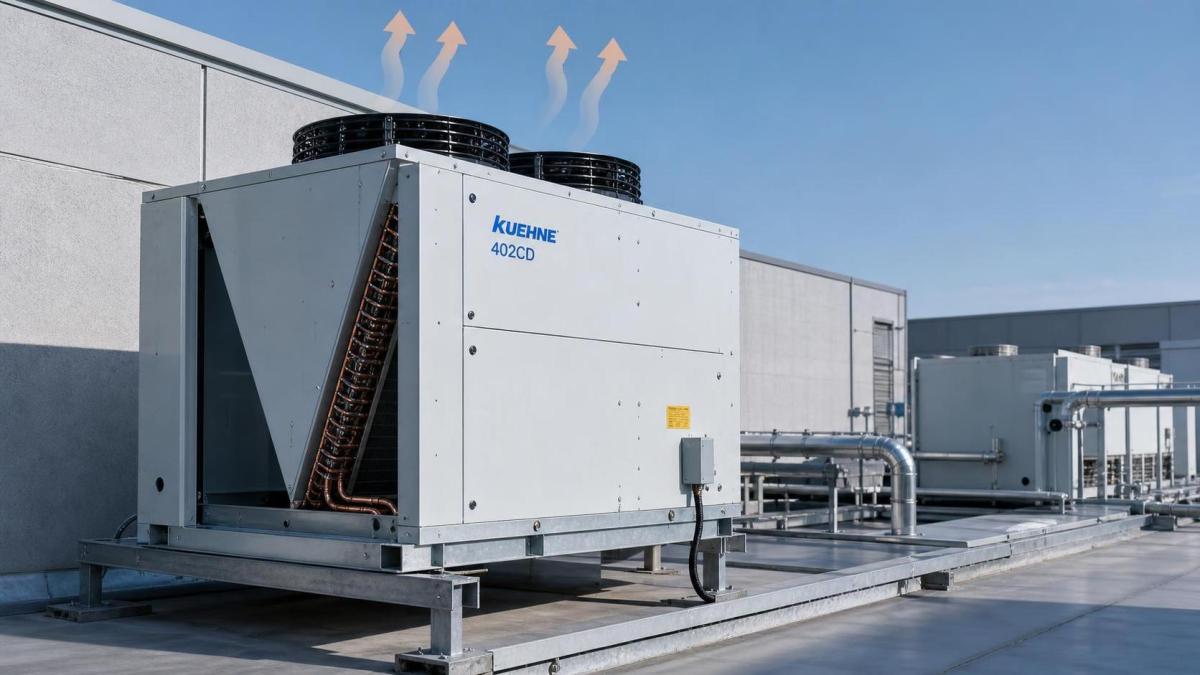
For the H-Type Condenser 402CD, the key question is whether the discharged air can leave the unit cleanly and avoid short-circuiting back into the condenser intake. If hot air recirculates, condensing temperature rises, head pressure can climb, and the system may lose efficiency or stability during high ambient periods.
What should you check in practice?
- Discharge direction relative to walls, parapets, louvers, and neighboring units.
- Clear vertical and horizontal space for heat to dissipate.
- Whether hot air can be pulled back toward the coil during low wind or crosswind conditions.
- Whether the installation area already runs hot because of kitchen exhaust, generators, or process equipment.
This is where layout drawings matter more than sales language. A strong condenser installed in a weak airflow position will underperform, and the operating penalty usually shows up when the site is busiest.
Look at the whole envelope if cold storage is part of the project
Noise and discharge are not isolated from the rest of the refrigeration system. If the cold room envelope leaks heat, the condensing side works harder and fan runtime increases. That changes both energy use and acoustic behavior. In projects where the condenser is being evaluated together with the cold room package, it is worth checking insulation quality, panel joints, and moisture resistance rather than treating them as separate procurement items.
For example, a modular enclosure using PIR Panel can be relevant to the condenser decision because lower thermal conductivity, tight splicing, and low water absorption help reduce heat gain into the room. That does not tell you condenser noise by itself, but it does affect how hard the system needs to reject heat over time.
Ask for the documents that actually support the decision
A commercial buyer should not stop at a quotation sheet. For a serious comparison, request the technical documents that let you judge whether the H-Type Condenser 402CD fits the project constraints.
- Dimensional drawing with airflow direction and service clearance.
- Electrical and fan configuration details.
- Performance data under defined ambient conditions.
- Any available test or compliance documentation tied to the exact product scope being quoted.
That last point matters. Certifications and quality systems can tell you something about the manufacturer’s process discipline, but for selection work you still need product-level documents that match the actual offered configuration. Do not assume every document applies to every fan motor, coil arrangement, or export destination.
Watch for the mistakes that create expensive noise problems later
The most common failures are not dramatic. They are small decisions that stack up:
- Mounting near reflective surfaces without considering perceived noise at occupied points.
- Using screening structures that look tidy but choke discharge airflow.
- Placing units too close together, which raises both local sound intensity and heat recirculation risk.
- Reviewing nominal performance without checking summer peak operation.
- Ignoring maintenance access, which later forces awkward service work and inconsistent fan condition.
If a supplier can explain how the proposed layout manages those five issues, the conversation is usually moving in the right direction.
Use a simple decision sequence
For procurement or technical review meetings, keep the sequence tight. Start with the site plan. Then verify airflow path and clearance. After that, compare noise data only when the test basis is clear. Finally, check whether the rest of the system, including room insulation and load profile, will push the condenser into harder operating conditions than the quotation seems to imply.
That is the practical way to judge an H-Type Condenser 402CD. If the unit has room to discharge heat cleanly, if the acoustic data matches the installation reality, and if the surrounding cold storage design is not adding avoidable load, you are evaluating the purchase on business terms rather than on catalog impressions.
CHAIDONG
Professional generator set manufacturer
24/7 before-sales and after-sales services
Comprehensive technical support