






How to Select an Air-Cooler Based on Room Size, Temperature, and Humidity
Start with the room load, not the catalog headline
When buyers compare an Air-Cooler, the mistake I see most often is starting with nominal cooling capacity alone. That number matters, but it is only useful after you understand the room itself: internal dimensions, insulation quality, door-opening frequency, pull-down requirement, product load, and target room temperature. A unit that looks sufficient on paper can become a constant source of icing, unstable room temperature, or long compressor run time if the room conditions were simplified too early.
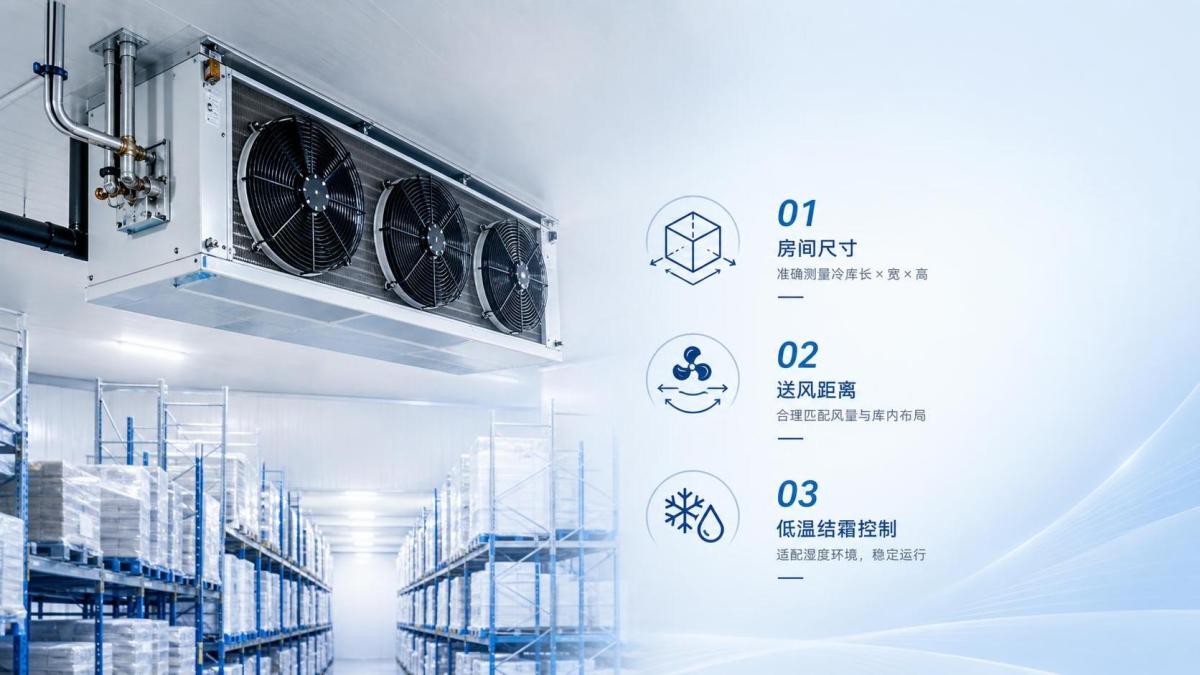
For procurement work, the practical sequence is simple: calculate or obtain the cold room load first, then match the evaporating condition, then check how humidity and air circulation will affect coil selection. If your supplier only asks for room length, width, and height, that is not enough for a serious selection.
Check room size in a way that actually helps selection
Room size is more than cubic meters. Two rooms with the same volume can need very different Air-Cooler configurations if one stores boxed frozen food and the other handles fresh produce with frequent loading cycles.
- Record internal room dimensions, not external building size.
- Note the stacking height of goods. A low-mounted evaporator in a room packed too close to the ceiling will lose effective airflow.
- Check aisle width and shelving layout. Good capacity with poor air distribution still gives hot spots.
- Separate storage rooms from processing rooms. Processing areas usually have higher sensible and moisture loads.
A useful buying question is not “What Air-Cooler fits a 100 m² room?” but “What air throw, coil size, and fan arrangement can keep this specific room uniform under actual loading conditions?” That wording usually gets better answers from technical teams.
Pin down the operating temperature range before comparing models
Temperature drives the whole selection. Chilled storage, deep-freeze storage, and dual-purpose rooms should not be grouped together during sourcing. The same Air-Cooler family may perform very differently depending on the evaporating temperature and the TD you are working with.
Ask for the selection basis in writing: room setpoint, evaporating temperature, refrigerant, and rated condition. Without that, capacity comparisons across suppliers are shaky. One quotation may be based on a milder condition and look stronger than another even when the actual low-temperature performance is weaker.
This is also where condensing equipment starts to matter. If your project includes a low-temperature system, the evaporator should be reviewed together with the condensing side. For example, a Piston-type Condensing Unit built around model 4TSE-9Y is specified for temperature conditions from 0 to -30 and lists low-temperature evaporating points down to -40°C with R507 and 380V/3/50HZ power supply. That kind of information is useful because it tells you whether the overall system is being considered as a matched low-temperature package rather than as isolated components.
Treat humidity as a selection factor, not an afterthought
Humidity changes the job of an Air-Cooler in a very practical way. High-humidity rooms, fresh produce storage, and spaces with frequent warm-air infiltration put more frost on the coil. That means you need to pay attention to fin spacing, defrost method, and allowable air velocity. If you ignore this, the unit may look efficient during commissioning and then lose capacity quickly in day-to-day operation.
Here is the rule of thumb buyers should use: the wetter the room, the less sense it makes to chase the most compact coil. A tighter fin pitch may increase heat transfer in clean, dry conditions, but in humid cold rooms it can become a maintenance penalty. You are buying stable operation, not just initial performance.
What to request on the technical sheet
A serious quotation should let you compare like for like. At minimum, ask for these items before approving an Air-Cooler model:
Look at airflow before you approve anything
Airflow problems usually show up after handover, when changing models is expensive. Check the mounting position, discharge direction, air throw distance, and clearance to stored goods. In long rooms, one oversized unit is not always better than two properly placed units. In compact rooms, too much direct air velocity can dry exposed product or create unnecessary temperature fluctuation near the outlet.
If the room will be heavily loaded most of the time, ask the supplier to comment on effective circulation under near-full occupancy. Empty-room performance tells only part of the story.
Review the system match, not just the evaporator
Procurement teams sometimes buy the Air-Cooler and condensing side separately, then discover a mismatch in operating conditions or piping arrangement. A better approach is to check whether the refrigerant, voltage, compressor selection, and winter operating control logic fit the same project brief.
For instance, low-temperature systems can benefit from features intended to stabilize liquid supply and condensing behavior. The linked condensing unit above includes a suction-line heat exchanger gas-liquid separator to help reduce flash gas before the expansion valve, and a head pressure controller for winter conditions. Those details do not replace proper Air-Cooler selection, but they do affect how reliably the whole refrigeration circuit performs once ambient conditions change.
Common buying errors that cost money later
- Choosing by room volume only and ignoring product turnover.
- Comparing quoted capacities without checking the rating condition.
- Using a humid-room coil selection in a dry frozen room, or the reverse.
- Overlooking power supply details such as 380V/3/50HZ compatibility.
- Leaving no service space for cleaning, fan replacement, or drainage work.
A practical approval sequence for buyers
Before issuing the purchase order, run the decision in this order: confirm room use and loading pattern, verify target temperature and evaporating condition, classify the room’s humidity and infiltration level, review airflow layout, then check whether the Air-Cooler and condensing equipment are rated on the same technical basis. That sequence catches most expensive mistakes early.
If two offers still look close, take the one with clearer rating conditions, better system matching, and fewer operational compromises in your actual room environment. In refrigeration procurement, the better choice is usually the unit that stays predictable after months of use, not the one that only looks stronger in a simplified comparison sheet.
CHAIDONG
Professional generator set manufacturer
24/7 before-sales and after-sales services
Comprehensive technical support