






How to assess a cold room exporter's remote installation support
A competitive quotation offers little reassurance when your installation crew is standing beside an unopened control cabinet, waiting for an answer. For project managers, assessing a cold room exporter’s remote installation support is part of controlling schedule, safety, and commissioning risk—not an after-sales detail to settle later.
The most useful question is not “Do you provide online support?” It is “Can your engineers guide our local team through this specific installation, using controlled documents, agreed response times, and a clear escalation process?” Before placing an order, ask for evidence that makes the answer measurable.
Start with the work your local team must actually perform
Remote support requirements depend on how the refrigeration system arrives. A prefabricated room with a factory-assembled refrigeration package presents different challenges from a split system requiring field piping, evacuation, and refrigerant charging.
Send each shortlisted supplier the same site information: room dimensions, target temperature, stored goods, loading pattern, ambient conditions, electrical supply, access restrictions, and local contractor capabilities. Include photographs of the proposed equipment location and surrounding ventilation space.
Then request a responsibility matrix covering:
- Building preparation: floor condition, drainage, structural supports, and any low-temperature floor frost protection.
- Room assembly: panel sequence, joints, vapor sealing, doors, and penetrations.
- Refrigeration installation: equipment mounting, piping where applicable, insulation, and condensate drainage.
- Electrical work: protective devices, earthing, isolators, and control connections.
- Startup: pre-start checks, parameter verification, operational testing, and acceptance records.
A capable exporter identifies what it supplies, what it explains remotely, and what a qualified local contractor must execute. “We guide everything” is not a substitute for that division.
Ask a cold room exporter to show the installation package before purchase
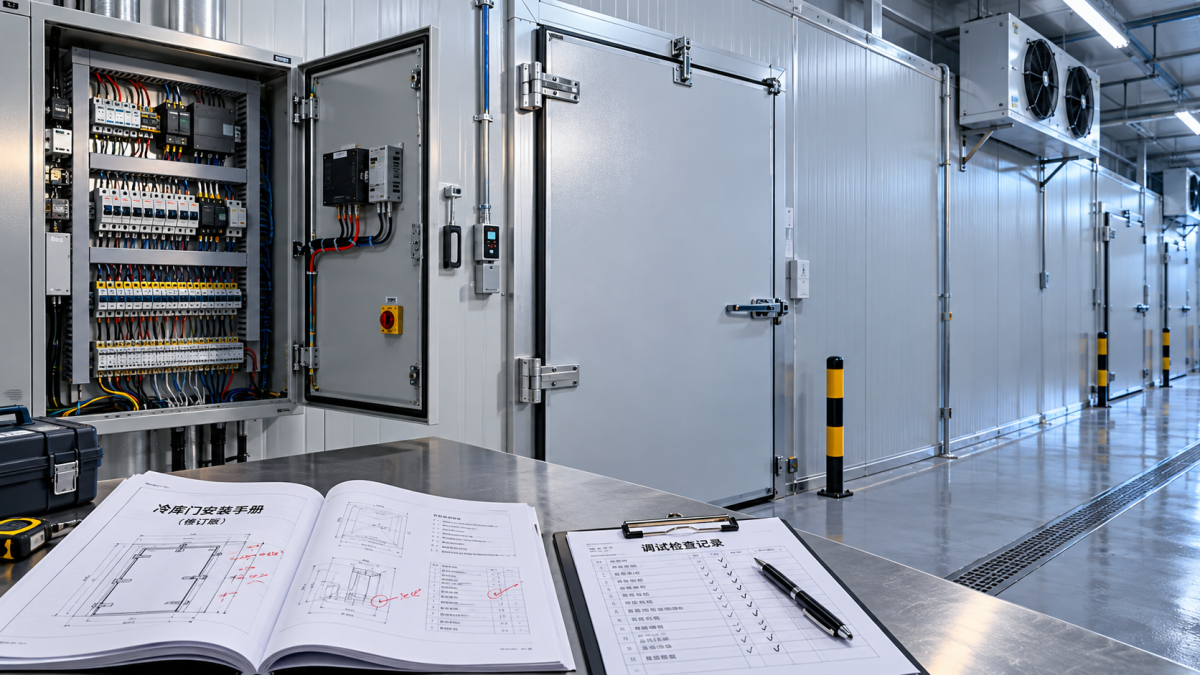
Request an anonymized sample package, followed by a commitment to provide project-specific documents before dispatch. Generic manuals may explain individual components but leave installers guessing how the complete system fits together.
Look for document numbers, revision dates, equipment identification, and readable units. Ask how changes made after order confirmation reach the site team. An outdated wiring diagram can create more trouble than a missing one because installers may trust it.
Turn “timely support” into an operational agreement
A messaging-app contact is convenient, but it does not define service availability. Your crew may start work just as the exporter’s engineering office closes. Clarify the overlap before the installation dates are fixed.
Ask the supplier to distinguish acknowledgment time from technical response time. Confirm support hours and time zone, working languages, weekend coverage, and whether scheduled video sessions are available. Any response commitments should be agreed in writing rather than inferred from sales conversations.
There should also be a named technical lead, a backup contact, and an escalation route for unresolved issues. The sales representative can coordinate communication, but electrical and refrigeration decisions need appropriate engineering review.
Establish one shared issue log. Each entry should identify the equipment, symptom, photographs or readings, proposed action, responsible person, and status. This prevents different technicians from following conflicting instructions across separate chat threads.
Run a troubleshooting rehearsal—not just a sales call
A short technical meeting before awarding the order can reveal how the supplier works under pressure. Present a realistic scenario: the room is not reaching its setpoint after startup, and the local technician needs guidance.
A methodical engineer should first establish operating conditions: ambient temperature, room temperature, product loading, door activity, alarm status, and whether fans and compressors are operating. Depending on the system, further measurements may require a qualified refrigeration technician.
Listen for a structured sequence:
- Confirm the unit identity and immediate safety concerns.
- Request specific photographs, readings, and operating history.
- Separate installation problems from settings, load, or equipment faults.
- Recommend a controlled action within the local technician’s competence.
- Record the outcome and escalate if the symptom remains.
Be cautious if the first recommendation is to add refrigerant, alter several parameters simultaneously, or bypass a protective device. Remote guidance must not replace qualified local work. Live electrical checks, pressure-system work, refrigerant handling, and lifting require competent personnel and compliance with local rules.
Match the support package to the equipment design
Integrated refrigeration equipment can reduce field assembly, but it does not eliminate site verification. For example, the All-in-One Machine, model BOR-LF012P1GC, combines the compressor, condenser, evaporator, throttling valve, and electrical controls in one package. Its specified supply is 230 V/50 Hz/single-phase, and its listed refrigerant is R404A.
For a factory-prepared package intended to avoid on-site refrigerant piping and charging, the remote-support discussion shifts toward mounting, sealing, ventilation, drainage, electrical connection, and controller checks. Request the model-specific installation drawing rather than assuming that every mounting arrangement is permitted.
Also confirm refrigerant acceptability, service availability, and applicable restrictions in the destination market before ordering. Factory testing does not remove the need for site startup checks. Likewise, temperature-control precision is not proof that a unit has sufficient cooling capacity for your room, product load, and ambient conditions.
Define completion before the equipment leaves the factory
“The compressor runs” is not an adequate handover criterion. Agree on a commissioning record that captures the room setpoint, ambient conditions, initial loading condition, operating temperatures, alarm checks, defrost operation, drainage, and door function. Define the observation period and acceptance limits for the actual project.
Test under an agreed load condition. An empty-room pull-down test does not demonstrate performance with incoming warm goods. Where product temperatures matter, distinguish them from displayed air temperature.
Clarify what happens if installation stops because of a suspected faulty component. Ask about diagnostic evidence, warranty authorization, spare-part availability, freight responsibility, and whether replacement work requires prior approval. Avoid promising a completion date to your own client until these dependencies are understood.
Make the selection evidence-led
Score shortlisted exporters against the same categories: project-specific documentation, technical competence, communication coverage, escalation, commissioning guidance, and spare-parts arrangements. Mark each item as demonstrated, promised in writing, or unverified. Treat safety-critical documentation gaps as approval conditions rather than weaknesses that a lower price can offset.
Shandong Boer Refrigeration Equipment Co., Ltd., established in 2014, manufactures cold storage systems and components including modular rooms, polyurethane panels, doors, air coolers, condensers, and condensing units. For an integrated supplier of this kind, ask how room-envelope details, refrigeration selection, and controls are coordinated within one project package. Manufacturing breadth is useful context, but it does not by itself prove remote-support readiness.
Before issuing the purchase order, hold a document review with the exporter and your local installer. Resolve open points, record support arrangements, and attach the agreed deliverables to the order. The right cold room exporter makes the installation team’s next step clear—and knows when remote advice must give way to qualified on-site intervention.