






How to check a cold room exporter's refrigerant compliance for the EU
Before approving a cold room exporter for an EU order, establish three things: what refrigerant the equipment will use, which restrictions apply to that equipment category, and who will fulfil the importer’s obligations. A CE mark alone does not answer these questions. A useful compliance assessment connects the exact model and shipment configuration to Regulation (EU) 2024/573, supported by documents that the EU importer can retain and explain.
For distributors and agents, the decision should cover both market access and serviceability. Equipment may face restrictions on being placed on the market, while separate rules affect the refrigerants available for maintenance. Approval therefore needs to address the proposed delivery and installation schedule, along with the customer’s expected operating life.
Start with the equipment configuration, not the supplier’s certificate folder
A “cold room package” can mean insulated panels and doors, a factory-complete refrigeration appliance, or separate components assembled into a working system at the destination. These configurations require different checks. Ask the exporter to identify every refrigeration component, whether it contains refrigerant when shipped, and how the finished system will be installed.
Request a model-specific technical schedule containing:
- The refrigerant designation, including the exact blend where applicable.
- The refrigerant’s GWP and the calculation basis used under the applicable EU rules.
- The factory charge in kilograms, or a clear statement that the equipment is shipped without refrigerant.
- The expected final charge, cooling capacity and design temperatures for the proposed system.
- A description of whether the equipment is self-contained or requires refrigerant connections during installation.
- The intended EU destination, installation arrangement and responsible importer.
A statement such as “environmentally friendly refrigerant” provides no usable compliance evidence. Even a familiar refrigerant designation needs to match the quotation, technical datasheet, equipment label and shipping documents. If different documents show different refrigerants, resolve the discrepancy before approving production.
Calculate the charge in tonnes of CO₂ equivalent where relevant: charge in kilograms multiplied by GWP, divided by 1,000. This helps assess obligations expressed in CO₂ equivalent, but it does not replace checks based on refrigerant type, equipment category or refrigerant mass.
Match the proposed system to the relevant EU restriction
Regulation (EU) 2024/573 is the central reference for fluorinated greenhouse gases. Its Annex IV sets out prohibitions on placing specified products and equipment on the market, with conditions and dates that differ by category. Ask the exporter to identify the applicable entry and explain how the offered configuration meets it. A generic statement that a refrigerant is “allowed in Europe” is insufficient.
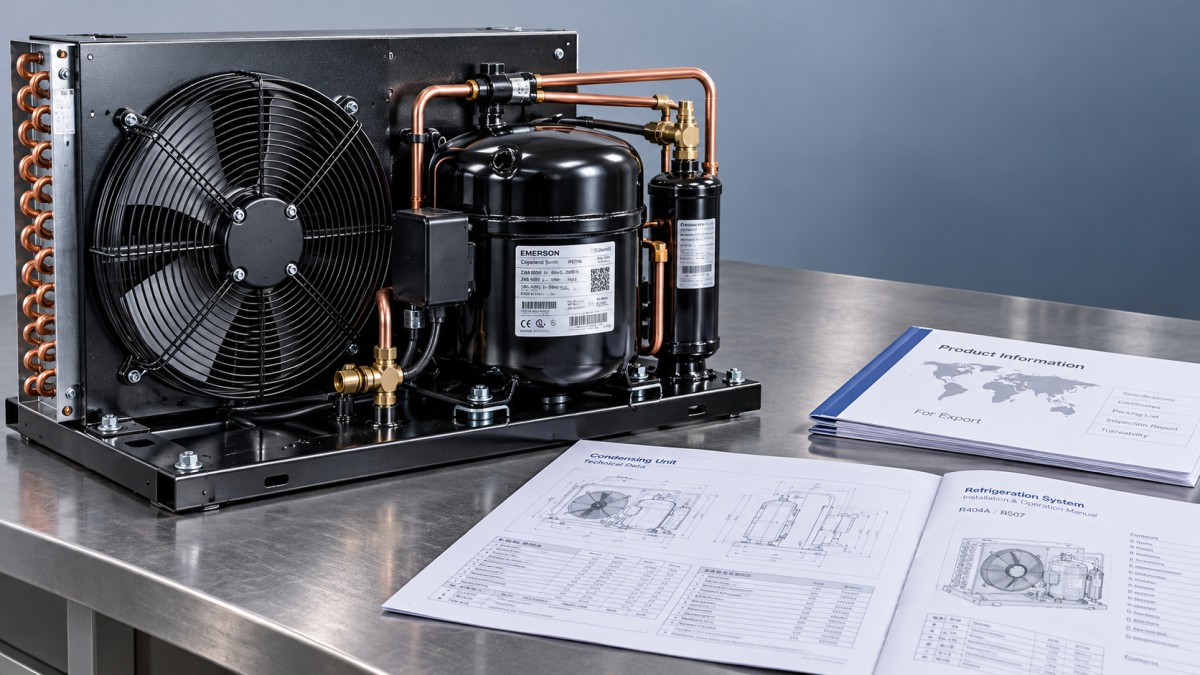
Classification deserves particular attention. A self-contained refrigeration appliance, a condensing unit connected to an evaporator on site, and a multipack centralised system serving commercial refrigeration should not automatically receive the same assessment. Capacity, application and temperature can affect which provisions apply. The commercial description “cold room unit” is too broad to settle the question.
For example, R404A has a GWP above 2,500, making it a clear warning sign when offered for a new stationary refrigeration installation. However, choosing a refrigerant below that threshold does not establish compliance. Other restrictions use lower thresholds, apply to particular equipment categories, or take effect on different dates. Some provisions also contain narrowly defined exceptions.
Require the compliance assessment to identify the relevant prohibition date and the event it governs. “Placed on the market” has a legal meaning; it is not interchangeable with the factory production date, order date or installation date. A distributor holding stock across a regulatory deadline needs evidence supporting the equipment’s status, rather than relying on the supplier’s invoice date alone.
Use the consolidated regulation available through EUR-Lex and relevant European Commission guidance to check the supplier’s interpretation. If an exception is claimed, obtain its precise legal basis and supporting technical justification. A sales representative’s assurance should not become the importer’s only record.
Check the servicing route before accepting a refrigerant choice
Article 13 contains restrictions on the use of certain fluorinated greenhouse gases for servicing and maintenance. These are separate from the rules governing new equipment. Provisions concerning reclaimed or recycled refrigerant have specific conditions and time limits; they should not be presented as an unrestricted long-term supply solution.
Ask who will service the system locally, whether technicians can handle the refrigerant safely, and how replacement refrigerant will be sourced. A proposed future conversion also needs scrutiny: changing refrigerant can require checks of compressor approval, controls, lubricant, operating pressures and cooling performance. “Can be retrofitted later” is not a service plan without an engineering assessment.
Separate product compliance from HFC import compliance
When refrigeration equipment arrives pre-charged with HFCs, Article 19 introduces an additional verification task: establishing that the HFCs charged into the equipment are accounted for within the EU quota system. The importer needs the required documentation and declaration of conformity, together with independent verification where applicable. This declaration serves a different purpose from the EU declaration of conformity associated with CE marking.
Ask the exporter and proposed EU importer to explain the accounting route for the actual shipment. Where quota authorisations are involved, check the relevant records in the F-gas Portal. Establish who holds the necessary registration and who will retain the supporting evidence. An exporter’s experience shipping to Europe does not prove that a particular importer or consignment meets these requirements.
If the equipment is shipped without HFC refrigerant and charged after installation, the pre-charged equipment accounting question changes. Other equipment restrictions, installation requirements and obligations concerning the refrigerant supplied in the EU still need assessment. Shipping a prohibited equipment configuration empty does not automatically make it acceptable.
Also review the materials supplied with the cold room. The refrigeration circuit and the insulation can raise separate questions because foam may involve regulated blowing agents. For an insulated component such as a Fully concealed hinge door, request a declaration identifying the foam blowing agent and its compliance basis. Door thickness and sealing performance help assess thermal suitability, but they do not establish compliance with fluorinated-gas restrictions.
Approve a traceable evidence package before shipment
The strongest supplier submission follows the equipment from quotation through shipment. It should let your team connect a model number and serial number to the refrigerant specification, legal assessment and importer records without reconstructing the transaction from sales emails.
Request these records before releasing the shipment:
- Technical identification: the approved model schedule, refrigeration schematic, refrigerant designation, factory charge and operating limits.
- Restriction assessment: the applicable Annex IV category, relevant dates and documented basis for any exception.
- Labels and instructions: label artwork meeting applicable F-gas requirements, with language requirements checked for the destination market.
- Import evidence: the applicable Article 19 documentation and relevant F-gas Portal records for pre-charged HFC equipment.
- Installation and service provisions: instructions, technician qualification requirements where applicable, and arrangements for commissioning and refrigerant records.
Review CE documentation alongside this package. The EU declaration of conformity should identify the supplied equipment and applicable legislation. A certificate for another model, a compressor certificate or an ISO 9001 certificate cannot establish refrigerant compliance for the complete installation. Alternative refrigerants also require suitable engineering: flammability, toxicity and operating pressure must be addressed through the applicable safety assessment and installation design.
Make the purchase specification enforceable by recording the approved refrigerant, shipment charge, equipment configuration and required documents. Require written approval for substitutions. Before dispatch, compare nameplate photographs and packing records against that specification. If the supplier changes the refrigerant or unit configuration, reopen the assessment before accepting the change; the original approval may no longer cover what is being shipped.
CHAIDONG
Professional generator set manufacturer
24/7 before-sales and after-sales services
Comprehensive technical support