






Refrigeration Equipment Buying Checklist: Cost, Lead Time, and After-Sales Support
What should a procurement team check before comparing Refrigeration Equipment prices?
Start with scope, not price. A low quote means very little if one supplier priced only the condensing unit while another included panels, doors, controls, piping accessories, or testing. In Refrigeration Equipment purchasing, the fastest way to lose control of budget is to compare incomplete offers as if they were equal.
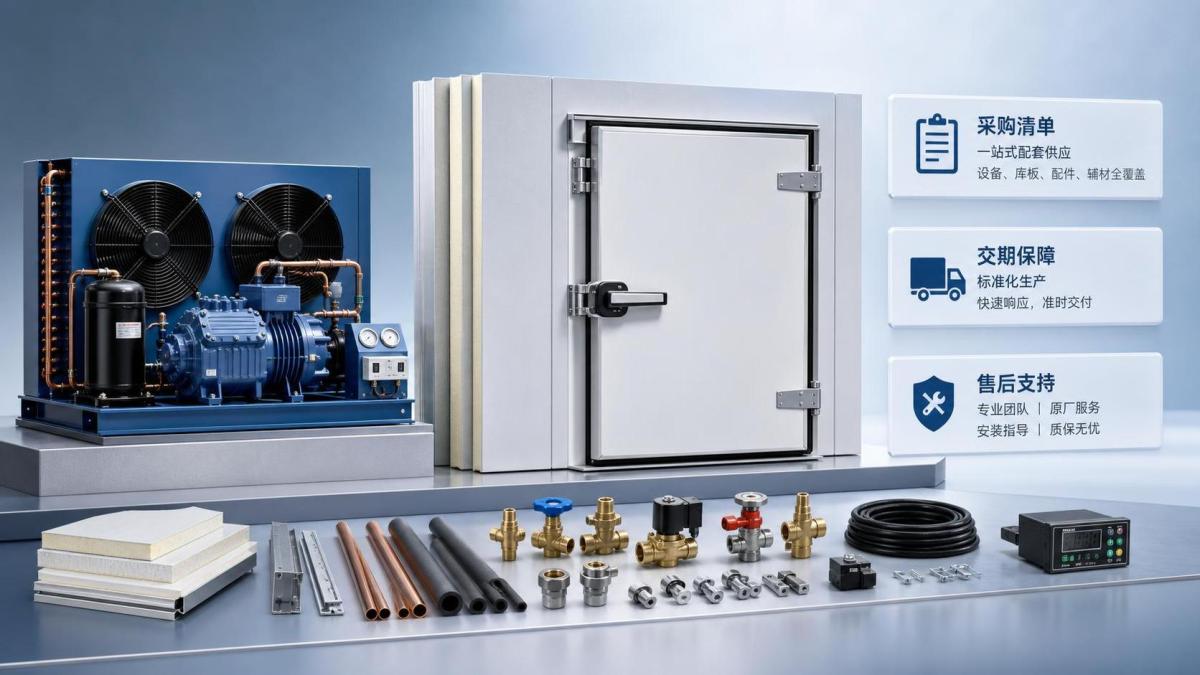
A usable buying checklist should include the application temperature, room size, product type being stored, installation location, power supply, insulation requirements, and the exact delivery scope. If the project involves a cold room, confirm whether the quotation covers only equipment or also enclosure parts such as panels and doors. This is where many hidden costs appear later.
For example, a door choice can affect both budget and installation time. In small and medium-sized cold storage facilities, a Semi-recessed Hinge Door may be selected because it has a relatively simple structure, reliable sealing, and easy on-site installation. If you are evaluating this kind of door, the practical checkpoints are straightforward: panel thickness options of 100mm, 150mm, or 200mm, standard opening sizes such as 0.7*1.7m, 0.8*1.8m, and 1.0*2.0m, plus whether your custom width stays within the recommended single-door range of 1.2m or less.
Is the lowest quotation usually the cheapest option in the end?
Usually, no. The purchase price is only one part of the cost. The real comparison is total cost over the equipment life: energy use, maintenance frequency, spare parts availability, installation complexity, and downtime risk.
Procurement teams often save money upfront and then give it back through higher operating cost or rework. A unit that is harder to install, a door with poor sealing, or components that do not match the project conditions can create repeated service calls. Even small failures become expensive when they interrupt storage operations.
A better comparison method is this:
- Quoted equipment price
- Freight and packaging cost
- Installation labor and site adjustment
- Expected energy consumption
- Wear parts and replacement intervals
- Potential cost of delayed startup or service response
If one supplier is higher by a small margin but offers better production consistency, clearer documentation, and easier maintenance, that quote may be stronger from a procurement standpoint.
How can I judge whether the lead time is realistic?
Ask for a lead time breakdown, not a single number. A realistic answer should separate production time, inspection, packing, and shipping. If customized components are involved, that should be stated clearly as well.
Lead time becomes unreliable when the supplier cannot explain what is standard and what is made to order. For cold storage projects, custom dimensions, special panel thickness, or nonstandard door openings often affect schedule. Imported components can also extend delivery even when the basic equipment is available.
A practical buyer should request these details in writing:
Which documents matter most before issuing a purchase order?
Three groups of documents matter most: technical documents, commercial documents, and quality documents.
On the technical side, request drawings, specifications, and the final bill of materials or configuration list. For commercial control, confirm quotation validity, payment terms, delivery terms, packing method, and warranty language. For quality review, ask what certifications apply to the offered product and whether the supplier has a documented production and inspection process.
This matters because broad company credentials do not automatically prove that every offered item matches your exact project scope. Procurement mistakes often happen when buyers assume the general company profile and the actual order configuration are the same thing.
What should I look for in after-sales support beyond the warranty period?
Warranty length is only the surface. What actually affects operations is response speed, parts supply, troubleshooting process, and whether the supplier can support your market after delivery.
A solid after-sales discussion should answer practical questions: who handles technical support, what information must be provided when reporting a fault, which spare parts are considered consumables, and how replacement parts are shipped. If the project is overseas, check whether the supplier routinely handles export business and can provide the documents needed for shipment and customs processing.
For parts exposed to regular wear, such as seals or hardware, low-maintenance designs can reduce long-term service cost. That is one reason some buyers pay attention to details such as replaceable sealing strips and durable hardware when reviewing cold room access components.
When does customization help, and when does it create purchasing risk?
Customization helps when the site conditions truly require it: nonstandard room dimensions, special thickness requirements, or operating conditions that standard products do not fit. It becomes a risk when the buyer requests changes without locking the full specification early.
Every custom element can affect price, lead time, packaging, and installation. So the rule is simple: customize only what changes performance or fit. Do not customize for preference alone unless the project can absorb the extra schedule and cost impact.
Before approving a custom item, confirm the final drawing, dimensions, materials, and interface points with the rest of the system. In cold room packages, even a small mismatch between opening size and delivered door specification can delay site work.
What are the most common buying mistakes in Refrigeration Equipment projects?
The most common mistakes are surprisingly basic:
- Comparing quotes with different scopes
- Ignoring installation details until after ordering
- Focusing on warranty months instead of service capability
- Approving custom dimensions without a final drawing check
- Missing operating details such as room temperature range or traffic frequency
Another frequent issue is treating every component as interchangeable. In reality, cold storage systems work as a package. Door structure, insulation thickness, condensing capacity, and service access all affect the final result. Even a component that looks minor in the quotation can influence operating stability.
If I have to make a fast decision, what is the shortest reliable checklist?
Use five control points. If any one of them is unclear, the order is not ready.
- Final application and temperature requirement are defined.
- Quotation scope matches the actual project scope line by line.
- Lead time is broken into production, inspection, and shipping stages.
- Key drawings, dimensions, and materials are confirmed before payment.
- After-sales process and spare parts path are clear in writing.
If procurement has to choose between a slightly cheaper offer and a clearer, better-supported one, the safer decision is usually the offer with fewer unknowns. In Refrigeration Equipment purchasing, unclear details are where cost overruns start.
CHAIDONG
Professional generator set manufacturer
24/7 before-sales and after-sales services
Comprehensive technical support