






What Certifications Matter When Importing Commercial Refrigeration Equipment?
What Certifications Matter When Importing Commercial Refrigeration Equipment?
The biggest mistake in cross-border purchasing is treating certifications as a box-ticking exercise. In commercial refrigeration, a certificate is not just a logo on a nameplate. It tells you which market the equipment can legally enter, what electrical and safety assumptions were used in design, whether test results were reviewed by a recognized body, and in some cases whether the product has a better chance of passing local inspection without delay. If you import Refrigeration Equipment for resale or project supply, that difference matters more than the brochure claims.
Many buyers ask for “all international certificates,” but that is not how compliance works in practice. Certifications are market-specific, product-specific, and sometimes even installation-specific. A condensing unit, an evaporator, a cold room panel, and a cold storage door may sit in the same system, yet they are not always evaluated under the same rules. A supplier that understands this distinction is usually easier to work with because the documentation package will match the actual shipment instead of relying on generic declarations.
The certifications that usually matter first
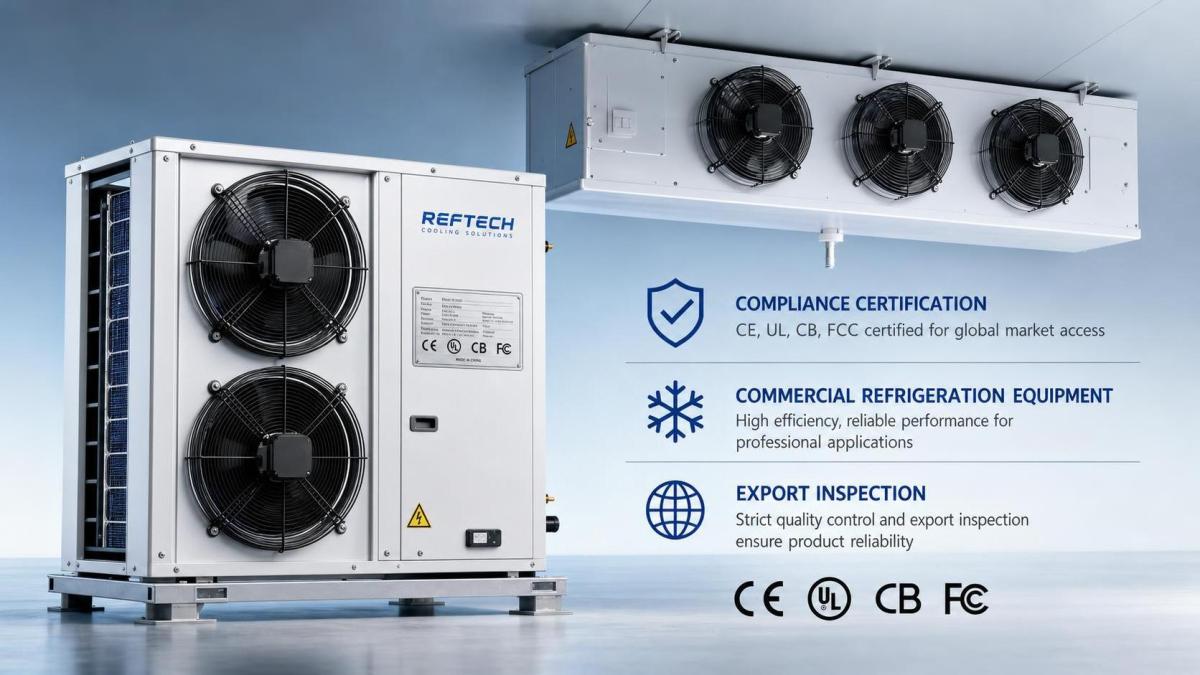
For most import decisions, the priority list starts with electrical safety, electromagnetic compatibility, and quality system evidence. In Europe, CE is often the first checkpoint, but CE itself is not one single test. It is a conformity framework tied to applicable directives and standards. For refrigeration equipment with electrical components, buyers typically look beyond the CE mark and ask which supporting directives are involved, especially LVD for electrical safety and EMC for electromagnetic compatibility. If the product uses controls, heaters, fan motors, or power components, this is not a small detail.
For North America, UL tends to carry more practical weight because local distributors, inspectors, and end users often recognize it immediately. UL is not interchangeable with CE. A unit prepared for one market may still require redesign, component substitution, or different documentation for the other. CB certification sits in a different category again. It is useful because it supports international market access and can simplify the path toward multiple national approvals, but it is not automatically a substitute for every country’s local requirement.
FCC becomes relevant when equipment contains electronic control systems that may emit radio-frequency interference. It does not replace electrical safety approval. ISO9001 also matters, but in a different way: it does not certify the product itself. It indicates that the manufacturer operates under a documented quality management system. For importers, that usually reduces risk around process consistency, traceability, and document control, especially when repeat orders and multi-batch procurement are involved.
Energy-related certifications can also affect purchasing decisions, especially for project bidding, public procurement, or customers with strict operating cost targets. In China, for example, CQC Energy Conservation certification can signal that the product aligns with recognized efficiency requirements in that market. Outside China, the equivalent benchmark may be different, so importers should map the certificate to the destination country rather than assume universal acceptance.
Why the document set matters as much as the certificate name
Experienced buyers rarely stop at the certificate headline. They ask for the test report reference, certificate validity, issuing body, covered model range, electrical rating, refrigerant context where relevant, and whether the exact shipped configuration matches the approved version. This is where import problems usually start. A manufacturer may hold legitimate approvals, but if the exported model uses a different fan motor, heater wattage, control box, or power supply, the paperwork may no longer cleanly apply.
That is especially important in refrigeration because small configuration changes are common. Take an evaporator used in a cold room application: defrost type, fan protection level, fin spacing, and operating temperature range all affect real-world use. A unit intended for medium-temperature storage is not automatically interchangeable with one selected for low-temperature duty, even if the external form looks similar. When evaluating a component such as Commercial Ceiling-Mounted Evaporator 401D, an importer should read beyond the model label and check whether technical details align with the target project. This model, for instance, lists different cooling capacities under 0°C, -18°C, and -25°C conditions, uses an IP54 external rotor axial fan, and offers different fin spacing options. Those are engineering details, but they also influence whether the supplied documentation truly supports the intended use.
Common misunderstandings that create import risk
One common misunderstanding is assuming that a certification held by the manufacturer applies to every product the factory makes. It does not. Certifications are granted to defined products or families under specific conditions. Another is assuming customs clearance and market compliance are the same thing. In some destinations, goods may clear customs but still face problems during local installation approval, insurance review, or end-customer acceptance if the compliance file is incomplete.
There is also a tendency to focus only on the main unit and ignore system components. In cold storage projects, panels, doors, evaporators, condensers, and condensing units can trigger different technical and fire, electrical, or insulation-related questions. A supplier with broad system experience generally handles this better because the compliance conversation is tied to the whole application, not just one SKU. Shandong Boer Refrigeration Equipment Co., Ltd., for example, manufactures across major cold storage categories and states that its main products have obtained certifications including UL, CE, CB, FCC, LVD, EMC, ISO9001, and CQC Energy Conservation. That breadth matters because distributors sourcing mixed refrigeration packages often need a coordinated document trail rather than isolated certificates from unrelated vendors.
How to judge a supplier before placing the order
A practical review is usually more useful than asking for “full compliance.” Start with three questions: which country is the final destination, which product model and configuration will be shipped, and which approvals are actually required for sale, installation, or tender participation in that market. Then request the certificate copies and supporting technical documents for that exact model range. Check the issuing body, dates, ratings, and description carefully. If the product includes electrical defrost, motors, or controls, ask whether those components are the same as in the certified version.
It is also worth checking whether the manufacturer has the production discipline to keep certified configurations stable over time. In refrigeration exports, repeatability matters. A factory with modern production lines, in-house testing capability, and a documented quality system is generally better positioned to maintain consistency from one batch to the next. That does not replace certification, but it helps explain why some suppliers generate fewer claims and fewer document disputes.
The useful question is not “Which certificate is best?” It is “Which certificate is relevant to this market, this product, and this use case?” Once that is clear, certifications stop being abstract paperwork and become what they should be: a way to reduce technical ambiguity before the equipment is on the water, at customs, or on the installation site.
CHAIDONG
Professional generator set manufacturer
24/7 before-sales and after-sales services
Comprehensive technical support