






What cold room temperature range keeps fresh produce from spoiling?
For most fresh produce, a cold room temperature between 0°C and 10°C (32°F to 50°F) slows respiration, moisture loss, microbial growth, and ripening. There is no single setting that suits every crop. Leafy vegetables and many temperate fruits hold best near 0°C to 4°C, while cold-sensitive produce such as cucumbers, tomatoes, eggplants, and tropical fruit require warmer conditions, often 7°C to 13°C. Setting the room too cold can damage certain items as surely as setting it too warm.
The practical target is the product temperature, not only the number displayed on the room controller. Produce arriving warm from harvest, transport, or a receiving area needs time to cool internally. A sensor beside the evaporator may show 2°C while cartons at the back of a stacked pallet remain much warmer. Spoilage frequently begins in these warm pockets, especially where packaging blocks airflow.
Recommended temperature ranges by produce group
These ranges are operating references rather than a reason to mix all items in one room. Mixed storage creates compromises. A 2°C room may preserve lettuce well while damaging cucumbers held there for several days. A room held at 10°C protects cucumbers but allows faster respiration and yellowing in leafy greens. Separate rooms, partitions, or clearly scheduled turnover are preferable when products need substantially different conditions.
Cold injury and freezing are different failures
Freezing injury occurs when water in plant tissue freezes. It often appears as glassy, water-soaked flesh after thawing, followed by collapse and leakage. Most fresh produce should be kept above its actual freezing point, which is often slightly below 0°C because dissolved sugars and salts lower the freezing temperature. A room set close to 0°C still needs good control; localized air from a coil can be colder than the room average.
Chilling injury happens above freezing. Bananas may blacken, cucumbers may develop pitting, and tomatoes may lose flavor or ripen unevenly after being held too cold. These symptoms can remain hidden while product is in the room and emerge later at retail or during preparation. For cold-sensitive items, “colder” is not a preservation strategy.
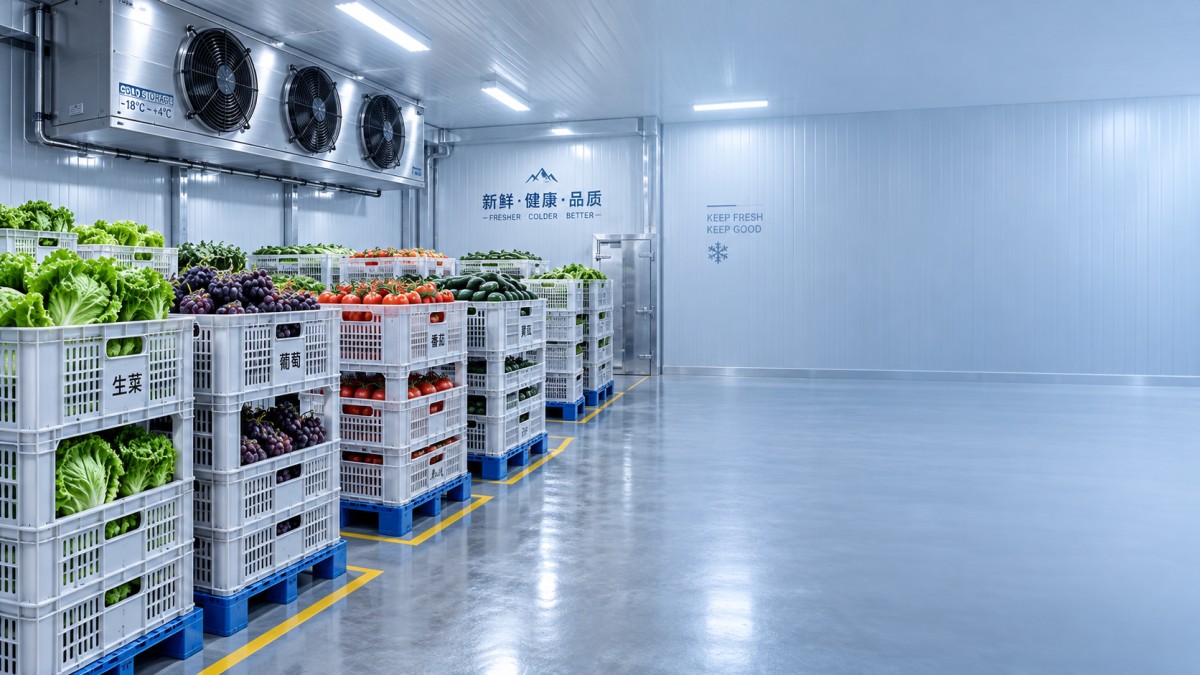
Temperature stability matters as much as the setpoint
A suitable Cold Room Temperature that swings repeatedly is less effective than a stable setting. Door openings, warm product loading, undersized refrigeration capacity, poor panel sealing, and blocked air circulation all create temperature variation. Short rises near the doorway may be expected during handling, but repeated or prolonged rises accelerate water loss and respiration. They also increase condensation when warm humid air contacts cold produce or packaging.
Place at least one temperature probe in the return-air path and another within a representative product load, away from the coil discharge and door. A third point near the farthest pallet is useful in longer rooms. Comparing these readings reveals whether the issue is refrigeration capacity, air distribution, loading practice, or sensor location. A single wall-mounted controller cannot show the full temperature pattern inside a loaded cold room.
Inspect readings after a delivery rather than relying only on overnight data. Warm incoming cartons impose a pull-down load that can keep the room above target for hours. Pre-cooling before storage reduces this burden and prevents warm loads from heating already chilled produce. Leave clear gaps between pallets, room walls, and the evaporator airflow path. Dense stacking may conserve floor space, but it can trap heat in carton centers and prevent uniform cooling.
Humidity and airflow must support the temperature target
Many vegetables need high humidity to remain crisp, while onions, garlic, and dry potatoes need a lower-moisture environment. Temperature alone cannot correct a humidity mismatch. Wilting usually points to moisture loss from low humidity, excessive air velocity, damaged packaging, or extended storage. Surface moisture, mold, and soft decay point in a different direction: condensation, insufficient airflow between loads, dirty drains, or a room that cycles warm enough for moisture to condense.
Airflow should circulate around the load, not blast directly onto delicate produce. Aim discharge air so it travels through room aisles and returns to the coil without a short path. Cartons stacked tightly against the evaporator can receive cold, dry air while the rest of the room gets poor circulation. Cartons placed directly against walls may collect condensation where surfaces are colder.
Evaporator selection affects usable storage conditions
The evaporator must match the room temperature, product load, moisture conditions, and available air path. A coil intended for frozen storage will not necessarily provide the best result for a produce room operating near 0°C to 10°C. Fin spacing influences frost accumulation and airflow retention, while defrost performance affects how consistently the coil can maintain room conditions. Excess frost reduces heat transfer, restricts air volume, and creates warmer zones even when the controller is calling for cooling.
For a compact food refrigeration room, equipment such as the Commercial Ceiling-Mounted Evaporator 401D can be evaluated against the actual room duty rather than its nameplate capacity alone. Its listed cooling capacity changes substantially between 0°C, -18°C, and -25°C operating conditions, illustrating why a capacity figure must always be read with its stated evaporating condition. The unit uses a copper-tube and aluminum-fin coil, offers 5 mm, 7 mm, or 9 mm fin spacing, and has an electric defrost arrangement. These details matter when selecting a coil for humid produce storage, where frost behavior and post-defrost drainage affect both airflow and temperature recovery.
Defrost should finish completely and drain properly. Ice remaining in the coil or drain pan gradually restricts airflow; excessive defrost, on the other hand, raises room temperature and adds moisture. Repeated ice around the fan guard, drain outlet, or pan often indicates a drainage slope problem, failed heater circuit, damaged door seal, or unusually high moisture entering during handling. Treat these as operating faults rather than simply lowering the setpoint.
Useful response when spoilage appears
Soft, wet decay near the door suggests warm-air entry or prolonged door opening. Wilted greens close to the evaporator suggest direct cold airflow or low humidity. Warm product in the middle of a pallet points to inadequate spacing, overstacking, or insufficient pull-down capacity. Ice on the coil with rising room temperature points to a defrost or airflow problem. The visible symptom should guide the inspection; changing the thermostat without locating the cause often makes another product problem worse.
Keep produce clean, sound, and free from damaged items before loading. Cooling cannot restore quality already lost through bruising, decay, or excessive field heat. With a temperature range selected for the crop, stable product-level monitoring, sensible load spacing, and clean evaporator airflow, fresh produce remains firmer, safer, and more saleable throughout its intended storage period.
CHAIDONG
Professional generator set manufacturer
24/7 before-sales and after-sales services
Comprehensive technical support