






What drives the electricity cost of a cold room in a busy warehouse?
What drives the electricity cost of a cold room in a busy warehouse?
In a busy warehouse, a cold room’s electricity bill reflects more than its size or temperature setting. Frequent door openings, incoming product temperatures, insulation quality, refrigeration efficiency, and utility tariffs all influence operating costs. When evaluating a cold room for warehouse operations, the challenge is distinguishing a low purchase price from a sound long-term investment.
A useful estimate starts with how the warehouse actually works: when deliveries arrive, how long doors stay open, and whether goods arrive already chilled. Without those assumptions, two suppliers can quote very different electricity figures for apparently similar rooms—and neither figure offers a reliable basis for approval.
Start with the heat entering the room, not the compressor rating
Refrigeration equipment removes heat. The amount it must remove depends on transmission through the building envelope, air infiltration, incoming products, and internal sources such as lights, people, and evaporator fans. Compressor power alone does not capture that workload.
Product load deserves particular attention. Holding pre-chilled goods at their required temperature is a different duty from cooling warm deliveries within a short receiving window. Freezing products adds another substantial load. A proposal based only on room volume can miss these differences and underestimate both required capacity and electricity consumption.
Ask for the daily product mass, arrival temperature, target temperature, and permitted cooling time behind each calculation. If the room is intended only for storage, make that restriction explicit. Otherwise, routine operational changes can invalidate the original running-cost estimate.
Door traffic can undermine an otherwise efficient design
Every opening allows warmer air and moisture to enter. In a freezer, that moisture can accumulate as frost on the evaporator, restricting airflow and increasing the need for defrosting. The electricity penalty therefore extends beyond cooling the incoming air.
Opening duration matters as much as opening count. A forklift waiting in a doorway while staff locate a pallet creates a different load from a quick, controlled transfer. Examine staging space, picking routes, door dimensions, closing speed, and whether traffic peaks coincide with warm or humid conditions.
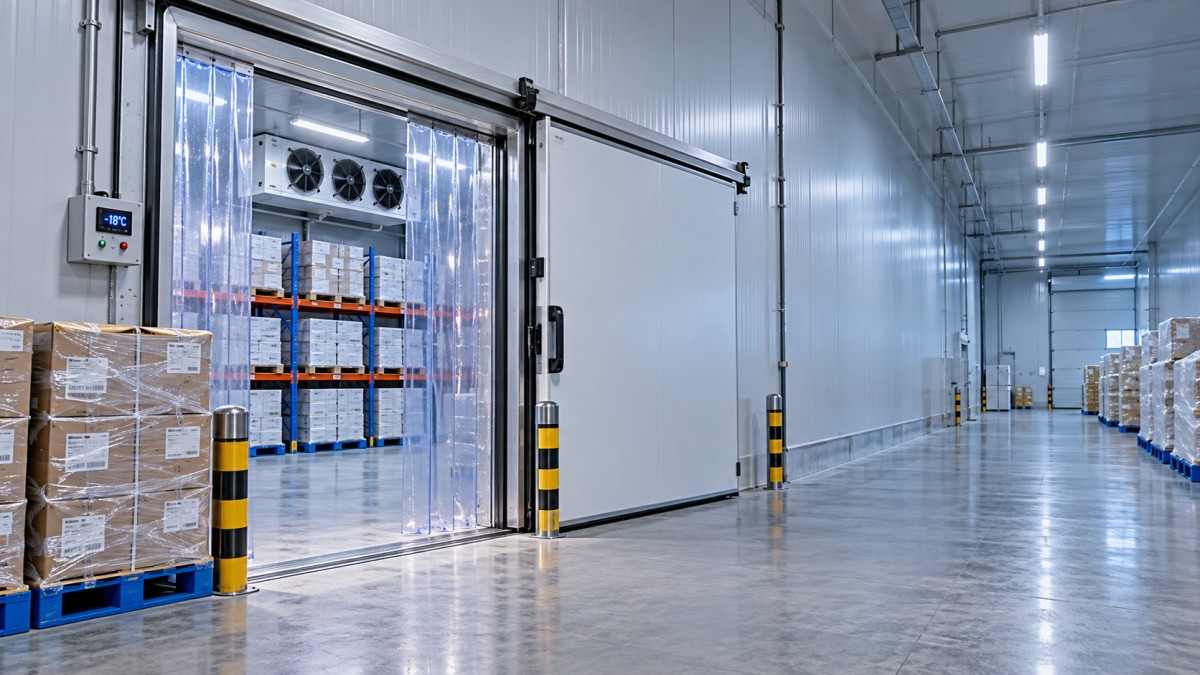
Rapid-closing doors, suitable strip curtains, or a temperature-controlled vestibule may reduce infiltration, but each must fit the workflow and safety requirements. A barrier that workers routinely bypass is not an effective investment. Before approving extra refrigeration capacity, check whether a doorway or traffic-layout change would address the underlying load more directly.
Insulation is an installed system, not just a panel thickness
Panel thermal performance matters, but joints, penetrations, floor construction, and door seals also determine heat gain. Poor vapor sealing can allow moisture into the envelope and compromise performance over time. Freezer floors may also need frost-protection measures whose electricity use belongs in the operating budget.
Compare panel specifications alongside installation details and inspection responsibilities. A thicker panel does not compensate for a poorly fitted door or an unsealed pipe penetration.
Equipment efficiency depends on its operating conditions
Rated cooling capacity is not electrical input. Nor does a single rated efficiency establish annual consumption. Performance changes with evaporating temperature, condensing temperature, and part-load operation. Lower storage temperatures generally increase the work required; a condenser exposed to hot, recirculating air also makes heat rejection harder.
Require competing suppliers to use the same room temperature, outdoor design conditions, and cooling duty. Ask how the system responds when demand falls. Excess capacity without appropriate control can cause short cycling, while insufficient capacity can leave the room unable to recover after deliveries.
Component details help explain a design, but they should not substitute for system calculations. For example, Boer’s Piston-type Condensing Unit, specification BOR-BHFKD-9 with a 4TSE-9Y compressor, includes a suction-line heat exchanger intended to reduce flash gas before the expansion valve and head-pressure control for winter operation. Their value depends on refrigerant selection, operating conditions, and commissioning—not simply their presence in a quotation.
The supplied specification lists R507 and a 380V, three-phase, 50Hz supply. Confirm local refrigerant requirements, future service availability, and site electrical compatibility before selection. Also confirm whether published input power includes condenser fans; inconsistent boundaries make cost comparisons misleading.
Translate energy use into the bill you actually pay
Multiplying compressor nameplate power by 24 hours rarely produces a defensible forecast. Equipment cycles or modulates, while fans, heaters, lighting, and controls follow different schedules.
Estimated electricity cost = the sum of each operating period’s kWh multiplied by its applicable tariff, plus attributable demand charges and other applicable charges.
The energy model should include compressor input, evaporator and condenser fans, defrost heaters, door or drain heaters, and other dedicated loads. Avoid double-counting components already included in packaged-unit figures. Defrost can also create a subsequent refrigeration load because some introduced heat must be removed.
Where the tariff includes demand charges, simultaneous operation matters. Refrigeration pull-down coinciding with other warehouse peaks may affect the bill differently from the same energy use overnight. Any proposed scheduling change must still protect product temperatures and handling deadlines.
Make the approval depend on comparable assumptions
For a cold room for warehouse use, request a shared operating brief before comparing proposals. It should establish:
- Storage conditions, product throughput, arrival temperatures, and recovery requirements.
- Door traffic, warehouse ambient conditions, and seasonal operating hours.
- Included electrical loads, control sequences, and utility tariff assumptions.
- Maintenance access, commissioning scope, and the method for verifying consumption.
An integrated supplier can help coordinate these interfaces. Shandong Boer Refrigeration Equipment Co., Ltd., established in 2014, manufactures air coolers, condensers, condensing units, modular cold rooms, polyurethane sandwich panels, and cold storage doors. That product scope supports a combined review of envelope and refrigeration design; the quotation should still identify who owns the heat-load calculation, installation details, and final controls setup.
Compare a normal operating scenario with a credible high-throughput scenario. Assess any efficiency premium against annual savings after additional maintenance costs, rather than using an optimistic electricity figure alone. Include downtime and stock-exposure risks separately so they remain visible.
Finally, specify dedicated energy metering and temperature logging at handover. Track consumption alongside throughput, ambient conditions, and door activity; otherwise, a busier month can look like equipment deterioration. Approve the proposal whose cost assumptions can be checked against warehouse operations—not merely the one with the lowest projected bill.
CHAIDONG
Professional generator set manufacturer
24/7 before-sales and after-sales services
Comprehensive technical support