






What factors have the biggest effect on cold room cost?
Cold Room Cost is driven by far more than floor area. The biggest budget changes usually come from temperature targets, insulation, refrigeration capacity, installation conditions, and lifetime energy use.
For information researchers comparing suppliers or planning a facility, the most useful question is not simply, “What does a cold room cost?”
It is, “What specification will protect my products reliably while keeping installation, maintenance, and electricity costs under control over the system’s working life?”
1. Required Temperature Has the Largest Technical Impact
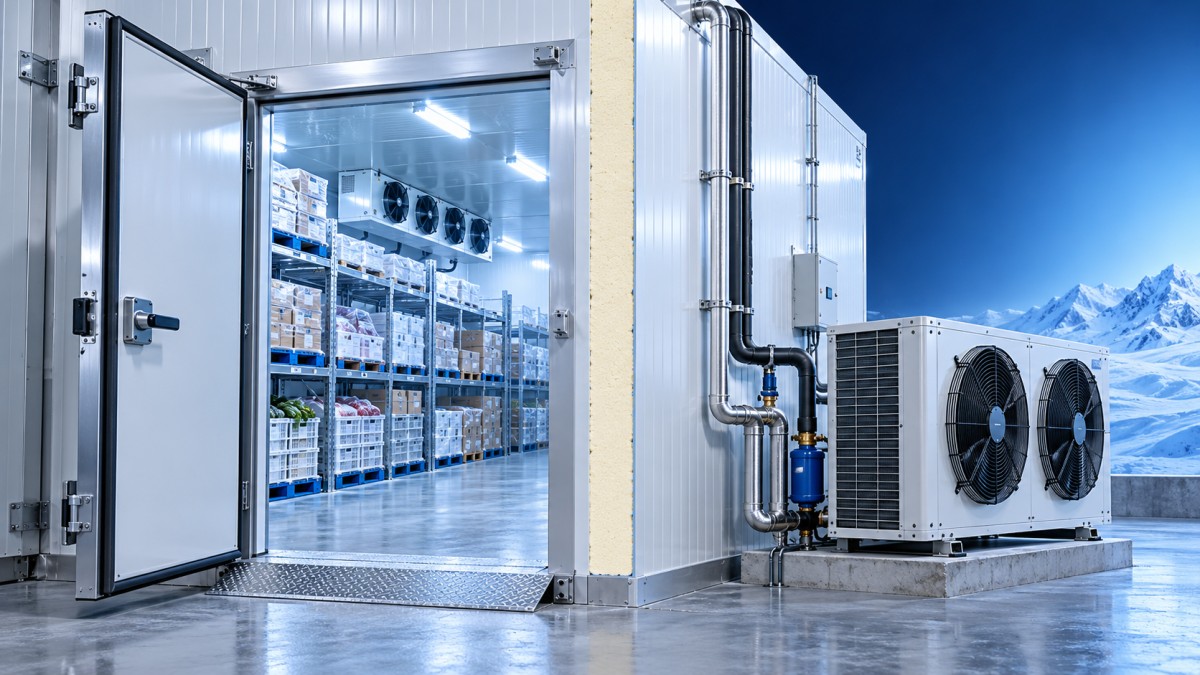
Required storage temperature is often the strongest Cold Room Cost driver because it determines the refrigeration load, insulation specification, defrost requirements, and equipment operating pressure.
A chilled room operating between 0 and +5°C generally needs less refrigeration capacity than a freezer room operating at -18°C or below.
Lower temperatures require more powerful compressors, thicker insulation panels, specialized doors, and carefully designed controls to prevent excessive frost, heat infiltration, and unstable room conditions.
Product loading also matters. A room holding already chilled goods has a different cooling demand than one regularly receiving warm produce, cooked food, or freshly processed products.
Businesses should define the product entry temperature, target storage temperature, daily throughput, expected pull-down time, and door-opening frequency before requesting quotations from suppliers.
Without this information, two quotations may appear comparable while actually being designed for completely different operating conditions and levels of refrigeration performance.
Choosing undersized equipment can reduce the initial purchase price, but it may lead to long pull-down times, product risk, high electricity use, and premature component wear.
2. Room Size Matters, but Volume Alone Does Not Tell the Full Story
Room dimensions affect panel quantities, refrigeration capacity, door size, installation labor, and structural requirements. However, cubic volume is only a starting point for estimating investment.
A compact room with frequent access can have a higher refrigeration load than a larger room that remains closed for long periods and stores stable-temperature products.
Ceiling height influences more than storage volume. Taller rooms may require different airflow patterns, longer refrigerant piping, stronger shelving plans, and more careful evaporator positioning.
The room’s length-to-width ratio also affects practical performance. Narrow, long layouts can complicate airflow distribution, product access, and placement of evaporators, doors, and storage racks.
Ask suppliers whether their capacity calculation includes usable loading space rather than only gross room volume. Racking, aisles, pallets, and air circulation all reduce available storage capacity.
Expansion plans should be addressed early. Building a slightly larger modular shell or allowing space for future equipment may cost less than disrupting operations later.
The best solution is usually sized around real inventory movement, not an optimistic estimate of maximum product volume that may never be reached.
3. Insulation Panels and Doors Shape Both Capital Cost and Energy Bills
Insulation thickness and panel quality significantly affect Cold Room Cost because they determine heat gain, compressor run time, condensation control, and long-term operating efficiency.
Polyurethane sandwich panels are commonly selected for their thermal performance and installation convenience. Their required thickness should match the room temperature and local ambient conditions.
Thin panels may reduce initial spending, but they can create higher heat transfer and energy consumption for years. They may also increase surface condensation risks.
Panel joints, vapor barriers, sealing quality, and floor insulation deserve the same attention as panel thickness. Small gaps can create persistent air leakage and moisture problems.
Cold room doors are another major variable. Hinged, sliding, service, and personnel doors have different prices, opening behavior, sealing performance, and space requirements.
High-traffic facilities may need durable doors, strip curtains, rapid-opening solutions, or air curtains to reduce warm-air infiltration during loading and unloading activities.
When comparing quotations, verify whether the quoted Cold Room Cost includes insulated flooring, door frames, pressure-relief provisions, hardware, sealing materials, and necessary accessories.
4. Refrigeration Equipment Selection Can Change the Investment Profile
Refrigeration equipment is not simply a line-item expense. The compressor, condenser, evaporator, controls, and piping must work together under the actual site conditions.
Air-cooled and water-cooled condenser options differ in installation requirements, water availability, maintenance needs, noise considerations, and performance in high outdoor temperatures.
For moderate-temperature applications, an integrated package can simplify purchasing and reduce uncertainty caused by separately selecting components from different manufacturers.
For example, the Integrated Cold Storage Cold Source combines a condensing unit, air cooler evaporator, expansion components, and control system into a standardized refrigeration solution.
Its stated operating range of -10 to +5°C can suit chilled storage uses such as restaurants, supermarkets, central kitchens, food factories, and logistics-oriented warehouses.
Standardized integrated equipment may reduce on-site matching, piping complexity, commissioning time, and the risk of poor compatibility between independently sourced refrigeration components.
However, buyers should still confirm local voltage, ambient temperature, refrigerant requirements, actual room load, defrost configuration, service access, and future maintenance support before purchase.
5. Site Conditions and Installation Scope Often Create Hidden Costs
Many budget surprises appear after equipment selection. Installation conditions can materially change the final Cold Room Cost even when the room itself has already been specified.
Factors include delivery access, building floor strength, roof penetrations, outdoor unit location, drainage, electrical supply, refrigerant pipe length, ventilation, and lifting equipment requirements.
A ground-floor installation with nearby power and clear access is usually simpler than a rooftop, basement, upper-floor, or operationally restricted construction project.
Electrical work deserves close review. A three-phase system may require distribution upgrades, protection devices, cabling, control wiring, and coordination with the customer’s electrical contractor.
Drainage is equally important, particularly where evaporators use defrost cycles. Inadequate drain design can lead to ice, water damage, sanitation issues, and operational interruptions.
Request a quotation that separates equipment supply, panel installation, refrigeration piping, electrical works, commissioning, freight, civil works, and optional accessories to expose exclusions clearly.
This level of detail makes supplier comparisons more meaningful and reduces the chance that an apparently low quotation becomes more expensive during project execution.
6. Energy Efficiency Should Be Treated as a Financial Decision
Purchase price matters, but electricity consumption can become a major lifetime expense. A lower-cost cold room may be less economical when operating continuously for several years.
Energy performance depends on insulation, door discipline, compressor efficiency, condenser cleanliness, airflow design, defrost controls, ambient temperature, and maintenance quality.
Ask suppliers for estimated power consumption under stated conditions, rather than accepting general claims about energy saving without defined room temperature, loading pattern, and outdoor temperature assumptions.
Efficient equipment is particularly valuable for facilities with long operating hours, frequent loading, high electricity rates, or demanding summer ambient conditions.
Remote monitoring can also protect operating value. Monitoring temperature, alarms, compressor status, and system trends helps operators identify performance problems before product losses occur.
How to Compare Cold Room Cost Quotes Correctly
Use one written specification when approaching several suppliers. Include room dimensions, temperature range, product type, entry temperature, daily loading, ambient conditions, access frequency, and installation location.
Then compare each proposal for refrigeration capacity, panel thickness, equipment brands, included doors, controls, installation scope, warranty terms, commissioning, and expected delivery schedule.
Do not select solely on the lowest total. A credible proposal should explain why its equipment capacity and insulation level match the application instead of relying on generic assumptions.
In summary, the biggest factors affecting Cold Room Cost are temperature requirement, heat load, insulation, refrigeration configuration, site installation conditions, and long-term energy performance.
A well-defined specification allows buyers to control spending without sacrificing reliability. The right cold room is the one that protects inventory, fits operations, and remains economical to run.
CHAIDONG
Professional generator set manufacturer
24/7 before-sales and after-sales services
Comprehensive technical support